
It’s 2 a.m. on I-10 outside Houston. Your trailer is loaded, your delivery window is closing, and then you hear it: a loud bang, a pull to the right, and a dash full of warning lights. You ease onto the shoulder as semis roar past and shake your cab.
Now what?
If you’ve driven long enough, you know this moment isn’t a matter of “if.” It’s “when.” The good news is that you don’t have to handle it alone. That’s where road service for semi trucks comes in.
In this guide, you’ll learn what road service is, what it covers, what it doesn’t, and how to pick a reliable provider in Texas. We’ll also share what to do in the first ten minutes of a breakdown, because those minutes matter most.
Table of Contents
ToggleWhat Is Road Service for Semi Trucks?
Road service for semi trucks is emergency help that comes to your truck when it breaks down, instead of making you find a shop on your own. A trained technician or tow operator arrives with the tools and equipment needed to fix the problem on the spot or tow your rig to a safe repair location.
Think of it as a mobile garage and rescue team in one. Instead of leaving your truck on the shoulder and hoping for the best, you make one call, and help starts rolling your way.
This is different from regular car roadside assistance. A passenger car weighs around 4,000 pounds. A loaded semi can weigh up to 80,000 pounds. That means the tools, trucks, training, and safety steps are completely different. A small tow truck can’t safely help a tractor-trailer. You need a crew with heavy-duty equipment.
If you want to see how basic roadside help works before we go deeper, our guide on how roadside assistance works walks through the process step by step.
What Does Semi Truck Road Service Cover?
Not every company offers the same list of services. But a good semi truck service provider usually covers the following.
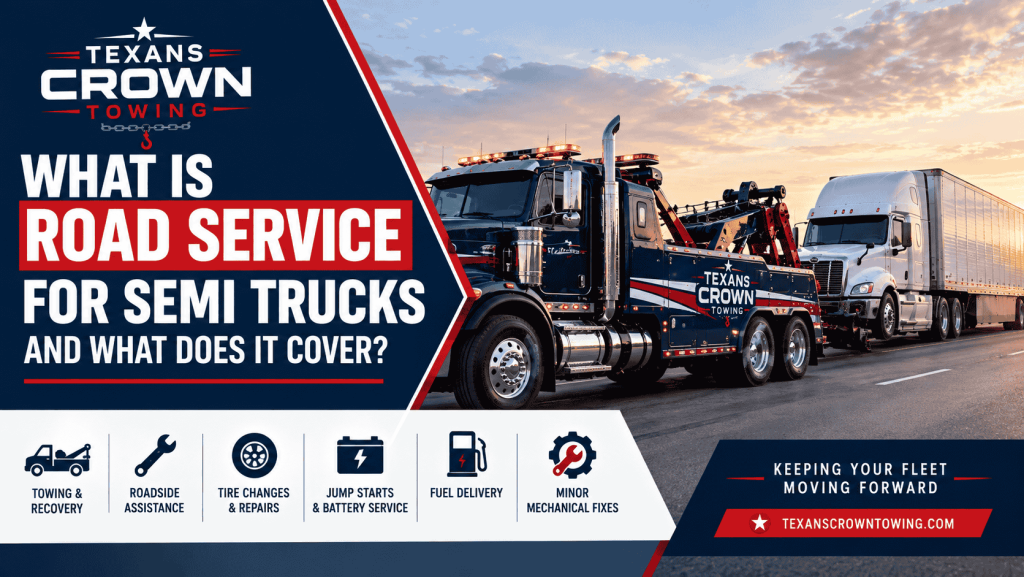
1. Heavy-Duty Towing
If your truck can’t be fixed on the roadside, it needs to be towed. Heavy-duty towing uses large wreckers built to lift and pull commercial trucks without damaging the frame, axles, or drivetrain. It’s one of the most important parts of any road service plan. You can learn more in our guide to heavy-duty towing near you.
2. Tire Repair and Replacement
Tires are the number one reason truckers call for help. Heat, road debris, overloaded trailers, and low pressure can all cause a blowout. A roadside technician can patch a tire, swap in a spare, or bring a new tire to you, depending on the damage.
3. Jump-Starts and Battery Help
Big diesel engines need strong batteries. A weak battery, a bad alternator, or a loose cable can leave you stuck. Road service crews carry heavy-duty jump equipment made for 12-volt and 24-volt systems.
4. Fuel Delivery
Running out of diesel happens more often than drivers like to admit, especially on long, empty stretches of West Texas highway. Many providers deliver enough fuel to get you to the next station. Some can also help if you’ve put the wrong fuel in the tank.
5. Minor Mechanical Repairs
Mobile technicians can often handle small fixes right where you are. Common examples include:
- Replacing a broken belt or hose
- Fixing air brake line leaks
- Repairing lights and wiring
- Swapping a faulty sensor
- Fixing a coolant leak
- Adjusting or repairing brakes
6. Lockout Service
Locked your keys in the cab? A trained operator can get you back inside without breaking a window or damaging the door.
7. Winching and Recovery
If your truck slides into a ditch, gets stuck in mud, or ends up off the road, recovery crews use winches and special rigging to pull it back safely. Our article on vehicle recovery services explains how this works. For more complex jobs, such as an overturned trailer, you may need a rotator. We break down the difference in rotator towing vs. crane hire.
8. Accident Response
After a crash, you need help clearing the scene and moving your truck and cargo safely. Road service teams work with police and other responders to get lanes open. If you’re ever in this situation, read what to do right after an accident on a Texas highway.
Quick Answer: What Does Road Service for Semi Trucks Cover?
Here’s a fast list you can save on your phone:
- Heavy-duty towing
- Tire repair and replacement
- Battery jump-starts
- Emergency fuel delivery
- Minor mobile repairs
- Lockout help
- Winching and recovery
- Accident scene towing
Every company is different, so always ask what’s included before you need the help.
What Doesn’t the Road Service Cover?
This part is just as important. Many drivers get surprised by a bill because they assume everything was included. Here’s what road service usually does not cover:
- Major engine or transmission rebuilds. These need a full repair shop.
- The cost of parts. You usually pay for new tires, belts, hoses, and sensors.
- Cargo damage or spoiled loads. That falls under your cargo insurance.
- Long-distance tows beyond a set mileage. Many providers charge by the mile after a certain point.
- Repairs caused by ignoring known problems. Some programs limit coverage in these cases.
If you’re comparing prices, our breakdown of how much towing costs in Texas will help you know what’s fair.
Why Do Semi Trucks Break Down? Common Causes
Understanding why trucks stall helps you avoid it. Here are the most common causes we see on Texas roads.
Tire failure. Texas summers can push pavement temperatures past 150°F. That heat wears down tires fast, especially if they’re underinflated.
Overheating. A low coolant level, a bad radiator, or a failing water pump can overheat a diesel engine quickly.
Electrical problems. Corroded cables, weak alternators, and old batteries are frequent troublemakers.
Air brake issues. Leaks and worn parts can cause brakes to lock or lose pressure. This is a serious safety problem.
Fuel system trouble. Clogged filters, water in the fuel, or contaminated diesel can make an engine stumble and quit.
Skipped maintenance. Most breakdowns grow from small problems that were ignored. A $50 fix on Monday can become a $5,000 tow and repair on Friday.
The Risks of Breaking Down Without a Plan
A breakdown isn’t just a headache. It’s a risk to your safety, your income, and your reputation.
Safety danger. A stopped truck on a busy Texas highway is a target. Drivers can misjudge distance, especially at night or in rain.
Lost money. Every hour your truck sits idle costs you. Late deliveries can mean penalties, lost contracts, and unhappy customers.
Higher repair costs. Driving on a damaged tire or an overheated engine can turn a small problem into a large one.
Legal trouble. Federal rules require drivers to put out warning devices quickly after stopping on a roadway. A truck left unmarked can lead to fines, or worse, a crash.
That’s why having a trusted road service provider saved in your phone before trouble hits is one of the smartest moves a driver or fleet owner can make.
What to Do in the First 10 Minutes of a Semi Truck Breakdown
Stay calm and follow these steps:
- Get off the road if you can. Aim for a wide, flat shoulder, away from curves and hills.
- Turn on your hazard lights.
- Set out your warning triangles. Federal safety rules say to place them within 10 minutes of stopping. The usual spots are about 10, 100, and 200 feet behind your truck.
- Stay out of traffic lanes. Never stand between your truck and passing cars.
- Call for help. Give your exact location, such as the highway name, mile marker, and direction of travel.
- Describe the problem clearly. Tell the dispatcher what you heard, saw, or smelled. It helps them bring the right tools.
- Wait in a safe spot. If traffic is heavy, stay in your cab with your seatbelt on, or stand well away from the road.
During winter storms and rare Texas freezes, these steps matter even more. Our guide on winter roadside preparation for commercial truckers covers what to keep in your cab.
Semi Truck Service in Texas: What Makes It Different?
Texas is huge. It’s more than 800 miles from El Paso to Beaumont, and a driver can go a long way without seeing a repair shop. That changes what you need from your semi truck service.
Houston and the Gulf Coast. Houston is one of the busiest freight hubs in the country. Between the Port of Houston, refineries, and warehouses, trucks are on I-10, I-45, US-59, and the Beltway at all hours. Traffic jams and heavy rain make breakdowns more dangerous here, and a fast response is critical.
Dallas–Fort Worth. Heavy congestion on I-35, I-30, and I-20 means a stalled truck can block traffic for miles.
San Antonio and Austin. I-35 is one of the busiest freight corridors in the nation, with lots of stop-and-go driving that’s hard on brakes and engines.
West Texas and the Permian Basin. Long, remote roads mean a breakdown can leave you far from help. Having a provider who covers wide areas can save your day.
Border routes near Laredo. Cross-border freight keeps trucks moving around the clock, and breakdowns near busy ports can cause expensive delays.
Because the state is so big, it pays to choose a provider that understands Texas roads, weather, and distances. If you’re comparing options, see our lists of the top heavy-duty towing companies in Texas and the best heavy-duty towing companies in Houston.
How to Choose the Right Road Service for Semi Trucks
Not all providers are equal. Use this checklist before you trust someone with a truck worth six figures.
- Do they have true heavy-duty equipment? Ask about wreckers, rotators, and trained operators.
- How fast do they respond? A good dispatcher gives you an honest arrival time.
- Are they insured? Your truck and cargo are valuable. Proof of insurance matters.
- Is pricing clear? Ask about hook-up fees, per-mile rates, and after-hours charges before they dispatch.
- Do they cover your route? Make sure they serve the area where you drive.
- Do they have honest reviews and real experience? Look for a track record, not just a slogan.
We share a full list of smart questions in what to ask a towing company before you hire them. You can also compare the difference between heavy-duty and light-duty towing so you know exactly what your truck needs.
How to Prevent Breakdowns and Reduce Risk
You can’t stop every problem, but you can lower your odds:
- Do a pre-trip inspection every day. Check tires, lights, brakes, fluids, and belts.
- Watch tire pressure. Texas heat is hard on rubber. Check often.
- Keep up with service schedules. Oil, filters, and coolant changes save money later.
- Don’t ignore warning lights. A small light today can be a tow tomorrow.
- Carry safety gear. Keep triangles, flares, a flashlight, gloves, a fire extinguisher, and a first-aid kit in the cab.
- Save your road service number. Store it in your phone and write it on a card in your cab. Don’t count on remembering it under stress.
Why Drivers and Fleets in Texas Call Texans Crown Towing
When your truck stops, you don’t need a sales pitch. You need someone who answers, shows up, and treats your rig with care.
Texans Crown Towing provides heavy-duty towing and roadside support for commercial drivers and fleets across Texas, with deep roots in the Houston area. Our team understands what a breakdown means for your schedule, your income, and your peace of mind. We keep the process simple:
- You call. A real person answers and asks a few clear questions.
- We send the right equipment. No guessing, no wasted time.
- We handle your truck with care. Your rig is your livelihood. We treat it that way.
- We get you moving again. Whether that means a roadside fix or a safe tow to a repair shop.
Whether you’re a solo owner-operator or you manage a fleet, a trusted partner makes every breakdown less stressful.
📞 Stuck on the Road? Call Now: +1 (713) 929-6299
Don’t wait until you’re on the shoulder with traffic rushing by. Save our number today, and when trouble hits, one call is all it takes. For other emergencies, see our page on emergency roadside assistance in Texas.
Frequently Asked Questions About Road Service for Semi Trucks
What is road service for semi trucks?
Road service for semi trucks is emergency help that comes to your location when your truck breaks down. It includes heavy-duty towing, tire repair, jump-starts, fuel delivery, lockouts, and minor mobile repairs.
What does semi truck road service usually cover?
Most providers cover towing, tire changes, battery jumps, fuel delivery, lockouts, and small repairs. Major repairs, parts, and cargo damage are usually not included. Always confirm the details before you call.
How much does semi truck road service cost?
Prices depend on the service, distance, time of day, and truck weight. Heavy-duty work costs more than car towing because it needs larger equipment. Ask for a clear quote first. Our guide to how much roadside assistance costs can help you plan.
Is road service for semi trucks the same as regular roadside assistance?
No. Regular roadside assistance is built for cars and light trucks. Semi trucks need heavy-duty wreckers, special tools, and trained operators because of their size and weight. You can read more in what roadside assistance covers.
Can a mobile technician fix my semi truck on the roadside?
Often, yes. Many problems, like flat tires, dead batteries, broken belts, and air line leaks, can be fixed on the spot. If the damage is serious, your truck will be towed to a repair shop.
Who do I call for semi truck service in Texas?
Call a heavy-duty towing company that serves your area and has experience with commercial trucks. In the Houston area and across Texas, you can reach Texans Crown Towing at +1 (713) 929-6299.
What should I do first if my semi truck breaks down?
Move to a safe spot, turn on your hazard lights, put out warning triangles, and call for help. Stay away from traffic and give the dispatcher your exact location.
Does road service work at night and on weekends?
Breakdowns don’t follow a schedule, and good providers don’t either. Always confirm hours and after-hours rates when you save a provider’s number.
Final Thoughts: Don’t Wait for a Breakdown to Find Help
Road service for semi trucks is more than a tow. It’s a safety net that protects your time, your money, and your life on the road. Knowing what it covers, what it doesn’t, and who to call gives you control when things go wrong.
A little planning today can save you hours of stress tomorrow. Choose a reliable semi truck service in Texas, keep your safety gear ready, and save your emergency number now.
When you need help fast, call Texans Crown Towing at +1 (713) 929-6299. We’re ready to get you and your truck back on the road.