
Table of Contents
ToggleTypes of RVs That Can Be Towed by a Semi-Truck?
Picture this. You just bought your dream RV. It is big, heavy, and ready for a Texas road trip. Then you look at your pickup truck and realize it is not enough. Now you are wondering if a semi-truck could do the job.
You are not alone. Every year, Houston RV owners, dealers, and snowbirds ask the same thing. Some are moving a new unit from a dealer lot. Others have a broken-down rig on the side of I-45 and need help fast.
The good news is that a semi-truck can tow many RVs. However, not every RV works with every rig. The wrong setup can damage your RV, hurt your truck, or put people in danger.
In this blog, you will learn which types of RVs a semi can pull, what hitch you need, and how to stay safe. You will also see the pros and cons, plus when to call a pro.
Can a Semi-Truck Tow an RV? Everything You Need to Know
Quick answer: Yes, a semi-truck can tow an RV. Semi trucks have strong engines, heavy frames, and powerful brakes. They work best with fifth wheel RVs and toy haulers. Other RVs need special hitches or a flatbed. The driver must also follow Texas license, weight, and safety rules.
That short answer is a good start. Still, the details matter a lot. A semi tractor is built to pull loads up to about 80,000 pounds in total. Most RVs weigh far less than that. So raw power is rarely the problem.
Instead, the real questions are about fit and safety. For example, does your RV have the right connection point? Is the weight balanced? Does your driver hold the right license? We will cover each point below.
What RVs Can Be Towed by a Semi-Truck?
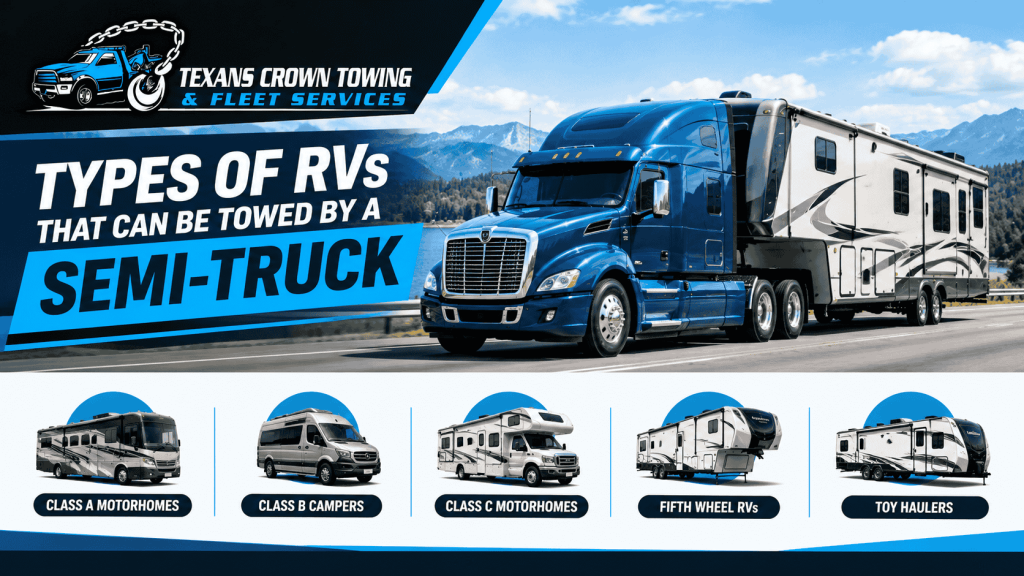
Let’s get into the main question. Here are the main types of RVs that can be towed by a semi-truck.
1. Fifth Wheel RVs (The Best Match)
Fifth wheel RVs are the top pick. They have a front section that rises over the truck bed. A big pin on the RV locks into a plate on the truck. Semi tractors use this same style of connection.
Because the setups are so close, a fifth wheel RV is often the easiest RV to tow with a semi. The weight sits right over the drive axles. As a result, the ride is steadier than with most other trailers.
2. Toy Haulers
Toy haulers are RVs with a garage space in the back. Owners store ATVs, dirt bikes, or golf carts there. Most toy haulers are fifth wheels, so they also pair well with a semi tractor.
Keep in mind that toy haulers get heavy once loaded. Gear, bikes, and fuel add up fast. Always weigh the full load before you hit the road.
3. Large Travel Trailers
Travel trailers connect with a ball hitch, not a fifth wheel plate. A semi tractor does not have a ball hitch by default. Therefore, you need an adapter, a gooseneck setup, or a pintle hook. A pro should check the match.
Smaller travel trailers rarely need a semi at all. Long, heavy models over 35 feet are the ones that sometimes do.
4. Park Model RVs and Tiny Homes on Wheels
Park models are built to sit in one place. They are often wide and tall. In many cases, they ship on a flatbed or a special trailer. Moving them often takes a permit and an escort.
5. Motorhomes (Class A, B, and C)
Motorhomes drive on their own. That means they are usually not towed behind a semi. If one breaks down, a heavy-duty wrecker or flatbed is the safer choice. Dragging a motorhome the wrong way can wreck the drivetrain.
So, when people ask what RVs can be towed by a semi-truck, the short list is fifth wheels, toy haulers, and big trailers. Motorhomes need a different plan.
The Best RVs to Tow With a Semi-Truck
Wondering about the best RVs to tow with a semi-truck? Use this simple table.
| RV Type | Fit With a Semi | Typical Hitch |
|---|---|---|
| Fifth wheel | Excellent | Fifth wheel plate |
| Toy hauler (fifth wheel) | Excellent | Fifth wheel plate |
| Large travel trailer | Good, with an adapter | Gooseneck or pintle |
| Park model RV | Fair, often hauled | Flatbed or special trailer |
| Motorhome | Poor | Heavy-duty wrecker or flatbed |
In short, fifth wheels and toy haulers win. They are built for the same kind of connection a semi uses. As a result, they need fewer changes, and the setup is safer.
Towing Capacity, Hitch Compatibility, and Safety Requirements
Now for the part that keeps people out of trouble. Let’s look at towing capacity, hitch compatibility, and safety requirements one by one.
Towing Capacity
Towing capacity is how much weight your truck can legally and safely pull. For a semi, the number is high. Still, you should never guess. Check three numbers:
- GVWR: the most your RV can weigh when loaded
- Pin weight: the weight pressing down on the hitch
- GCWR: the top combined weight of the truck and the RV
Your RV’s tag lists its GVWR. Your truck’s door sticker lists its limits. Add up your real weights at a truck scale. That is the only way to know for sure.
Hitch Compatibility
Next, check the hitch. A fifth wheel pin must match the plate on your tractor. The height must line up as well. If the RV sits too high or too low, it will not lock in right.
Also, the king pin and plate need to be in good shape. Worn parts can fail on the highway. Before every trip, grease the plate, lock the jaws, and tug test the hitch.
For ball-style trailers, you need a proper adapter. Never use a homemade setup. A weak link can snap and send a trailer into traffic.
Safety Requirements
Safety rules matter just as much as the hardware. Here is a simple checklist:
- Working brakes on the RV, with a brake controller
- Lights and turn signals that match the tractor
- Safety chains or breakaway cables
- Tires with good tread and the right air pressure
- Fresh straps and tie-downs on all loose gear
Also, license rules can change based on weight and use. Texas has its own rules for heavy combinations. Because laws and exemptions differ, check with Texas DPS and your insurance agent before you go. That quick call can save you from a big fine.
Pros and Cons of Using a Semi-Truck to Tow an RV
Every choice has trade-offs. Here are the pros and cons of using a semi-truck to tow an RV.
Pros
- Power to spare. A semi pulls heavy loads with less strain.
- Strong brakes. Air brakes stop heavy weight better than most pickup brakes.
- Stable ride. A long wheelbase and heavy frame cut sway.
- Great for long hauls. Houston to El Paso is a long way. A semi handles it well.
- Good for big or odd RVs. Some rigs are just too heavy for a pickup.
Cons
- Cost. Hiring a driver or running a semi costs more than a pickup.
- License needs. Heavy combinations may require a special license.
- Hard to park. A semi does not fit in many RV parks or gas stations.
- Rough ride for the RV. Stiff truck suspensions can shake an RV more.
- Insurance questions. Not every policy covers this setup.
So, is it worth it? For heavy RVs and long trips, often yes. For light trailers, a pickup is usually enough.
Common Problems When an RV Is Towed by a Semi Truck
Even a good setup can go wrong. Here are the main problems we see on Texas roads. For each one, you will find the cause and the fix.
Problem 1: Trailer sway.
Cause: Uneven weight or low tire pressure.
Fix: Move heavy gear over the axles and check your air pressure.
Problem 2: Hitch won’t lock.
Cause: Wrong height or a worn pin plate.
Fix: Adjust the landing gear, or have the plate replaced.
Problem 3: Overheated brakes.
Cause: Long downhill drives and poor brake use.
Fix: Use lower gears, and brake in short bursts.
Problem 4: Flat or blown tires.
Cause: Heat, overload, or old tires. Houston summers are hard on rubber.
Fix: Inspect tires before each trip. If you get stuck, our guide on how to change a flat tire can help. For heavy rigs, though, call a pro.
Problem 5: Wide-load trouble.
Cause: Some RVs are wider than normal lanes allow. Our post on how wide a dually truck is shows how fast width adds up.
Fix: Plan your route, and ask about permits.
Risks You Should Never Ignore
Towing a big RV can be safe. Yet the risks are real, so let’s be honest about them.
First, overloading is the top risk. Too much weight can break axles and cause crashes. Second, bad hitching can let the RV come loose. Third, driver skill matters. A semi handles very differently from a pickup. Backing up, turning, and braking all take practice.
Finally, there is weather. Texas storms, high winds, and flooding can strike fast. During hurricane season, many families move RVs inland. Traffic is heavy and stress runs high. A breakdown at that moment can feel like a disaster.
If any of this worries you, that is a smart instinct. Do not push your luck. Instead, let a trained team handle the heavy lifting.
When to Call a Professional for Semi Truck Towing
Sometimes the safest move is to hand it off. Here are the signs you need help:
- Your RV is too heavy or too tall for your rig
- The hitch will not connect or lock
- Your RV broke down on a highway
- The RV was in a crash or slid into a ditch
- You do not have the right license or insurance
- Your motorhome will not start or shift
In these cases, semi truck towing by a trained crew is the better path. Pros bring the right equipment, such as heavy duty wreckers, flatbeds, and rotators. To learn the difference, read our guides on heavy-duty vs. light-duty towing and flatbed towing explained.
Stuck in a ditch or soft mud? That calls for special gear. See what recovery looks like in our post on a car stuck in a deep ditch or mud. In bigger recoveries, a rotator may be the best tool. We explain why in rotator towing vs. crane hire.
How Much Does It Cost to Tow an RV?
Price depends on weight, distance, and the type of truck. A short local move costs far less than a long highway haul. Rush calls, night calls, and recoveries can add to the bill.
For a closer look at pricing, read our Houston towing cost guide and our breakdown of how much towing costs in Texas. Either way, always ask for a clear quote before the truck rolls.
Why Texas RV Owners Trust Texans Crown Towing
Texas is big. A breakdown in Houston is not the same as one near Lubbock, Austin, or San Antonio. You need a team that knows the roads and the heavy gear.
At Texans Crown Towing, we help drivers across Houston and the entire state. Our team handles heavy loads with care, because we know your RV is more than metal. It is your vacation, your home on the road, and often your biggest purchase.
Here is what you can expect from us:
- Heavy-duty experience for large and awkward rigs
- The right equipment for each job, from flatbeds to heavy wreckers
- Clear talk and fair quotes with no pressure
- Careful handling so your RV arrives in one piece
Curious how our heavy fleet compares? See our post on the best heavy-duty towing trucks for commercial use in Texas, or browse our heavy-duty towing near you page. If you run a fleet, our road service for semi trucks guide is also worth a read.
Need Help Right Now? Call Texans Crown Towing
Do not let an RV problem ruin your trip. Whether you need a safe move, a heavy recovery, or advice on the right setup, we are ready to help.
📞 Call Texans Crown Towing at +1 (713) 929-6299
Tell us your RV type, your location, and what happened. We will walk you through the next steps and get a truck headed your way. Houston, Texas, or beyond, we have your back.
FAQ: Semi-Truck RV Towing Questions
Can a semi-truck tow an RV?
Yes. A semi-truck can tow an RV, especially a fifth wheel or toy hauler. Semis have the power, frame, and brakes for heavy loads. The driver must still use the right hitch, stay within weight limits, and follow Texas license rules.
What is the best RV to tow with a semi-truck?
A fifth wheel RV is usually the best choice. It uses a hitch style that is close to a semi’s own setup. Toy haulers that are fifth wheels also work very well.
Can you tow a motorhome with a semi-truck?
It is possible but not common. Most motorhomes are better moved with a heavy-duty wrecker or on a flatbed. Wrong towing can damage the drivetrain and transmission.
Do I need a CDL to tow an RV with a semi-truck?
It depends on weight, use, and Texas rules. Some RV trips may not need a commercial license, but heavy combinations can need a special class. Please check with Texas DPS before you go.
How much weight can a semi-truck tow?
Many semi tractors are built for a total combined weight of about 80,000 pounds. Your real limit depends on your truck, axles, and local laws. Always check your own ratings.
Is it safe to have an RV towed by a semi truck?
Yes, when done right. Safety depends on the correct hitch, balanced weight, good brakes, and a skilled driver. A trained towing company can lower the risk even more.
Who can tow my RV in Houston?
A heavy-duty towing company with the right equipment can help. Texans Crown Towing serves Houston and all of Texas. Call +1 (713) 929-6299 for help.
What should I do if my RV breaks down on a Texas highway?
First, pull over safely and turn on your hazard lights. Next, get everyone out of the RV if it is safe. Then call a heavy-duty towing company. Do not try to repair it in traffic.
Final Thoughts
So, which RVs can a semi pull? Fifth wheels and toy haulers fit best. Large travel trailers can work with the right adapter. Motorhomes and park models usually need a different method.
Before you tow, remember the key steps. Check your weights, confirm your hitch, follow license rules, and inspect your gear. When the job feels too big, ask for help. That is a smart move, not a weak one.
Your RV deserves a safe ride. Call Texans Crown Towing at +1 (713) 929-6299, and let us handle the heavy part.