

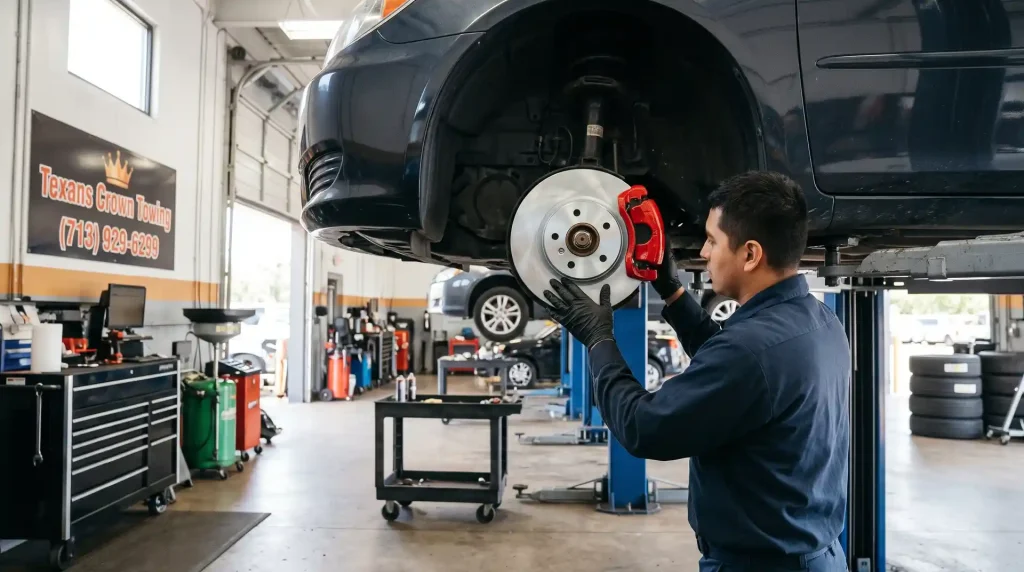
Hearing a high-pitched squeal when slowing down at a red light on a Texas highway creates immediate stress for any driver. Your braking system serves as your primary defense against collisions, yet busy schedules often force drivers to delay essential repairs.
Here at Texans Crown Towing, our roadside teams assist stranded motorists every day across the Lone Star State. A basic brake service on a single axle requires roughly one to two hours of garage labor. However, knowing exactly how long it takes to get your brakes changed depends on whether you replace only the pads or include rotors, calipers, and hydraulic fluid flushes.
In this comprehensive guide, we will analyze standard shop timelines, break down average repair costs, and share practical safety advice so you can plan your garage visit with total confidence.
Table of Contents
ToggleQuick Answer: How Long Does a Brake Job Take?
Automotive technicians work efficiently on modern disc systems, but component scope changes the clock. In fact, replacing pads alone takes far less time than overhauling rusted hardware.
The typical timelines for professional brake services generally run as follows:
- Changing Front or Rear Brake Pads Only: 30 to 60 minutes per axle.
- Replacing Rotors and Brake Pads (Single Axle): 1 to 2 hours.
- Complete 4-Wheel Brake Job (Pads & Rotors): 2 to 4 hours.
- Full Overhaul (Pads, Rotors, Calipers & Fluid Bleed): 3 to 5 hours.
If you encounter engine trouble alongside poor stopping performance, you can also read our guide on diagnosing a car sputtering check engine light to resolve multiple issues simultaneously.
Brake Service Timelines by Component & Service Type
Every vehicle uses slightly different braking hardware depending on its weight and towing rating. Consequently, the depth of service dictates your total wait time.
| Brake Service Task | Typical Labor Time | Included Parts & Steps |
| Front Brake Pads Only | 30 – 60 minutes | Wheel removal, caliper swing, new pads, hardware lubrication |
| Two Brake Pads and Rotors | 1 – 2 hours | Caliper bracket removal, rotor replacement, hub cleaning |
| Full 4-Wheel Brake Job | 2 – 4 hours | All four wheels, four rotors, eight pads, slide pin service |
| Pads, Rotors, and Calipers | 3 – 5 hours | Full component teardown, hydraulic disconnect, full fluid bleed |
| Dealership Service Visit | 2 – 5+ hours | Multi-point inspection, check-in queue, factory road test |
How Long Does It Take to Change Front Brake Pads vs. Rotors?
Front brakes handle up to 70 percent of a vehicle’s stopping force. For this reason, front friction material wears out nearly twice as fast as rear components.
When a technician changes front pads only, they lift the car, remove the wheels, and unbolt the caliper guide pins. Next, they compress the caliper piston, slide out the old pads, insert fresh hardware, and bolt the assembly together. This streamlined process takes roughly 45 minutes on modern vehicles.
On the other hand, replacing rotors and brake pads requires extra labor steps. The technician must unbolt the heavy caliper mounting bracket to free the disc. Rust and heat cycles often seize the rotor directly to the wheel hub, requiring penetrant spray and mechanical pullers to break the bond. Cleaning hub corrosion adds necessary time, pushing single-axle rotor jobs to about 90 minutes.
What Happens During a 4-Wheel Brake Job?
A complete 4-wheel brake overhaul restores balanced stopping power to both the front and rear axles. To understand the labor involved, follow this standard shop procedure:
- Safety Lift & Wheel Removal: The mechanic raises the vehicle on an electric hoist and removes all four wheels using pneumatic impact tools.
- Hardware Teardown & Inspection: Technicians unbolt the calipers and slide out the worn pads. Then, they examine flexible rubber brake hoses for cracks or dry rot.
- Rotor Removal & Hub Preparation: The mechanic pulls off the old brake discs. After removal, they use a wire wheel to clean road grime from the wheel hub surface.
- Caliper Slide Pin Lubrication: Mechanics clean the slide pins and apply high-temperature silicone grease to ensure smooth caliper movement.
- New Component Installation: Technicians install clean rotors and seat fresh ceramic or semi-metallic pads into new stainless steel clips.
- Torque Spec Fastening & Road Test: After remounting the wheels, the mechanic torques lug nuts with a calibrated wrench and tests the brakes on the road.
If sudden brake fluid leaks leave your vehicle immobilized before you reach a repair shop, our team provides reliable heavy duty towing across Texas to transport your vehicle safely.
Dealership vs. Independent Repair Shop: Wait Time Differences
Many motorists wonder why dealership visits take longer than quick-lube facilities. While the hands-on wrenching time remains identical, dealership logistics alter your total wait.
Dealerships typically operate structured service lanes. When you drop off your vehicle, a service advisor writes up the order before routing it through a dispatcher. Afterward, a certified technician performs a detailed multi-point inspection covering suspension, tires, and battery health before touching the brakes. As a result, a standard brake job at a dealership often takes 3 to 5 hours from drop-off to pickup.
In contrast, independent local shops often assign a technician directly to your car upon arrival. Because independent garages operate with less administrative overhead, you can frequently wait in the lobby and leave within 90 to 120 minutes.
> Pro Tip #1: Book the First Morning Appointment
If you plan to wait at the repair shop, schedule your appointment for the first morning slot (usually 7:30 or 8:00 AM). Technicians work without shop backlogs early in the day, helping you get your keys back much faster.
How Much Should a Full Brake Job Cost?
Brake repair costs fluctuate based on vehicle size, component quality, and local labor rates. In Texas, hourly shop labor ranges from $110 to $185 per hour.
| Repair Category | Average Price (Single Axle) | Average Price (All 4 Wheels) |
| Brake Pads Only | $150 – $300 | $300 – $600 |
| Brake Pads and Rotors | $300 – $550 | $600 – $1,100 |
| Pads, Rotors & New Calipers | $500 – $900 | $1,000 – $1,800 |
| Complete Brake Fluid Flush | $90 – $160 | Included in major overhauls |
Is $500 for Brakes Good?
Paying $500 for a single axle that includes premium pads, brand-new coated rotors, and labor represents a fair, competitive price in today’s market. Furthermore, if $500 covers pad replacement across all four wheels, you received an excellent deal. However, if a shop charges $500 for basic pad replacement on just one axle without new rotors, you are likely overpaying.
If you drive a heavy-duty pickup, your parts cost slightly more due to larger rotor diameters. You can review our detailed guide on Silverado 1500 engine options to compare powertrain demands and heavy trailering setups.
How Long Do Brake Pads Take to Wear Out?
Under standard driving conditions, quality brake pads last between 30,000 and 70,000 miles. However, driving habits and local road conditions directly influence pad lifespan.
Aggressive highway braking and stop-and-go city traffic accelerate friction wear. In addition, rural driving with gentle deceleration allows pads to easily surpass 60,000 miles. Premium ceramic pads generally outlast budget semi-metallic pads while producing far less black brake dust on your alloy wheels.
Common Pitfalls to Avoid During Brake Replacement
Avoid these frequent mistakes to ensure your fresh brakes perform safely and last for years:
- Pad Slapping Worn Rotors: Installing fresh pads onto grooved, heat-scored rotors ruins the new friction material within weeks. Always replace or resurface rotors alongside new pads.
- Skipping Brake Fluid Flushes: Brake fluid absorbs airborne moisture over time. Consequently, boiling fluid under heavy braking causes pedal fade and ruins internal hydraulic brake seals.
- Failing to Bed-In New Brakes: Fresh pads require a gentle thermal conditioning process. Skipping this step leaves uneven resin deposits on the rotor, causing steering wheel vibration.
- Driving Extended Periods on Bad Brakes: Delaying service forces steel backing plates into direct contact with iron rotors. According to safety research from the National Highway Traffic Safety Administration (NHTSA), degraded friction surfaces significantly extend vehicle stopping distances and heighten collision risks.
> Pro Tip #2: Request Coated Rotors for Texas Weather
High humidity and sudden rainstorms along the Gulf Coast cause untreated rotor hats to develop unsightly surface rust quickly. Always request GEOMET or zinc-coated rotors to keep your wheel hubs corrosion-free and make future service easier.
How Long Can You Drive with Bad Brakes?
You should never drive with noticeably bad brakes once you hear loud squealing or feel vibrations through the pedal; your remaining friction lining measures less than 3 millimeters.
Driving on metal-to-metal pads destroys the brake rotors instantly. Furthermore, severe friction heat can weld the brake caliper piston in place or boil hydraulic fluid, leading to sudden, total brake failure on the highway.
Frequently Asked Questions
How long should a 4-wheel brake job take?
A professional 4-wheel brake job that includes replacing pads and rotors across both axles takes between 2 and 4 hours. If technicians must replace seized calipers or bleed contaminated hydraulic lines, the job may require up to 5 hours.
Can I replace only the front brakes?
Yes. Vehicles carry independent front and rear braking systems. Because the front axle handles up to 70 percent of braking energy, front pads routinely wear out twice as fast as rear pads.
Why do my new brakes squeak right after replacement?
New brakes often emit a slight squeak during the first 100 miles while protective factory coatings wear off. However, persistent squealing usually points to unlubricated slide pins, missing anti-rattle clips, or cheap pad compound.
How do I know if my calipers need replacement?
If your car pulls hard to one side while braking, or if one wheel feels burning hot after a drive, a caliper piston is likely sticking. Technicians test piston retraction during pad replacement to confirm caliper health.
What causes a spongy brake pedal after getting new brakes?
A spongy brake pedal indicates air bubbles trapped inside the hydraulic lines. Technicians must perform a complete pressure bleed to remove all air and restore a firm, responsive pedal feel.
Reliable Roadside Assistance Across Texas
Maintaining functional brakes protects your passengers and everyone sharing Texas roadways. By recognizing early wear signs and booking timely service, you prevent costly rotor damage and avoid dangerous stopping failures.
If worn brakes, a seized caliper, or unexpected mechanical trouble ever leaves you stranded on a Texas highway, Texans Crown Towing stands ready to assist. Contact our friendly dispatch team anytime for fast, professional roadside assistance and careful vehicle transport.