
It starts with a shudder. Then the dash lights up, and the engine loses power. Within seconds, you are rolling to a stop with 80,000 pounds behind you and traffic closing in at 65 miles per hour.
If this has happened to you, you know that sinking feeling. Your load is late, and your phone is blowing up. Meanwhile, cars are whipping past your mirror far too close.
Take a breath. A breakdown is stressful, but it does not have to turn into a disaster. In this guide, you will learn exactly what to do in the first five minutes. You will also see the most common causes, the real risks, and how to get help fast. Most importantly, you will know who to call for heavy duty towing when your rig can’t go any farther.
Table of Contents
ToggleQuick Answer: What to Do When Your Semi Breaks Down in Houston
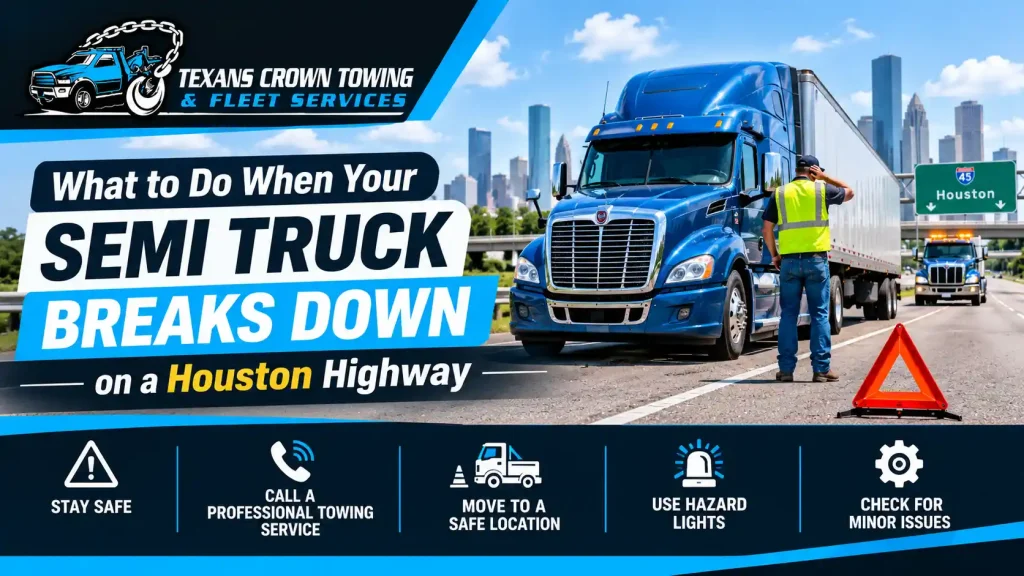
Here is the short version, so you can act now:
- Turn on your hazard lights right away.
- Steer to the right shoulder as far from traffic as you can.
- Set your parking brake and keep your seat belt on until you stop.
- Place three warning triangles behind your truck within 10 minutes.
- Stay safe. Stand well off the road, or stay in the cab if the shoulder is too tight.
- Call 911 if there is fire, smoke, injury, or a blocked lane.
- Call a heavy duty towing company and give your exact location.
- Tell your dispatcher and your broker what happened.
- Take photos for insurance.
- Wait for the tow driver in a safe spot.
Now, let’s break each step down.
Why Houston Highways Are So Tough on a Broken-Down Semi
Houston is one of the busiest freight cities in the country. Because of the port, the rail yards, and the oil and gas industry, trucks are everywhere. That is good for business. However, it also makes a breakdown more dangerous.
I-10 (Katy Freeway and East Freeway)
I-10 is wide, fast, and packed. On the Katy side, the shoulders can be narrow in spots. On the east side, heavy port traffic never slows down. As a result, a stopped truck is hard to see and easy to hit.
I-45 (North Freeway and Gulf Freeway)
I-45 connects Houston with Dallas to the north and Galveston to the south. Construction zones are common. Lanes shift, and shoulders disappear. If you break down inside a work zone, you have almost no room to move.
Beltway 8 (Sam Houston Tollway)
Beltway 8 circles the city and carries a huge amount of truck traffic. Many sections have tolls, frontage roads, and tight ramps. Also, it can be hard to describe your exact spot to a tow driver. Mile markers and exit numbers help a lot here.
Heat, Storms, and Flooding
Houston weather adds another layer of stress. Summer heat pushes engines and tires to the limit. Meanwhile, sudden storms can flood low areas in minutes. So, even a simple breakdown can get worse fast if you don’t act quickly.
The First Five Minutes: Safety Comes Before Everything
Your load matters. Your schedule matters. But nothing matters more than your life.
Get Off the Road if You Can
The moment you feel trouble, do not slam the brakes. Instead, ease off the gas and turn on your hazards. Then steer toward the right shoulder. Even a few extra feet can save your life.
If you can reach an exit ramp, a wide shoulder, or a parking lot, go for it. A short, slow roll on a flat tire is often safer than stopping in a live lane. Still, do not drive far if you risk fire or total brake loss.
Set Your Brakes and Light Up the Scene
Once you stop, set the parking brake. After that, keep your hazards on. At night, turn on your cab lights as well. Visibility is your best protection.
Place Your Warning Triangles
Federal rules say commercial drivers must set out reflective warning triangles within 10 minutes of stopping on a highway. You should place them behind your truck, facing oncoming traffic. The usual spots are about 10, 100, and 200 feet back.
However, walking near fast traffic is risky. Look carefully, stay close to the shoulder edge, and carry the triangles with you. If the shoulder is too narrow to walk safely, prioritize your safety and call for help first. You can read the full rule in the FMCSA warning device regulation.
Know When to Call 911
Call 911 right away if you see:
- Fire or heavy smoke
- Fuel or fluid leaking onto the road
- Any injury
- A truck blocking a lane or the whole road
- A load that has shifted or spilled
Also, Texas has a Move Over or Slow Down law that protects tow trucks and other roadside workers. Not every driver follows it, though. So never assume cars will give you space.
What to Do Next: A Simple Step-by-Step Plan
Once you are safe, move to the next steps. Stay calm and take them in order.
Step 1: Pinpoint Your Exact Location
Tow drivers can’t help if they can’t find you. Look for these details:
- The highway name and direction (for example, I-10 westbound)
- The nearest exit or cross street
- The closest mile marker
- Any big landmark, such as an overpass or sign
Your phone’s map app can also share a live pin. This saves valuable minutes.
Step 2: Call a Heavy Duty Towing Company
A regular tow truck can’t safely move a loaded semi. You need a company with the right equipment and trained drivers. In Houston, 24/7 heavy duty towing in Houston is available through Texans Crown Towing. Call (713) 929-6299 and a real person will walk you through the next steps.
Step 3: Tell Your Dispatcher and Broker
Next, call your dispatcher. Explain where you are and what happened. Then update your broker or customer about the delay. Early honesty protects your reputation. In addition, it can help you avoid late penalties.
Step 4: Document Everything
While you wait, take clear photos and short videos. Capture:
- Your truck and trailer from all four sides
- Your exact location and any road signs
- The damage or the problem area
- Your load and how it is secured
- Any nearby hazards
These photos help your insurance claim. They also protect you if there is a dispute later.
Step 5: Wait in the Safest Place Possible
If the shoulder is wide and your truck is well off the road, stand behind a guardrail if one is nearby. Otherwise, stay in the cab with your seat belt on. Keep your hazards on and your phone charged.
Common Causes of Semi Truck Breakdowns in Houston
Knowing the cause helps you explain the problem to the tow company. It also helps you prevent the same issue next time.
Tire Blowouts and Flats
Hot Houston asphalt is brutal on tires. Underinflation, worn tread, and overloading all raise the risk. A blowout can also damage fenders, air lines, and wiring.
Quick fix: Do not try to change a tire on a busy highway. Instead, call for roadside help and a tow if needed. For more on this topic, see our guide on road service for semi trucks.
Overheating
Stop-and-go traffic on I-45 can cook an engine. Low coolant, a bad fan clutch, or a clogged radiator are common causes. If your temperature gauge climbs, pull over safely and shut the engine off.
Quick fix: Never open a hot radiator cap. Wait until the engine cools, then call for service.
Brake and Air System Problems
An air leak or brake failure is scary at highway speed. If your air pressure drops, the spring brakes may lock. That can leave you stuck in a lane.
Quick fix: Do not drive on low air pressure. You should call for a tow right away.
Electrical and Battery Failures
Dead batteries, bad alternators, and loose cables can shut down a truck in seconds. Heat and vibration make these failures more common.
Quick fix: A jump start may work, but if the alternator is bad, the truck will die again. So a tow to a shop is often the safer choice.
Fuel, DEF, and Emissions Issues
Clogged fuel filters, contaminated diesel, and low diesel exhaust fluid (DEF) can cause power loss. Many modern trucks will derate, which means the engine limits its speed or power.
Quick fix: Check your fluid levels and fuel gauge. If the truck won’t recover, call for help.
Engine and Transmission Trouble
Strange noises, grinding, or sudden loss of power can signal serious damage. Driving farther can turn a repair into a rebuild.
Quick fix: Shut it down and call for towing. Do not take the risk.
Mistakes to Avoid When Your Semi Breaks Down
Even experienced drivers make these errors under stress. So keep them in mind.
- Don’t stay in a live lane if you can move safely.
- Don’t stand between your truck and traffic.
- Don’t try major repairs on a busy highway.
- Don’t accept help from random “tow trucks” that show up uninvited. Some are unlicensed or overcharge stranded drivers.
- Don’t leave your truck unattended with cargo inside, unless it is safe and necessary.
- Don’t drive on a damaged tire, low air, or an overheated engine just to “make it to the next exit.”
If you want to know how to vet a company before you call, read our post on what to ask a towing company before you hire them.
The Real Risks of Waiting or Fixing It Yourself
It is tempting to think, “I can fix this and keep moving.” Sometimes that is true. On a Houston highway, though, the risks add up fast.
Accidents. A stopped truck is a major crash risk, especially at night or in rain. Rear-end collisions with trucks are often severe.
Fines and citations. Blocking traffic or failing to use warning devices can lead to tickets and penalties.
Cargo loss and delays. The longer you sit, the more your delivery slips. Perishable loads can spoil. Missed windows can cost you the contract.
More damage. Driving on a failing part can destroy the surrounding system. A small repair becomes a huge bill.
Personal injury. Roadside work near fast traffic is one of the most dangerous situations a driver can face.
For these reasons, calling a pro early is almost always the smarter and safer move. If a crash is involved, also read our guide on what to do immediately after an accident on a Texas highway.
Why You Need Heavy Duty Towing, Not a Regular Tow Truck
Not all towing is the same. A tow truck built for a sedan can’t handle a loaded tractor-trailer. Trying to use one is unsafe, and it can damage your rig.
What Makes Heavy Duty Towing Different
Heavy duty towing uses large wreckers and rotators. These trucks are built to lift and pull Class 7 and Class 8 vehicles. They have stronger winches, bigger booms, and air brake systems. In addition, the drivers are trained to handle heavy loads and tricky recoveries.
To see how the two compare, check our breakdown of heavy duty vs light duty towing.
Semi Duty Towing in Houston
Many drivers search for semi duty towing in Houston when they are stuck. That term simply means towing built for big rigs, tractor-trailers, and other large commercial vehicles. Our semi truck towing in Houston service covers breakdowns, accidents, and recoveries. It also covers trailer moves and roadside support.
Highway-Specific Recovery
Highway breakdowns need extra care. Traffic control, lane safety, and fast clearing all matter. Learn more about how this works on our page for heavy duty towing on highways.
When a Rollover or Jackknife Happens
Some situations need more than a basic wrecker. For example, a rolled trailer or a truck off the road may need a rotator. Our article on rotator towing vs crane hire explains the difference in simple terms.
What to Tell the Dispatcher When You Call
A clear call gets help to you faster. Have this information ready:
- Your name and callback number
- Your exact location, direction, and mile marker
- Truck type, make, and approximate weight
- Whether the trailer is loaded or empty
- What went wrong, as best you know
- If you are blocking a lane
- Whether you need the truck towed to a shop, yard, or terminal
Because of this, the dispatcher can send the right equipment the first time. You will not lose time waiting for the wrong truck.
How Much Does Heavy Duty Towing Cost?
Cost depends on several things:
- The weight and type of your rig
- The distance towed
- The time of day
- How hard the recovery is
- Whether special equipment is needed
Because every case is different, ask for a clear quote before the work starts. A good company will explain the charges up front. For more help, see our post on Houston towing costs.
How to Prevent a Highway Breakdown Before It Happens
You can’t stop every problem. Still, a good routine cuts your risk a lot.
Do a Strong Pre-Trip Inspection
Check tires, lights, brakes, belts, hoses, and fluid levels every single trip. Look for leaks under the truck. Listen for odd noises.
Keep Up With Maintenance
Follow your service schedule. Replace filters, belts, and tires before they fail. In Texas heat, cooling systems and tires need extra attention.
Carry an Emergency Kit
Your kit should include:
- Three reflective warning triangles
- A flashlight with fresh batteries
- A fire extinguisher
- A reflective vest
- Gloves and basic tools
- Water, snacks, and a phone charger
- A first aid kit
Save Your Towing Number Now
Don’t wait until you are stranded. Save (713) 929-6299 in your phone today. Then you won’t have to search while stressed.
Heavy Duty Towing Across Texas, Not Just Houston
Houston may be your home base, but your route probably goes much farther. Trucks cross I-10 from Beaumont to El Paso. They run I-45 to Dallas and I-35 to San Antonio and Austin. Others haul along US-59, US-290, and the Gulf Coast.
Breakdowns don’t stay in one city. That is why it helps to work with a team that understands the whole state. Texans Crown Towing supports drivers around Houston and across Texas, so you are not left guessing who to call. If you want to compare options, read our list of the top 10 best heavy duty towing companies in Houston.
Stuck on a Houston Highway? Call Texans Crown Towing Now
When your truck stops, every minute counts. You need a team that answers fast and shows up with the right equipment. You also need people who treat you like a professional, not a number.
Texans Crown Towing provides heavy duty towing in Houston for semis, tractor-trailers, box trucks, and other commercial vehicles. Our team handles breakdowns, recoveries, and roadside help on I-10, I-45, Beltway 8, and beyond.
📞 Call now: +1 (713) 929-6299
Available 24/7 for 24/7 heavy duty towing in Houston and across Texas.
Don’t wait on the shoulder and hope for the best. Call, share your location, and let our team take it from there.
Frequently Asked Questions
What should I do first if my semi truck breaks down on a highway?
First, turn on your hazard lights and steer to the right shoulder. Next, set the parking brake and place warning triangles behind your truck. Then call 911 if there is danger, and call a heavy duty towing company for help.
How long does it take to get heavy duty towing in Houston?
Response time depends on your location, traffic, and the time of day. Often, help can arrive within a short window when you give a clear location. Calling early and sharing your mile marker speeds things up.
Can I stay in my truck while I wait for a tow?
Yes, in many cases. If the shoulder is narrow or traffic is heavy, staying in the cab with your seat belt on is safer than standing outside. However, leave the truck right away if there is fire, smoke, or fuel leaking.
How many warning triangles do I need for a semi?
Federal rules call for three reflective triangles. You should place them behind your truck within 10 minutes of stopping, if it is safe to do so.
Is heavy duty towing the same as semi truck towing?
They are closely related. Heavy duty towing covers all large vehicles, such as buses, dump trucks, and big rigs. Semi truck towing focuses on tractor-trailers. Both need large wreckers and trained operators.
Who do I call for a semi truck breakdown near me?
Call a licensed heavy duty towing company that offers 24/7 service. In Houston, you can call Texans Crown Towing at (713) 929-6299 for fast help.
Does heavy duty towing cover areas outside Houston?
Yes. Texans Crown Towing serves Houston and drivers across Texas. Call and share your location to confirm coverage.
How much does it cost to tow a semi truck in Houston?
Price depends on weight, distance, time, and the type of recovery. Always ask for a quote before service begins so there are no surprises.
Final Thoughts
A semi breakdown on I-10, I-45, or Beltway 8 is a tough moment. Still, you can handle it. Get to safety first. Then set your triangles, call for help, and document the scene.
Most of all, don’t try to tough it out alone. The right heavy duty towing team protects you, your truck, and your load. Save the number, keep your kit ready, and drive safe out there.
Need help right now? Call Texans Crown Towing at +1 (713) 929-6299.