
Picture this: it’s 2 a.m. on I-45 outside Houston, and your delivery truck just blew a rear axle. Your cargo is sitting on the shoulder. Your driver is stuck. And every minute that truck isn’t rolling is money leaking out of your business. If you run a fleet, own a construction company, or manage commercial vehicles anywhere in Texas, you already know that a breakdown isn’t just inconvenient, it’s expensive, stressful, and sometimes dangerous.
That’s why knowing which heavy duty towing trucks actually get the job done matters. Not every tow truck can safely move a loaded semi, a bus, or a piece of heavy equipment. Using the wrong truck or the wrong towing company can lead to more damage, longer downtime, and bigger repair bills.
In this guide, we’ll break down the best heavy duty towing trucks for commercial use, why fleet and business owners across Texas rely on them, what causes most commercial breakdowns, and how to pick a towing partner you can actually trust. We’ll also answer the questions Texas business owners search for most, including how much towing really costs in this state.
Table of Contents
Toggle
What Makes a Tow Truck “Heavy Duty”?
A heavy duty tow truck isn’t just a bigger version of a regular tow truck. It’s built with a stronger frame, a more powerful winch, and specialized rigging to safely move vehicles that weigh well over 26,000 pounds, think semi-trucks, box trucks, buses, RVs, and heavy construction equipment.
Regular light-duty tow trucks simply don’t have the horsepower, boom strength, or stability to handle that kind of weight. Trying to force it usually ends badly, with dropped loads, damaged axles, or a truck that tips during recovery. If you want a deeper breakdown of the difference, our guide on heavy-duty vs. light-duty towing walks through exactly where that line is drawn.
Types of Heavy Duty Towing Trucks Used for Commercial Work
Not every commercial towing job needs the same equipment. Here are the main types of heavy duty tow trucks Texas fleet owners should know about.
1. Heavy-Duty Wreckers (Integrated Tow Trucks)
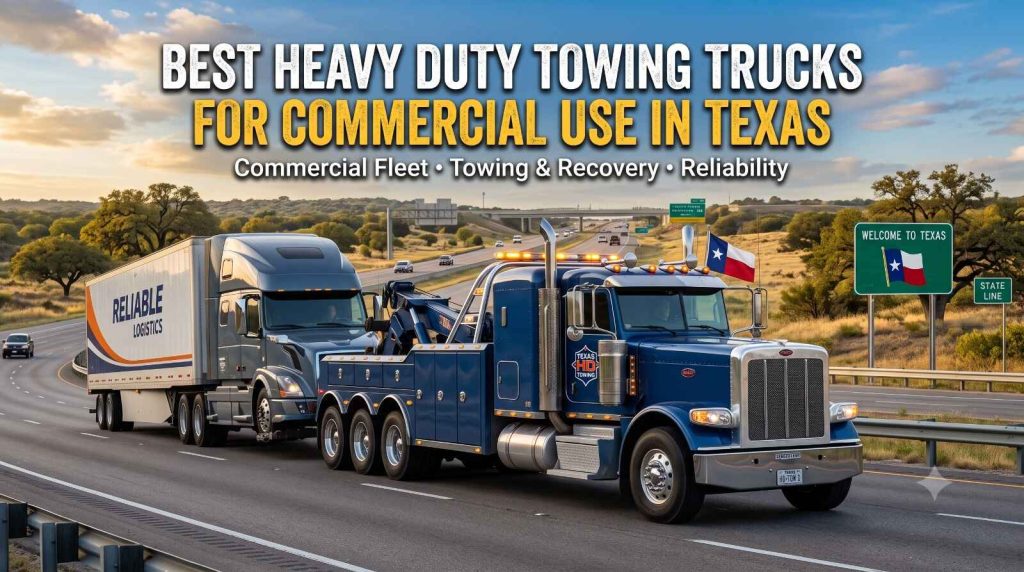
These are the workhorses of commercial towing. Integrated wreckers combine a boom, winch, and underlift into one unit, giving operators the power to lift and tow tractor-trailers, dump trucks, and other large commercial vehicles safely. They’re the go-to choice for highway recoveries where a truck has jackknifed or slid off the road.
2. Rotator Tow Trucks
When a vehicle rolls over, lands in a ditch, or ends up in a hard-to-reach spot, a rotator is often the only truck built for the job. Its rotating boom can lift a vehicle straight up and swing it back onto the roadway, which makes it essential for complex accident recoveries on busy Texas highways like I-10 and I-35.
3. Flatbed Heavy Haulers
For moving equipment, disabled trucks, or vehicles that shouldn’t be dragged on their wheels, a heavy-duty flatbed is often the safest option. It carries the entire vehicle above the road surface, which protects the drivetrain and reduces the risk of further damage. Learn more about when this method makes sense in our article on flatbed towing.
4. Landoll and Lowboy Trailers
For oversized loads, construction equipment, or vehicles that are too long or too heavy for a standard flatbed, landoll and lowboy trailers give businesses a way to transport large assets without exceeding weight limits or risking road damage.
What Causes Most Commercial Breakdowns in Texas?
Understanding the “why” helps fleet managers plan ahead. The most common causes we see across Texas include:
- Extreme heat. Texas summers push engines, tires, and transmissions to their limits, especially on long highway routes.
- Tire blowouts. Heavy loads combined with hot asphalt are one of the top reasons commercial trucks end up stranded.
- Brake and axle failure. Overloaded trailers put extra strain on braking systems, especially on hilly routes near Austin or San Antonio.
- Fuel and electrical issues. Older fleet vehicles are more prone to sudden electrical failures, especially in humid coastal areas like Houston.
- Accidents and jackknifing. Sudden weather changes, heavy rain, or fog can cause commercial vehicles to lose control, particularly on I-45 and I-10.
The Risks of Using the Wrong Truck or an Unqualified Towing Company
Hiring the cheapest or nearest towing service without checking their heavy-duty capabilities can backfire fast. Here’s what’s at stake:
- Vehicle damage. Underpowered equipment can bend frames, damage suspension systems, or crack drivetrains.
- Longer downtime. If the first truck sent can’t handle the job, you’re paying for a second dispatch — and losing more hours.
- Safety hazards. An improperly secured load on a highway is a danger to your driver, your cargo, and everyone else on the road.
- Higher costs later. A rushed or improper tow often leads to expensive repairs down the line, costing far more than the tow itself.
This is exactly why choosing a proven towing service in Texas with real heavy-duty experience matters more than saving a few dollars upfront.
How to Choose the Right Heavy Duty Towing Partner in Texas
If you manage a fleet or run a business with commercial vehicles, here’s what to look for when picking a towing company:
- Ask about their equipment. A reliable provider should have wreckers, rotators, and flatbeds, not just standard tow trucks.
- Check response times. In commercial towing, every hour off the road costs money. Look for 24/7 availability.
- Confirm licensing and insurance. This protects your business if anything goes wrong during recovery.
- Look for local Texas experience. A crew that knows Houston traffic patterns, weather, and terrain will move faster and safer than an out-of-state operator.
- Read real reviews. Reputation matters. If you’re comparing options, our roundup of the best towing companies in Texas is a good place to start your research.
For a step-by-step breakdown, check out our guide on choosing the best towing company in Houston, which applies to fleet owners statewide too.
How Much Does Towing Cost in Texas?
This is one of the most common questions Texas business owners ask, and the honest answer is: it depends on the job. On average, towing cost in Texas for standard vehicles ranges from about $75 to $150 for a local tow. Heavy-duty commercial towing, however, typically runs higher often between $200 and $600 or more depending on:
- The size and weight of the vehicle
- Distance to the tow yard or repair shop
- Time of day (nights and weekends may cost more)
- Whether special equipment like a rotator is needed
- Recovery difficulty (ditch, rollover, or highway median recoveries cost more)
For a full pricing breakdown, our detailed guide on how much towing costs in Texas covers pricing by vehicle type and situation. If you’re specifically in the Houston area, our Houston towing cost guide breaks down local pricing in more detail.
The best way to avoid surprise costs is to work with a provider who gives upfront, honest pricing before the truck even arrives.
Why Texas Businesses Trust Texans Crown Towing
At Texans Crown Towing, we understand that a breakdown isn’t just a mechanical problem — it’s a business problem. Every hour your truck sits on the shoulder is an hour of lost revenue, missed deliveries, and frustrated customers.
That’s why we invest in real heavy-duty equipment, including wreckers, rotators, and flatbeds, and staff our team with operators who know how to handle commercial vehicles safely. Whether you’re based in Houston or anywhere else across the state, our team offers reliable towing services built specifically for fleet and commercial needs. You can also explore our heavy-duty towing near you page to see the areas we cover.
We know Texas roads, Texas weather, and Texas traffic and we show up prepared for all of it.
Get Fast, Reliable Heavy-Duty Towing — Call Now
Don’t let a breakdown cost you more than it should. If your commercial vehicle is stuck anywhere in Texas, call Texans Crown Towing at +1 (713) 929-6299 for fast, professional heavy-duty towing you can count on, day or night.
Frequently Asked Questions
What is considered a heavy duty tow truck?
A heavy duty tow truck is designed to move vehicles over 26,000 pounds, such as semi-trucks, buses, RVs, and heavy equipment. These trucks use stronger winches, reinforced booms, and specialized rigging that standard tow trucks don’t have.
How much does towing cost in Texas for a commercial truck?
Commercial and heavy-duty towing in Texas typically costs between $200 and $600 or more, depending on vehicle size, distance, and recovery difficulty. Standard vehicle tows usually cost less, closer to $75–$150.
What’s the difference between a wrecker and a rotator?
A wrecker lifts and tows vehicles using a boom and underlift, while a rotator has a rotating arm that can lift vehicles out of ditches, medians, or rollover positions. Rotators are used for more complex recoveries.
How do I find a reliable towing service in Texas?
Look for a company with 24/7 availability, proper licensing and insurance, heavy-duty equipment, and strong local reviews. Statewide coverage and experience with commercial vehicles are also important for fleet owners.
Can a regular tow truck tow a semi-truck?
No. Standard tow trucks aren’t built to handle the weight or size of a semi-truck safely. Attempting it can damage the vehicle and create serious safety risks. A heavy-duty wrecker or rotator is required.
How fast can a heavy-duty tow truck arrive in Houston?
Response times vary by provider, but a reliable heavy-duty towing service should be available 24/7 with response times typically under an hour in the greater Houston area, depending on traffic and location.