
It’s 2 a.m. on a Houston job site, and a piece of heavy equipment just tipped over into a ditch. Your foreman is on the phone, your crew is standing around doing nothing, and every minute that passes is costing you money. You need something big, strong, and fast to lift that machine back onto solid ground. But do you call a crane company, or do you call a rotator tow truck?
If you’ve never had to make this call before, it’s an easy trap to fall into: picking the wrong equipment for the job. It can mean paying for hours of standby time, waiting for permits, or worse, damaging the equipment you were trying to save. This guide breaks down rotator towing and crane hire in plain English, so the next time you’re staring down a lifting problem anywhere in Texas from Houston to Dallas, Austin, San Antonio, or Lubbock you’ll know exactly who to call.
Table of Contents
ToggleWhat Is Rotator Towing?
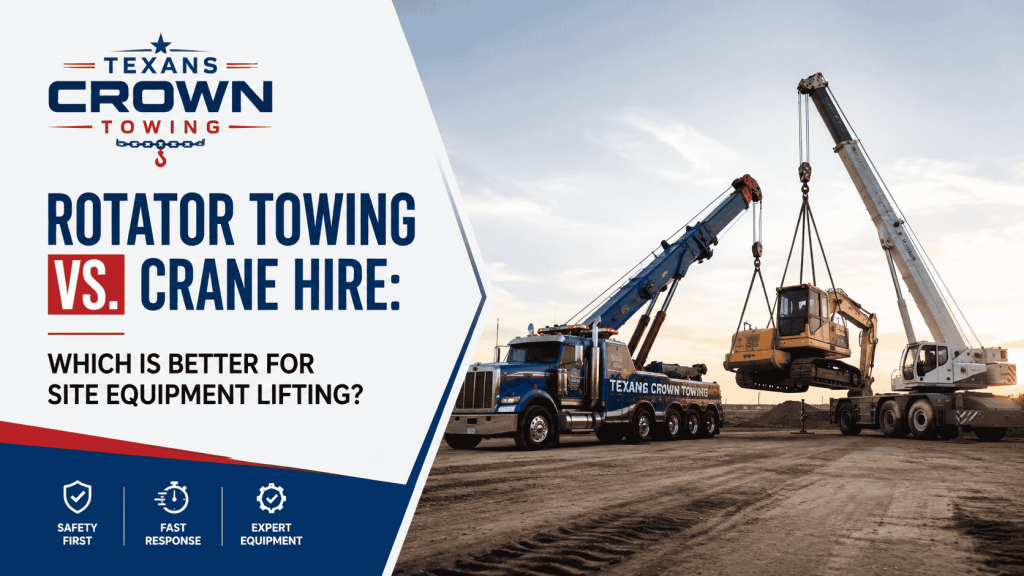
A rotator tow truck is a heavy-duty recovery vehicle with a rotating boom mounted on the back. That boom can spin a full 360 degrees and lift, pull, or reposition loads from almost any angle. Rotator services were built for recovery work: flipping overturned trucks, pulling vehicles out of ditches, hoisting machinery off uneven ground, and clearing wrecks off busy Texas highways.
Rotators combine a few different jobs into one vehicle. They can tow, they can winch, and they can lift all without needing a second truck on site. That’s a big reason contractors and site managers call rotator towing companies for equipment mishaps instead of waiting on a separate lifting rig.
Key Features of Rotator Trucks
- Full 360-degree rotating boom for flexible lifting angles
- Lifting capacity that typically ranges from 25 to 75 tons, depending on the unit
- Built-in winches for pulling and stabilizing loads
- Mobility to reach tight, uneven, or off-road job sites
- One crew, one truck — no need to coordinate a second contractor
What Is Crane Hire?
Crane hire means renting a mobile or tower crane, along with an operator, for lifting jobs that need extreme height, extreme weight, or precise placement. Crane services are the standard choice for construction sites: setting steel beams, placing HVAC units on rooftops, or lifting materials many stories into the air.
Cranes are purpose-built for controlled, planned lifts. They shine when a job has a clear lift plan, enough lead time to schedule the equipment, and space for outriggers and ground preparation.
Key Features of Crane Rigs
- Extremely high lifting capacity, often well beyond what a rotator can handle
- Precise, slow, and controlled movement for delicate placements
- Requires a flat, prepared surface and outrigger setup
- Usually booked days or weeks in advance
- Often needs permits, especially for road closures or overhead work
Rotator Towing vs. Crane Hire: The Real Differences
| Factor | Rotator Towing | Crane Hire |
| Response time | Minutes to a couple hours | Often scheduled days ahead |
| Best for | Emergency recovery, uneven terrain, mixed loads | Planned, high-precision, high-height lifts |
| Setup needed | Minimal — works on rough ground | Needs flat, stable ground and outrigger space |
| Cost structure | Priced per job/hour, no long lead time | Often higher day rates plus mobilization fees |
| Permits | Rarely needed for roadside recovery | Frequently required for road/site closures |
| Versatility | Tows, winches, and lifts in one unit | Lifts only — needs separate hauling if load must move |
When Rotator Towing Is the Better Choice
Rotator towing makes the most sense when speed and flexibility matter more than sheer height or precision. Some common situations where a rotator wins:
Equipment tipped over on a job site. If a skid steer, excavator, or forklift rolls on soft or uneven ground, a rotator can reach spots a crane simply can’t get to, then right the machine and load it in one visit.
Roadside or highway recovery. When a piece of equipment or a heavy truck is blocking traffic, waiting days to book a crane isn’t an option. Rotator services can be dispatched fast, clear the scene, and get traffic moving again.
Mixed recovery and transport jobs. A rotator doesn’t just lift, it can also load the equipment onto a flatbed and haul it away. That saves you from hiring two separate companies for one incident.
Unpredictable ground conditions. Construction sites, farmland, and storm-damaged areas rarely offer the flat, stable footing a crane needs. A rotator’s mobility and stabilizing legs are built for exactly that kind of unpredictable terrain.
When Crane Hire Is the Better Choice
Cranes still win in situations where the job is planned, the weight is extreme, or the placement needs pinpoint accuracy.
Setting structural steel or rooftop units. Cranes are designed for controlled vertical lifts, like placing an HVAC unit on a three-story roof or setting beams during a building’s frame stage.
Lifts beyond rotator capacity. Some industrial loads exceed what even the biggest rotator trucks can safely handle. For those jobs, a crane with the right tonnage rating is the only safe option.
Scheduled construction work. If you know weeks in advance that you’ll need a lift, and the site has room for a prepared crane pad, booking a crane ahead of time is usually more cost-effective than an emergency call.
Common Causes of Site Equipment Lifting Emergencies
Understanding why these emergencies happen can help you plan ahead and pick the right partner before disaster strikes.
- Soft or waterlogged ground — common after Texas rainstorms, causing equipment to sink or tip
- Operator error — turning too sharply on a slope or misjudging load balance
- Mechanical failure — a hydraulic or axle failure that leaves equipment stuck mid-operation
- Overloading — placing more weight on equipment than it’s rated for
- Poor site prep — uneven grading or hidden debris that shifts a machine off balance
Risks of Choosing the Wrong Lifting Option
Picking the wrong equipment for the job isn’t just inconvenient — it can be expensive and dangerous.
- Downtime costs. Every hour equipment sits stuck or in the wrong spot is an hour your crew isn’t working.
- Further equipment damage. Using the wrong lifting angle or a rig that isn’t rated for the load can bend frames, crack hydraulic lines, or worse.
- Safety hazards. Unstable lifts on soft ground put your crew, and anyone nearby, at risk.
- Permit delays. Trying to bring in a crane for an emergency roadside recovery can mean hours of waiting on permits you didn’t need in the first place.
The Fix: Match the Tool to the Job
The safest approach is simple: for anything urgent, uneven, or mixed with towing needs, call a rotator towing company first. For planned, high-precision, high-tonnage lifts on a prepared site, book a crane in advance. Many experienced towing companies in Texas can also tell you honestly when a job is bigger than what a rotator can safely handle, and point you toward the right resource that honesty is worth more than a company that says yes to every job regardless of fit.
Why Texans Trust Local Rotator Services for Emergencies
Texas job sites deal with heat, sudden storms, red clay mud, and long distances between towns. That combination makes fast, flexible rotator response more valuable here than almost anywhere else. Whether you’re managing a site in downtown Houston, out near the Gulf Coast, or in a rural stretch of West Texas, having a rotator crew that already knows local roads, terrain, and permit rules saves real time when something goes wrong. If your project also involves general roadside assistance, it helps to work with a company that offers both under one roof. You can read more in our guide on how roadside assistance actually works.
How Texans Crown Towing Can Help
At Texans Crown Towing, we specialize in rotator towing and heavy-duty recovery across Houston and the entire state of Texas. Our rotator fleet is built to handle tipped equipment, off-road recoveries, and emergency site incidents day or night, rain or shine. Unlike a crane rental that needs days of lead time, our crews can typically be on-site fast, assess the situation, and safely lift, stabilize, or transport your equipment in a single visit.
If you’re comparing companies before you make the call, our breakdown of heavy-duty vs. light-duty towing and our tips on what to ask a towing company before you hire them can help you feel confident in your choice. And if you’re simply looking for dependable, nearby help, see our page on heavy-duty towing near me for coverage across the state.
We understand that equipment emergencies don’t wait for business hours, and neither do we. Our roadside assistance and rotator recovery teams are ready around the clock to get your site back up and running.
Don’t let a stuck or tipped piece of equipment cost you another hour of downtime. Call Texans Crown Towing now at +1 (713) 929-6299 for fast, reliable rotator towing anywhere in Texas.
Frequently Asked Questions
What is the difference between rotator towing and crane hire?
Rotator towing uses a tow truck with a rotating boom to lift, tow, and recover equipment quickly, often in emergency or uneven-terrain situations. Crane hire involves renting a dedicated crane and operator for planned, high-precision, or extremely heavy lifts, usually on a prepared site.
How much weight can a rotator tow truck lift?
Most rotator trucks can lift between 25 and 75 tons, depending on the model and setup. For loads beyond that range, a crane with a higher tonnage rating is usually needed.
Is rotator towing cheaper than crane hire?
For emergency or short-notice jobs, rotator towing is usually more cost-effective because it avoids crane mobilization fees, permit delays, and multi-day booking. For long-planned, high-tonnage construction lifts, crane hire can be more economical.
Can a rotator tow truck lift equipment on uneven ground?
Yes. Rotator trucks are built with stabilizing outriggers and a flexible rotating boom, which lets them work on soft, sloped, or uneven ground where a crane’s stabilizers can’t be safely set up.
How fast can a rotator towing company respond in Houston?
Most rotator towing companies, including Texans Crown Towing, aim to respond within one to two hours for emergency calls in the Houston area, and often faster for jobs close to the city.
Do I need a permit for rotator towing services?
Typically, no. Roadside and job-site rotator recovery usually doesn’t require the same permits as a crane, which may need road closure or overhead-work permits depending on the location and job.
When should I choose crane hire over a rotator?
Choose crane hire when the load exceeds rotator capacity, when the job needs slow and precise placement (like setting rooftop units or structural steel), or when the lift is planned well in advance on a prepared site.
Final Thoughts
Rotator towing and crane hire both have their place on Texas job sites, but they solve different problems. If your equipment emergency needs a fast, flexible, all-in-one response, rotator towing is almost always the better fit. If your project needs a slow, precise, high-tonnage lift with time to plan, crane hire makes more sense.
When equipment trouble strikes and you need answers now, you don’t have to figure it out alone. Texans Crown Towing brings rotator recovery, heavy-duty towing, and roadside assistance to job sites across Houston and all of Texas.
Call +1 (713) 929-6299 today, and let our rotator crew get your equipment and your project back on track.