

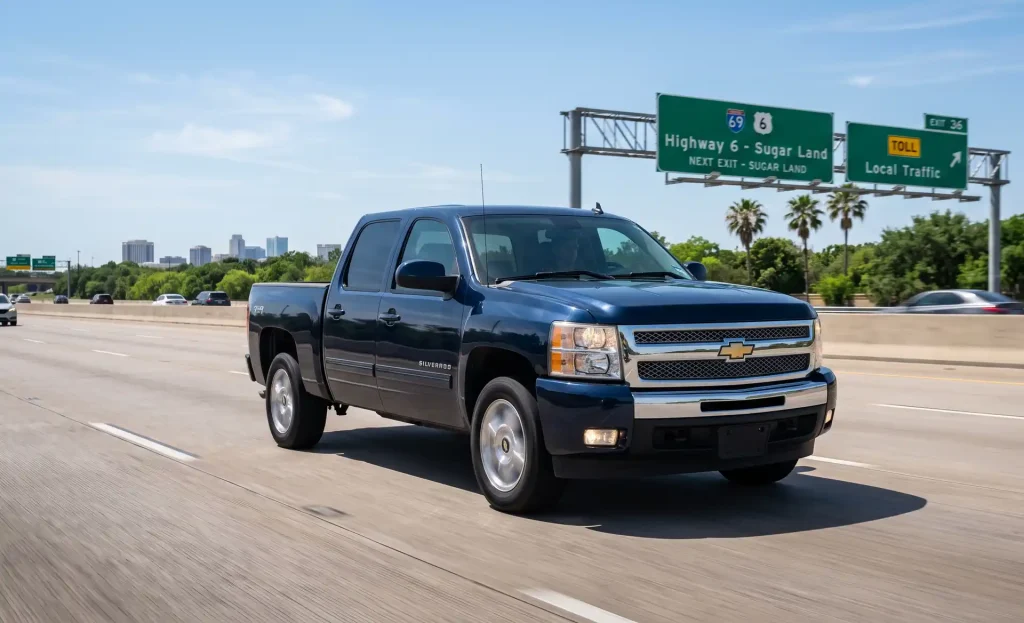
Navigating the bustling lanes of I-69, making quick runs down Highway 6, or hauling gear out toward the Brazos River demands a pickup truck that stays dependable. As the grand finale of the beloved GMT900 generation, the 2013 Chevrolet Silverado 1500 remains a favorite on Texas roads. It combines timeless, muscular styling with strong towing specs and a proven chassis.
However, keeping this truck on the road or shopping for a pre-owned model in Fort Bend County requires a deep look under the hood. The 2013 Chevy Silverado 1500 engine family offers impressive versatility, but certain configurations feature Active Fuel Management (AFM) hardware that requires vigilant care to prevent high oil consumption and lifter issues.
In this complete guide, we will analyze every 2013 Chevrolet Silverado 1500 engine choice, explore key specs, walk through step-by-step diagnostics, and share practical upkeep advice tailored specifically for drivers in Sugar Land.
Table of Contents
ToggleThe Quick Answer: 2013 Chevy Silverado Engine Lineup Overview
The 2013 Chevy Silverado 1500 engine lineup features four main internal combustion engines, ranging from a fuel-conscious V6 up to a roaring 6.2L V8 powerplant.
Here is a quick snapshot of the factory performance metrics across the 1500 half-ton model range:
- 4.3L Vortec V6 (LU3): 195 hp / 260 lb-ft torque
- 4.8L Vortec V8 (L20): 302 hp / 305 lb-ft torque
- 5.3L Vortec V8 (LC9 / LMG): 315 hp / 335 lb-ft torque
- 6.2L Vortec V8 (L9H): 403 hp / 417 lb-ft torque
If you regularly pull heavy commercial loads that exceed these half-ton limits, compare these numbers against the heavier 2006 Chevrolet Silverado 2500HD specs to evaluate a three-quarter-ton truck instead.
Breaking Down Every 2013 Chevrolet Silverado 1500 Engine Variant
Choosing the right motor configuration depends entirely on your daily commuting needs, towing requirements, and maintenance preferences.
4.3L Vortec V6 (LU3)
The standard base engine on entry-level Work Truck trims. It utilizes a simple pushrod design that delivers reliable, low-cost operation for basic transit. While it lacks heavy trailering muscle, it avoids complex cylinder deactivation hardware entirely.
4.8L Vortec V8 (L20)
This small-block V8 is often highlighted by technicians as the most mechanically straightforward V8 in the 2013 catalog. It features Variable Valve Timing (VVT) for smooth power delivery, but does not use Active Fuel Management. For drivers prioritizing long-term durability over highway fuel-saving features, the 4.8L is a rock-solid workhorse.
5.3L Vortec V8 (LC9 / LMG)
The most popular 2013 Chevy Silverado 1500 engine option found on Sugar Land streets. Available in both iron-block (LMG) and aluminum-block (LC9) Flex-Fuel versions, it comes paired with a smooth 6-speed automatic transmission. It utilizes Active Fuel Management to shut down four cylinders under light highway load conditions to save fuel.
6.2L Vortec V8 (L9H)
The powerhouse choice for high-end LTZ and High Country models. Delivering 403 horsepower, this motor makes pulling large trailers or merging onto fast-moving freeways effortless. Like the 5.3L, it requires consistent maintenance to protect its upper valve train components.
2013 Chevy Silverado Engine Specifications Comparison
To see how these motor configurations compare side by side, review the performance figures below. If you want to trace how these engines developed across model years, you can also explore the 2008 Chevy Silverado 1500 engine and the earlier 2007 Silverado engine generations.
| Engine Variant | Cylinder Configuration | Horsepower | Torque (lb-ft) | Active Fuel Management (AFM) | Standard Transmission |
| 4.3L Vortec V6 | V6 (Pushrod) | 195 hp @ 4,600 RPM | 260 lb-ft @ 2,800 RPM | No | 4-Speed Automatic |
| 4.8L Vortec V8 | V8 (Iron Block) | 302 hp @ 5,600 RPM | 305 lb-ft @ 4,600 RPM | No | 4-Speed Automatic |
| 5.3L Vortec V8 | V8 (Iron / Aluminum) | 315 hp @ 5,200 RPM | 335 lb-ft @ 4,400 RPM | Yes | 6-Speed Automatic |
| 6.2L Vortec V8 | V8 (Aluminum) | 403 hp @ 5,700 RPM | 417 lb-ft @ 4,300 RPM | Yes | 6-Speed Automatic |
Step-by-Step Diagnostic Routine for Common Engine Issues
When an engine misfire occurs, or dashboard warning lights illuminate, following a structured diagnostic procedure prevents guesswork and unnecessary spending.
Step 1: Scan for On-Board Diagnostic (OBD-II) Codes
Plug a digital code scanner into the port beneath the driver-side dashboard. Look specifically for misfire codes (such as P0300 or cylinder-specific P0301 through P0308 codes). AFM-equipped engines frequently trigger misfire faults on cylinders 1, 4, 6, or 7.
Step 2: Check Physical Oil Levels and Quality
Pull the dipstick and inspect the oil level. In AFM-equipped 5.3L models, oil spray during cylinder deactivation cycles can cause combustion chamber blow-by, burning through 1 to 2 quarts of oil between service intervals without leaving external driveway leaks.
Step 3: Inspect Spark Plugs for Oil Fouling
Remove the spark plugs from cylinders 1 and 7. Check the electrodes for thick carbon buildup or wet oil deposits. Fouled spark plugs cause misfires, rough idling, and hesitation during heavy acceleration.
Step 4: Check Electronic Throttle Body Condition
If your dashboard displays a “Reduced Engine Power” message and code P2135, remove the air intake tube to inspect the throttle plate. Carbon buildup around the throttle blade forces the engine into limp mode, limiting speeds to 25 MPH.
Symptom, Cause, and Action Matrix
This quick reference table links common driving issues with their underlying mechanical causes and recommended fixes.
| Observed Symptom | Underlying Cause | Corrective Repair Action |
| Cold-start ticking or metallic clicking noise | Collapsed or sticking AFM valve lifter | Replace lifter set, inspect camshaft, clean oil channels |
| “Reduced Engine Power” message on dash | Throttle position sensor voltage mismatch | Clean throttle body housing or install new TPS assembly |
| Burning 1+ quarts of oil per 1,000 miles | Faulty PCV valve cover baffle / stuck piston rings | Install updated GM valve cover and perform top-end decarbonization |
| Engine pinging or hesitation under heavy load | Clogged or failing knock sensor harness | Replace knock sensors and wiring harness beneath intake manifold |
Common Pitfalls to Avoid with a 2013 Silverado
Avoiding these frequent ownership mistakes keeps repair costs low and prevents unexpected breakdowns:
- Relying Solely on the Digital Oil Life Monitor: The oil life display measures oil quality based on driving algorithms, not actual fluid volume. Relying on it without checking the dipstick manually can leave your engine operating dangerously low on oil.
- Skipping Valve Cover Updates: Installing a basic factory-style replacement valve cover on a 5.3L engine will not stop oil consumption. You must install the redesigned GM driver-side valve cover featuring an updated internal PCV baffle.
- Ignoring Minor Valve Train Ticking: A faint ticking sound on cold starts indicates an AFM lifter is struggling to pressurize. Ignoring this warning sign allows the lifter roller to score the camshaft, turning a simple lifter replacement into a major engine overhaul.
Safety and Mechanical Urgency Guide
Dashboard warning lights require prompt action to prevent total mechanical failure on busy roads.
| Warning Sign / Indicator | Urgency Level | Recommended Driver Action |
| Flashing Check Engine Light | Critical Emergency | Pull off the roadway immediately; turn off the engine to prevent catalytic converter damage |
| Low Oil Pressure Warning Display | Critical Emergency | Safely stop the vehicle and shut off the engine; verify oil level on the dipstick before restarting |
| Solid Check Engine Light | Medium Severity | Schedule a diagnostic scan within 48 hours; inspect the gas cap and basic sensor connections |
| Coolant Temp Exceeding 235°F | High Urgency | Shut off air conditioning, turn cabin heat to maximum, and pull off the road safely |
Estimated Service and Repair Costs in Sugar Land, TX
Budgeting for common maintenance items ensures your truck remains dependable without surprising your wallet.
- Redesigned GM PCV Valve Cover Installation: $250 to $420 (Includes updated cover assembly, gaskets, and shop labor)
- Plug-and-Play Electronic AFM Disabler: $200 to $260 (Installs into the OBD-II port to keep the engine in V8 mode constantly)
- Throttle Body Cleaning or Replacement: $180 to $380 (Clears carbon deposits causing “Reduced Engine Power” codes)
- Complete AFM Mechanical Delete & Camshaft Service: $2,900 to $4,400 (Replaces AFM lifters with standard lifters, new camshaft, and ECM tuning)
Local Environmental Factors for Fort Bend County Drivers
Operating a full-size truck in Sugar Land involves specific regional challenges. High heat and humidity during Texas summers put heavy stress on cooling systems and accelerate oil breakdown. High thermal stress reduces the protective viscosity of motor oil, increasing friction inside delicate AFM valve lifters during extended idle times in traffic along Highway 6 or US-59.
Furthermore, sudden heavy rainstorms near the Brazos River can leave deep standing water on low-access roads. Keeping your air filter clean and intake tubing sealed prevents water ingestion.
Finally, maintaining a smooth-running engine without active fault codes is necessary for passing annual Fort Bend County safety and emissions inspections.
Pro Tip #1: Clean the Throttle Body Every 30,000 Miles
Humidity and crankcase oil vapors build up sticky carbon behind the throttle plate, triggering “Reduced Engine Power” fault codes. Removing the assembly and spraying it with throttle body cleaner every 30,000 miles prevents unexpected limp-mode episodes.
Pro Tip #2: Switch to High-Quality Full Synthetic Oil
Use full synthetic 5W-30 motor oil meeting GM Dexos standards, and shorten your service interval to every 4,000 to 5,000 miles. Fresh synthetic oil keeps internal oil passages clean, protecting delicate overhead valve components from sludge buildup.
Frequently Asked Questions
Which 2013 Chevy Silverado 1500 engine is the most reliable?
The 4.8L V8 (L20) is widely regarded as the most reliable engine for this model year. Because it lacks Active Fuel Management (AFM) hardware, it avoids the oil consumption and collapsed lifter problems that affect the 5.3L and 6.2L V8 options.
What causes high oil consumption in the 2013 5.3L V8?
High oil consumption is primarily caused by the AFM system. During cylinder deactivation, oil spray from the crankcase pressure relief valve and suction past low-tension piston rings draws oil into the combustion chambers, where it burns off cleanly without leaving ground leaks.
Does an electronic AFM disabler fix stuck lifters?
No. A plug-in electronic disabler prevents the ECM from triggering cylinder deactivation in the future, which helps prevent future mechanical wear. However, if a lifter has already collapsed or damaged the camshaft physically, mechanical replacement is required.
What is the towing capacity of a 2008 vs 2013 Silverado 1500?
Towing capacities depend on cab style, rear axle ratio, and engine size. When equipped with the 5.3L V8 and trailering package, both model years offer maximum conventional towing limits between 9,500 and 9,600 pounds.
How often should I check my oil in a 2013 Silverado?
Check your oil level manually using the dipstick every two weeks or every second fuel fill-up. Because AFM engines can burn up to a quart of oil every 1,000 miles, checking fluid levels regularly prevents low oil pressure conditions.
Dependable Roadside Support for Sugar Land Drivers
Taking good care of your truck’s powertrain keeps it running strong for daily errands, work tasks, and family road trips. Staying aware of warning signs, monitoring oil levels, and performing routine maintenance helps you enjoy dependable performance for miles to come.