

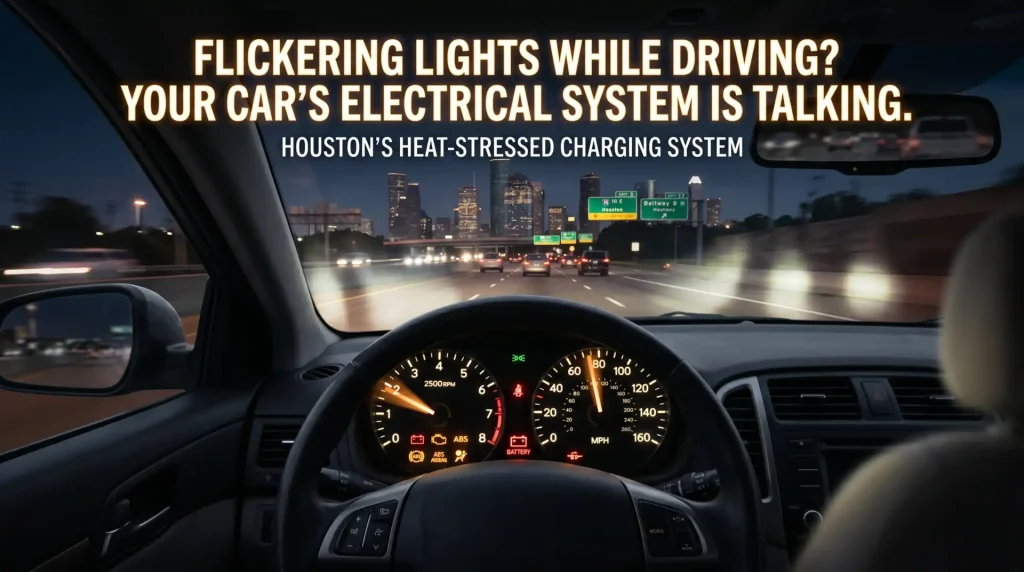
You’re on the Beltway, idling in a drive-through on Westheimer, or sitting in your driveway with the engine running, and the headlights and dashboard lights start flickering together.
Not dimming slightly. Actually flickering. Pulsing. Going bright-dim-bright in a rhythm.
For first-time car owners, this can be alarming. And it should get your attention — because when your headlights and dash lights flicker at the same time while the car is running, it almost always points to one of a handful of specific electrical system issues, most of which get worse the longer they’re ignored.
This guide walks you through every cause, step by step, in plain language, so you know exactly what you’re dealing with and what to do next in the Houston area.
Table of Contents
ToggleWhy Do Headlights AND Dash Lights Flicker at the Same Time?
This is the detail that makes this symptom specific and diagnostic.
When just one light flickers, it’s usually a bulb or a wiring issue local to that light. But when your headlights and dash lights flicker together while the engine is running, the problem is systemic — something is affecting the voltage supply to the entire vehicle.
Your car’s electrical system depends on a stable voltage — typically 13.5 to 14.5 volts when the engine is running. When voltage drops, rises, or fluctuates outside that range, every electrical component fed by that circuit responds simultaneously. That’s why your headlights dim at the same moment your dash gauges flicker.
The system sending all those components their power is the charging system — primarily your alternator and battery working together.
The 6 Most Common Causes of Flickering Headlights and Dash Lights While Running
1. Failing Alternator — The #1 Cause
If your headlights and dash lights flicker while the car is running — not just when starting — a failing alternator is the most likely culprit.
The alternator is responsible for generating electricity while the engine runs. It charges the battery, powers all electrical components, and maintains stable voltage throughout the vehicle. When it begins to fail, its output becomes inconsistent — and that inconsistency shows up as flickering across every electrical component simultaneously.
What a failing alternator feels like:
- Flickering headlights and dash lights that come and go, especially at idle
- The battery warning light appears on the dashboard
- Electrical components behaving erratically (radio cutting out, AC blower speed changing)
- In later stages, the car may become hard to start or stall
Houston-specific factor: Houston’s extreme summer heat is one of the leading causes of premature alternator failure. Internal alternator components — the diode rectifier, voltage regulator, and brushes — degrade faster under sustained high-temperature operation. A vehicle that spends hours idling in Houston stop-and-go traffic on US-59 or the Beltway puts significant heat stress on the charging system.
💡 Pro Tip: A quick way to check if your alternator is causing the flicker — turn on your high-beam headlights and the rear defroster at the same time while idling. If the flickering gets noticeably worse under that increased electrical load, the alternator is struggling to keep up. That’s a strong indicator it needs testing.
2. Weak or Failing Battery
A battery that can no longer hold a proper charge creates voltage instability — even while the engine is running. The alternator tries to compensate by working harder, but if the battery is too far gone, voltage swings occur, and you see flickering throughout the vehicle.
What makes this particularly common in Houston:
- Houston’s extreme heat degrades battery cells faster than anywhere else in the country
- The average car battery lasts 3–5 years nationally — in Houston, 2–4 years is more realistic due to the heat
- Temperature swings between Houston winters and summers cause repeated expansion and contraction inside the battery casing, accelerating internal wear
Signs the battery may be causing your flicker:
- Flickering is most noticeable right after starting the car, before the alternator fully takes over
- The battery is more than 3 years old
- The car cranks slowly or hesitates before starting
- The battery warning light appears intermittently
⚠️ Common Pitfall: Many Houston drivers replace their alternator when the battery was actually the root problem — and vice versa. These two components work together, and one failing stresses the other. Always test both before replacing either.
3. Loose, Corroded, or Damaged Battery Terminals and Cables
This is one of the most overlooked causes — and one of the most fixable.
The battery cables connect the battery to the rest of the vehicle’s electrical system. When the terminal connections are loose or corroded, they create resistance in the circuit. That resistance causes voltage to drop and fluctuate — producing the same flickering pattern as a failing battery or alternator, even when both components are perfectly healthy.
What to look for:
- White, blue, or greenish crusty buildup around the battery terminals (corrosion)
- Battery cables that wiggle or have play when you try to move them by hand
- Flickering that started recently, possibly after a battery service or engine work
Houston-specific factor: Houston’s humidity accelerates terminal corrosion faster than in drier climates. Battery terminals on vehicles parked outside, especially near the coast in areas like Clear Lake or Pasadena, corrode more aggressively than on garaged vehicles.
💡 Pro Tip: Cleaning corroded battery terminals is a 10-minute DIY fix. Disconnect the negative terminal first (black), then the positive (red). Clean with a mixture of baking soda and water on a wire brush, rinse, dry, and reconnect. If the flickering stops after cleaning, you just saved yourself a diagnostic fee.
4. Loose or Worn Alternator Belt (Serpentine Belt)
The alternator is driven by the serpentine belt — a rubber belt that routes around multiple engine pulleys. If this belt is worn, cracked, glazed, or running loose on its tensioner, it can slip intermittently. When the belt slips, the alternator briefly loses its drive and output drops — causing a momentary voltage dip you see as flickering.
What it feels like:
- Flickering that’s brief and rhythmic — tied to engine RPM
- Squealing or chirping from the engine bay, especially on startup or acceleration
- Flickering that improves at higher RPM (belt grips better at speed) but worsens at idle
Houston-specific factor: Belt tensioners and belt rubber degrade faster in Houston’s heat. Vehicles with over 60,000 miles and original serpentine belts are at real risk. This is a common finding during summer service visits at Houston-area shops.
5. Grounding Issues, Bad Ground Connections
Your vehicle’s electrical system depends on a complete circuit — electricity flows from the battery, through components, and back to the battery through ground connections. When a ground strap or ground wire becomes loose, corroded, or broken, the circuit loses its return path and voltage becomes erratic.
Ground issues are particularly tricky because they can cause flickering, random warning lights, and other electrical gremlins that seem completely unrelated.
Signs of a grounding problem:
- Multiple unrelated electrical issues appearing at the same time (lights flickering, gauges acting erratically, windows moving slowly)
- Flickering that changes when you touch or move certain wiring harnesses
- Symptoms that come and go with no obvious pattern
Common ground locations on most vehicles:
- Battery negative cable to chassis (usually bolted near the battery)
- Engine block to chassis ground strap
- Body ground straps beneath the vehicle
Houston flooding events can introduce moisture into ground connection points that are normally never exposed to water. Vehicles that have been through standing water — unfortunately common in many Houston neighborhoods — sometimes develop ground issues months after the flood event.
6. Failing Voltage Regulator
The voltage regulator controls the alternator’s output, ensuring it maintains a stable 13.5–14.5 volts under varying electrical loads. On most modern vehicles, the regulator is built into the alternator itself. When it fails, the alternator either undercharges or overcharges — both of which cause flickering.
Signs of a failing voltage regulator:
- The voltage gauge on the dashboard is reading above 15V or dropping below 12.5V while running
- Flickering that’s constant and doesn’t respond to electrical load changes
- Bulbs are burning out more frequently than normal (overcharging condition)
- Battery warning light combined with flickering
Step-by-Step: How to Diagnose Flickering Headlights and Dash Lights
Work through these steps before spending money at a shop. This process is designed specifically for first-time car owners who want to understand what’s happening before they hand over the keys.
Step 1: Note Exactly When the Flickering Happens
The timing is your first diagnostic clue:
| When It Flickers | What It Most Likely Points To |
| Only when starting the car | Normal brief voltage drop during cranking — often harmless |
| While idling with the engine running | Alternator struggling at low RPM, weak battery, or loose belt |
| While driving at highway speed | Loose belt, failing alternator diode, or ground issue |
| When you turn on accessories (AC, defroster, headlights) | Alternator can’t handle the load — near the end of life |
| Randomly with no pattern | Ground connection issue or a failing voltage regulator |
| Getting worse over days/weeks | Alternator or battery approaching failure — act now |
Write this down before calling a shop. Mechanics who receive this specific information skip hours of diagnostic guesswork.
Step 2: Do a Visual Battery and Terminal Check
Pop the hood with the engine off and check:
- Battery terminals: Any white or blue-green corrosion?
- Cable connections: Do they wiggle when you try to move them?
- Battery case: Any swelling, bulging, or cracks in the casing?
- Serpentine belt: Look for cracks, fraying, glazing (shiny surface), or a belt that looks loose on its tensioner
This takes 3 minutes and eliminates the most common fixable causes immediately.
Step 3: Check the Battery Voltage With a Multimeter
A basic multimeter costs $15–$25 at any Houston AutoZone or Harbor Freight. With the engine off, touch the red probe to the positive battery terminal and the black probe to the negative terminal.
What the readings mean:
| Reading (Engine Off) | Interpretation |
| 12.6V or higher | Battery is fully charged — likely not the primary issue |
| 12.2V–12.5V | The battery is partially discharged |
| Below 12.0V | The battery is significantly discharged or failing |
Now start the engine and check again with it running:
| Reading (Engine Running) | Interpretation |
| 13.5V–14.5V | The charging system is working correctly |
| Below 13.0V | Alternator is undercharging — likely failing |
| Above 15.0V | Voltage regulator is overcharging — also a problem |
💡 Pro Tip: If you don’t have a multimeter, most AutoZone and O’Reilly locations in Houston offer free battery and alternator testing while you wait. They’ll test both components in under 10 minutes and give you a printed report.
Step 4: Load Test the Electrical System
Sitting in the parked car with the engine running, turn on:
- High-beam headlights
- Rear window defroster
- Air conditioning on max
Watch the dashboard lights and headlight brightness. If flickering increases noticeably when you add these loads, the charging system is struggling under demand — a clear sign the alternator is weakening.
Step 5: Check for Warning Lights
Is the battery light on? Any other warning lights appearing alongside the flickering?
A Check Engine Light flashing at the same time as flickering headlights and dash lights suggests the voltage instability is severe enough to affect the engine management system. This combination needs a professional diagnosis quickly.
Similarly, if you’re dealing with a car sputtering check engine light on situation at the same time as flickering lights, you may have a charging system failure severe enough to affect fuel injector timing and ignition — these are interconnected systems that share the same power supply.
Step 6: Check for Recent Electrical Work or Modifications
Did the flickering start after:
- A battery replacement?
- Any aftermarket audio or accessory installation?
- An oil change or other service?
New batteries sometimes have loose terminal connections after installation. Aftermarket accessories draw extra current that can push a marginal alternator over the edge. A recent service that involved disconnecting and reconnecting wiring can disturb ground connections.
Step 7: Get a Professional Diagnosis If the Source Isn’t Clear
If steps 1–6 don’t reveal an obvious cause, a shop diagnostic is the next step. A qualified technician will perform a charging system load test, check all ground connections, inspect the serpentine belt and tensioner, and scan for any electrical fault codes stored in the ECU.
Most Houston auto shops offer a free or low-cost charging system inspection — typically bundled with a battery test.
Is It Safe to Drive With Flickering Lights in Houston?
| Situation | What To Do |
| Brief flicker only on startup, clears immediately | Normal cranking voltage drop — monitor it |
| Mild flicker at idle, no warning lights | Drive carefully to a shop within 1–2 days |
| Consistent flickering at all speeds + battery warning light | Schedule service today — don’t delay |
| Flickering is getting worse over the days | Alternator or battery near failure — get tested immediately |
| Flickering + car feels like it might stall | Do not drive on highways — get it tested today |
| Flickering + stalling or won’t restart | Stop driving — call for roadside assistance or tow |
The real risk of driving on a failing alternator or battery in Houston isn’t just losing your lights. It’s being stranded in traffic on I-45, I-10, or the Beltway — or losing power steering and other electrically assisted systems while driving at speed.
What About a Jeep Engine Light Flashing Alongside Flickering?
If you drive a Jeep and you’re seeing both a Jeep engine light flashing and a flickering dashboard and headlights at the same time, you’re likely dealing with a charging system failure severe enough to affect the engine management system. Voltage instability can cause the ECU to log misfire codes, trigger warning lights, and behave erratically — all from a single failing alternator.
Get both symptoms diagnosed together — they share the same root cause.
Houston-Specific Factors That Accelerate Charging System Failure
- Summer heat — Sustained temperatures above 95°F accelerate battery cell degradation, and alternator wear faster than anywhere in the northern US
- Stop-and-go traffic — Hours of low-speed idling on US-59, I-10, and the Beltway keep the alternator working at lower RPM for extended periods, which is the least efficient operating range
- Humidity and flooding — Moisture infiltrates battery terminal connections, ground straps, and electrical connectors. Vehicles driven through standing water are particularly vulnerable to ground circuit corrosion months after the event
- Short trip driving — Many Houston commuters do multiple short trips per day — dropping kids at school, running errands. Short trips don’t give the alternator enough time to fully recharge the battery after each startup, gradually draining it over weeks
How Much Does It Cost to Fix Flickering Lights in Houston?
| Repair | Estimated Cost in Houston |
| Battery terminal cleaning (DIY) | $0–$10 |
| Battery replacement (standard) | $120–$200 installed |
| Alternator replacement (most vehicles) | $300–$700 installed |
| Serpentine belt + tensioner replacement | $150–$350 |
| Ground strap repair/replacement | $50–$200 |
| Voltage regulator (if separate from alternator) | $100–$300 |
| Full charging system diagnostic | Free–$100 |
💡 Pro Tip: If your alternator is being replaced, ask the shop to test the battery at the same time. A failing alternator often partially damages the battery by undercharging it for months. Installing a new alternator on a compromised battery means the battery may fail within weeks — and you’ll be back in the shop. Testing both upfront saves a second visit.
Common Pitfalls First-Time Car Owners Make
❌ Replacing just the battery when the alternator is the real problem — The new battery will drain within days if the alternator isn’t charging it properly
❌ Ignoring corrosion on battery terminals — What looks cosmetic is actually causing resistance that affects the whole electrical system
❌ Assuming flickering is “just how the car is” — Progressive flickering means the charging system is deteriorating. It always gets worse, never better on its own
❌ Driving on Houston highways with a failing charging system — Losing electrical power at 70 mph affects power steering, ABS, and all safety systems
❌ Installing aftermarket accessories without checking alternator output capacity — Heavy audio systems, extra lighting, or winches added to a vehicle with a marginal alternator push it over the edge
Frequently Asked Questions
Q: Is it normal for headlights to flicker briefly when I start the car?
Yes — a very brief dim or flicker at the exact moment of cranking is normal. The starter motor draws a large current during cranking, causing a momentary voltage drop. If it clears within a second or two, it’s not a concern. If it persists after the engine starts, investigate further.
Q: Can a bad alternator cause dashboard lights to flicker while driving?
Yes — this is one of the most classic symptoms of a failing alternator. Inconsistent voltage output from a worn alternator causes all electrically powered components — including dashboard instruments — to flicker simultaneously.
Q: How long can I drive with a failing alternator in Houston?
Not long. Once an alternator starts failing, it’s powering the car primarily off the battery. A fully charged battery can run a vehicle for 30–60 minutes without alternator input — less if electrical loads (AC, headlights, radio) are high. Don’t attempt a long Houston commute on a known bad alternator.
Q: Can Houston flooding damage my car’s electrical system?
Yes, significantly. Standing water infiltrates battery connections, ground straps, and wiring harness connectors. Corrosion can develop over weeks or months after the flood event — meaning you might see flickering lights and electrical issues long after the water receded. If your vehicle was in significant flooding, have the electrical system inspected even if nothing seems wrong initially.
Q: Will my car fail the Texas inspection because of flickering lights?
Not directly from flickering — but if the charging system failure has triggered a check engine light or caused OBD readiness monitors to reset, that will cause an emissions inspection failure in Harris and Fort Bend Counties.
Final Word: Flickering Lights Are an Early Warning, Act on It
Headlights and dash lights flickering while the car is running is your electrical system sending a specific, diagnosable signal. It’s not random. It’s not “just how older cars are.” It’s a component approaching failure.
The good news: most causes — a corroded terminal, a weak battery, a worn alternator — are straightforward fixes at any Houston-area auto shop. Caught early, these are $150–$500 repairs.
Left alone, a failed alternator strands you on the side of I-10. A dead battery leaves you stuck in a parking lot in Katy. Neither outcome is worth the risk when the warning signs are this clear.
Work through the diagnostic steps, get the battery and alternator tested for free at any Houston auto parts store, and get the repair done before the flickering becomes a failure.