

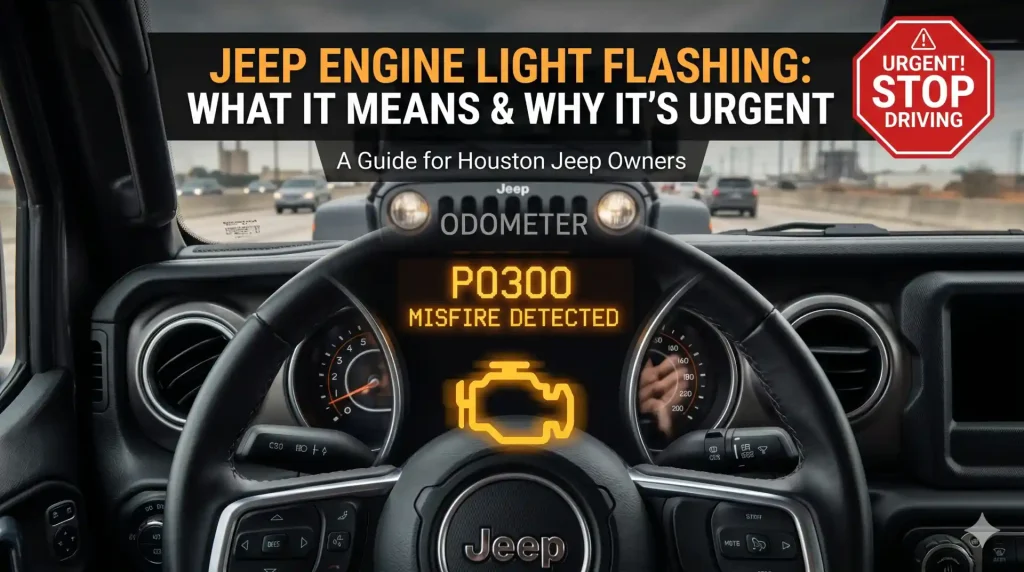
You’re on I-10, the Hardy Toll Road, or heading out of Houston toward the trails in Huntsville, and suddenly your Jeep’s check engine light starts flashing.
Not glowing steadily. Flashing.
That difference is everything. A steady check engine light means “get this checked soon.” A jeep engine light flashing means your engine is misfiring actively, right now, and you need to take it seriously before the repair bill multiplies.
This guide is written specifically for first-time Jeep owners in the Houston area. It covers exactly what a flashing engine light means, why Jeeps do it differently than other vehicles, the famous “10 blink” code, what causes it in Wranglers and Grand Cherokees, and a clear step-by-step process for what to do next.
Table of Contents
ToggleFlashing vs. Steady: The Most Important Thing to Know First
Before anything else, understand this distinction completely.
| Light Behavior | What It Means | What To Do |
| Steady amber engine light | A fault has been stored — needs attention soon | Drive carefully to a shop or get a free OBD-II scan |
| Flashing/blinking engine light | Active, severe engine misfire happening right now | Pull over safely as soon as possible — stop driving |
| Steady red oil or temp light | Oil pressure or cooling system emergency | Stop immediately — engine damage is imminent |
When your jeep’s check engine light flashes, the ECU (Engine Control Unit) is detecting that one or more cylinders are misfiring so badly that unburned fuel is being pushed into the exhaust system. That unburned fuel superheats your catalytic converter — and a destroyed catalytic converter on a Jeep Wrangler or Grand Cherokee runs $800–$2,500+ to replace.
Every mile you drive on a flashing engine light risks that damage.
The Jeep “10 Blink” Code: What It Is and Why So Many Owners Search for It
One thing that sets Jeeps apart from most other vehicles is the ability to read diagnostic trouble codes directly from the instrument cluster — no OBD-II scanner required. This is a feature built into Chrysler/FCA/Stellantis vehicles, including Jeep Wrangler and Grand Cherokee models.
How to Read the Jeep Blink Code
On most Jeep Wranglers (JK, JL) and Grand Cherokees:
- Sit in the driver’s seat with the doors closed
- Without pressing the brake, turn the ignition key (or push the start button on newer models) to the ON position three times in a row — ON, OFF, ON, OFF, ON — without starting the engine
- On the third cycle, leave the key in the ON position
- Watch the odometer display — it will show stored fault codes
- The check engine light may also blink out the codes in a sequence
When owners describe their Jeep Wrangler check engine light flashes 10 times, they are typically seeing either:
- A P1000 code (OBD-II system not ready — monitors haven’t completed) displayed as 10 blinks, OR
- Multiple fault codes are being displayed sequentially, where the total blink count reaches 10
What “10 blinks” usually means in practice:
- The most common interpretation is that the system is cycling through codes
- P1000 specifically means the OBD readiness monitors haven’t completed their drive cycles — this often appears after a battery disconnect or code reset
- In Texas, a P1000 code causes a state inspection failure even if no other faults are present
💡 Pro Tip: If you recently had your Jeep’s battery replaced, disconnected the battery yourself, or had codes cleared at a shop, the “10 blink” sequence you’re seeing is likely the system telling you it hasn’t finished running its self-tests yet. Drive the Jeep through several normal drive cycles (highway and city mix), and the monitors will complete, then recheck.
Why Is My Jeep Engine Light Flashing? The 7 Most Common Causes
1. Engine Misfire — The Primary Cause of Any Flashing CEL
A Jeep Wrangler engine light flashing or a Jeep Grand Cherokee engine light flashing situation is almost always caused by an engine misfire. This is the universal trigger for a flashing check engine light on any vehicle — and Jeeps are no exception.
According to the on-board diagnostics (OBD-II) standard, a misfire severe enough to damage the catalytic converter triggers the CEL to flash rather than glow steadily. It’s the system’s way of escalating urgency.
What a misfire feels like in a Jeep:
- Rough, uneven idle — the engine shudders instead of purring
- Stumbling or hesitation when you press the accelerator
- Loss of power, especially noticeable when pulling onto Houston’s highways
- The Jeep may shake noticeably at idle or low speed
Common misfire OBD-II codes on Jeep:
- P0300 — Random/multiple cylinder misfire
- P0301–P0308 — Specific cylinder misfire (number indicates which cylinder)
2. Worn Spark Plugs or Failing Ignition Coils
This is the most frequent root cause of Jeep misfires — and therefore the most common reason for a blinking check engine light Jeep Grand Cherokee or Jeep Wrangler blinking check engine light.
Spark plugs wear over time. When the electrode gap erodes or the plug fouls with carbon deposits, combustion becomes inconsistent. One or more cylinders misfire, and the flashing CEL follows.
Jeep-specific context:
- 3.6L Pentastar V6 (used in JK/JL Wrangler and Grand Cherokee): spark plugs recommended every 30,000–60,000 miles
- 5.7L HEMI V8 (Grand Cherokee): plugs every 30,000 miles; ignition coil failures are common on high-mileage HEMIs
- 2.0L turbo (JL Wrangler): more sensitive to spark plug condition due to turbo boost pressure
Houston’s extreme heat accelerates spark plug wear and ignition coil degradation. Under-hood temperatures in a Jeep sitting in Houston summer traffic can exceed 200°F — and that heat breaks down coil insulation over time.
⚠️ Common Pitfall: Many first-time Jeep owners replace only the misfiring cylinder’s spark plug when a code points to one cylinder. If the plugs are original and the mileage is high, replace all of them at once — replacing one worn plug among seven other worn ones is a short-term fix.
3. Fuel System Issues (Injectors, Fuel Pressure)
A clogged fuel injector delivers too little fuel to its cylinder — creating a lean misfire that triggers the jeep engine light blinking condition.
Fuel pressure problems — from a weakening fuel pump or failing fuel pressure regulator — affect multiple cylinders simultaneously and often produce a P0300 (random misfire) code rather than a single-cylinder code.
Signs of a fuel-related flashing CEL:
- Misfire codes across multiple cylinders (not just one)
- Stumbling is worse when the engine is cold
- Rough running that improves slightly once the engine warms up
- P0087 (fuel pressure too low) appears alongside misfire codes
Houston’s reformulated gasoline (required in Harris County) burns cleaner than standard fuel but can leave deposits in older injectors over time — particularly on Jeeps with 80,000+ miles that haven’t had injector maintenance.
4. Vacuum Leaks
A cracked vacuum hose or failing intake manifold gasket lets unmetered air into the engine. The ECU tries to compensate but can’t fully correct the imbalance — the mixture goes lean, combustion becomes inconsistent, and misfires follow.
What makes this common in Houston Jeeps: The temperature swings between Houston winters (40°F) and summers (100°F+) crack rubber vacuum hoses faster than in moderate climates. Jeep Wranglers that spend time off-road — including the trails at Lake Conroe and the Sam Houston National Forest north of Houston — are also exposed to debris that can puncture or dislodge vacuum lines.
How to suspect a vacuum leak:
- Rough idle that partially smooths out at higher RPM
- Flashing CEL accompanied by a P0171 or P0174 (running lean) code
- Hissing sound from the engine bay at idle
5. Catalytic Converter Issues
Here’s the irony: a flashing CEL caused by a misfire can create a catalytic converter problem if you keep driving. The converter that’s being damaged by the misfire can eventually fail to the point where it throws its own code — P0420 (Cat efficiency below threshold, Bank 1) or P0430 (Bank 2).
At that point, you’re dealing with both a misfire cause and a converter replacement — a compounding repair bill that started with something as fixable as worn spark plugs.
This is exactly why pulling over when you see a flashing check engine light jeep grand cherokee or Jeep Wrangler check engine light flashing situation is so serious.
6. EVAP System Leaks
The Evaporative Emission Control System captures fuel vapors before they escape into the atmosphere. Jeep Wranglers — particularly those with aftermarket modifications, lifted bodies, or skid plates that have been removed and reinstalled- sometimes develop EVAP system leaks from disturbed hoses and connectors.
EVAP codes (P0440–P0457) typically cause a steady CEL rather than a flashing one — but they’re worth mentioning because they’re common in Houston’s heat and because they’ll cause a Texas state inspection failure regardless of light behavior.
7. Jeep Wrangler-Specific: Death Wobble and Related Sensor Faults
This one is unique to Jeeps, particularly lifted Wranglers, and it’s especially relevant in Houston, where lifted Jeeps are extremely common.
The Wrangler’s solid front axle design, when combined with worn steering and suspension components, can develop the infamous “death wobble”, a violent side-to-side shaking at highway speeds. While the death wobble itself doesn’t directly trigger a flashing CEL, the underlying worn components can affect wheel speed sensors and ABS systems in ways that store fault codes alongside the physical symptoms.
If your Jeep is shaking violently at speed AND has a flashing or steady check engine light, you may be dealing with two separate issues that need attention at the same time.
Jeep Wrangler vs. Grand Cherokee: Are There Differences in What Causes the Flashing CEL?
Yes — the two vehicles have different engines and different common failure points.
| Jeep Wrangler (JK/JL) | Jeep Grand Cherokee | |
| Common engines | 3.6L Pentastar V6, 2.0L Turbo | 3.6L Pentastar V6, 5.7L HEMI V8, 3.0L EcoDiesel |
| The most common flashing CEL cause | Spark plugs/coils, vacuum leaks | Spark plugs/coils (HEMI), cam/lifter issues (HEMI) |
| Engine-specific issues | 3.6L cam phaser wear (high mileage) | 5.7L MDS deactivation system failures |
| Turbo issues | 2.0L boost leaks are common | Less common |
| Transmission codes | Less common on manual JKs | More common on 8-speed auto ZF8HP |
The 5.7L HEMI Grand Cherokee — Special Note
If you own a Grand Cherokee with the 5.7L HEMI V8 and you’re seeing a flashing check engine light, pay attention to this:
The HEMI’s Multi-Displacement System (MDS) deactivates four cylinders during light-load highway driving to save fuel. When MDS components — lifters, solenoids — wear or fail, they cause cylinder deactivation-related misfires. This is a known issue on high-mileage HEMI Grand Cherokees and produces misfire codes on the deactivating cylinders specifically.
The fix ranges from an MDS solenoid replacement ($300–$600) to a full lifter replacement job ($2,000–$4,000+), depending on how far the wear has progressed.
💡 Pro Tip: If you have a HEMI Grand Cherokee with over 100,000 miles and a flashing CEL with misfire codes on cylinders 1, 4, 6, or 7 specifically — those are the MDS cylinders. Get it diagnosed before assuming it’s just spark plugs.
Step-by-Step: What To Do When Your Jeep Engine Light Flashes
Step 1: Don’t Panic — But Do Act Immediately
A flashing Jeep Wrangler engine light is urgent but not instant doom. You have time to pull over safely. You do not have time to finish your commute, run one more errand, or “see if it clears up.”
Pull over to a safe location — a parking lot, a gas station, a side street. Turn the engine off.
Step 2: Check for Obvious Symptoms
Before calling a shop or driving anywhere, sit for a moment and assess:
- Is the engine running rough or shaking?
- Do you smell burning from the engine bay?
- Are any other warning lights on (oil pressure, temperature)?
- Did anything feel different before the light started flashing?
If you see a red oil pressure or temperature warning alongside the flashing CEL, do not restart the engine. Call a tow.
Step 3: Try the Ignition Key Blink Code Test
Before spending money on an OBD scanner, try the built-in Jeep blink code method:
- Key to the ON position (don’t start the engine)
- OFF
- ON
- OFF
- ON — leave it here and watch the odometer display
Write down any codes that appear. Take a photo. These codes go directly to your mechanic and save diagnostic time.
Step 4: Get a Free OBD-II Scan
If the blink code test doesn’t give you clear information, drive carefully (short distance, low speed) to the nearest AutoZone, O’Reilly, or Advance Auto Parts in Houston for a free scan. Locations along Hwy 6, Westheimer, and Hwy 290 can scan your Jeep at no charge.
The scan tells you exactly which cylinder is misfiring and what related faults are stored — turning a mystery into a specific repair list.
Step 5: Do Not Drive Hard Until the Cause Is Found
Once the light is flashing:
- Avoid highway speeds
- Avoid hard acceleration
- Skip any towing or off-road plans
- Drive only as far as necessary to reach a shop
Every mile of hard driving on a severe misfire risks catalytic converter damage. On a Jeep Grand Cherokee, a single catalytic converter replacement can run $1,200–$2,500 at a Houston shop.
Step 6: Get the Root Cause Fixed, Not Just the Code Reset
This is the most common mistake first-time Jeep owners make. They reset the code, the flashing stops, and they assume the problem is gone. It isn’t.
The underlying misfire cause — worn plugs, a bad coil, a vacuum leak — is still there. The light will return within days, often flashing again. And in Texas, a recently reset CEL means your OBD readiness monitors haven’t been completed, which is an automatic state inspection failure.
Fix the cause. Then reset.
How This Compares to Other Vehicle CEL Issues
If you’ve dealt with a Check Engine Light Flashing situation on another vehicle before, the Jeep’s behavior is largely the same — a flashing CEL always means active misfire, regardless of make. What’s different with Jeeps is the built-in blink code diagnostic system, the HEMI-specific MDS issues on Grand Cherokees, and the lifted Wrangler considerations.
If you’re comparing to a f150 check engine light situation, Ford and Jeep/Chrysler use the same OBD-II standard — the codes are universal. A P0301 means cylinder 1 misfire on both a Wrangler and an F-150. The platform-specific causes differ, but the diagnostic process is nearly identical.
Jeep CEL OBD-II Code Quick Reference
| Code | Meaning | Urgency |
| P0300 | Random/multiple cylinder misfire | High — flashing CEL |
| P0301–P0308 | Specific cylinder misfire | High — flashing CEL |
| P0351–P0358 | Ignition coil fault | High |
| P0171 / P0174 | Running lean (Bank 1 / Bank 2) | Medium-High |
| P0087 | Fuel pressure too low | Medium-High |
| P0420 / P0430 | Catalytic converter efficiency low | Medium |
| P0440–P0457 | EVAP system leak | Low-Medium |
| P1000 | OBD monitors not ready | Low (inspection issue) |
| P0700 | Transmission control fault | Medium-High |
| P0016 / P0017 | Cam/crank correlation (timing) | High |
Houston-Specific Factors That Affect Jeep CEL Issues
Houston Jeep owners face specific challenges that drivers in other markets don’t:
- Heat — Houston summers push under-hood temps to extremes that accelerate ignition coil failure, crack vacuum hoses, and degrade spark plug performance faster than moderate climates
- Lifted Jeep culture — Fort Bend County and Harris County have one of the highest concentrations of modified and lifted Jeeps in Texas. Lift kits, aftermarket exhausts, and cold air intakes can all affect CEL behavior and OBD readiness
- Off-road use — Trails at Lake Conroe, Huntsville State Park, and East Texas put Jeeps through conditions that stress ignition systems, disturb vacuum lines, and introduce moisture into components
- Texas state inspection — A flashing CEL, any stored misfire code, or a P1000 “not ready” status will all fail a Harris County or Fort Bend County emissions inspection
- Flooding aftermath — Houston’s flooding events introduce moisture into ignition systems and can cause intermittent misfires weeks after the water recedes
How Much Does It Cost to Fix a Flashing CEL on a Jeep in Houston?
| Repair | Estimated Cost (Houston) |
| Spark plug replacement (3.6L V6) | $150–$300 |
| Spark plug replacement (5.7L HEMI) | $200–$400 |
| Ignition coil replacement (per coil) | $150–$300 |
| Fuel injector cleaning | $100–$200 |
| Vacuum leak repair | $100–$400 depending on location |
| MAF sensor cleaning/replacement | $0–$350 |
| HEMI MDS solenoid replacement | $300–$600 |
| HEMI lifter replacement | $2,000–$4,000+ |
| Catalytic converter replacement | $800–$2,500 |
| Full diagnostic scan | Free–$150 |
💡 Pro Tip: Independent Jeep and Mopar specialists in the Houston area typically charge significantly less than dealership labor rates for misfire diagnosis and repair. A shop that specializes in Jeep/Chrysler platforms will diagnose HEMI and Pentastar issues faster than a general shop, which saves labor hours and money.
Common Pitfalls First-Time Jeep Owners Make
❌ Continuing to drive because “the Jeep still moves” — The issue isn’t drivability right now; it’s the catalytic converter that’s being destroyed with every mile
❌ Replacing only one spark plug when codes point to one cylinder — If the plugs are high-mileage, replace the full set; single plug replacements on worn engines are temporary fixes
❌ Resetting the code without fixing the cause — The light returns within days, the monitors reset, and you fail Texas inspection regardless
❌ Assuming a lifted Jeep’s CEL is just “a sensor thing” — Aftermarket modifications can cause legitimate misfires, not just false readings
❌ Ignoring a HEMI misfire on specific cylinders — Cylinders 1, 4, 6, 7 misfire on a high-mileage HEMI may indicate MDS failure, which gets drastically more expensive the longer it’s ignored
Frequently Asked Questions
Q: Is a flashing check engine light on my Jeep an emergency?
Yes, treat it as urgent. Pull over when it’s safe to do so and don’t drive at highway speeds or under hard load until the cause is diagnosed. Every mile risks catalytic converter damage.
Q: What does it mean when my Jeep Wrangler’s check engine light flashes 10 times?
Most commonly, it’s the built-in blink code system cycling through stored codes or displaying a P1000 “not ready” code after a battery disconnect or code reset. Use the key ON-OFF-ON-OFF-ON sequence to read the full code display on the odometer, or get a free OBD-II scan at any Houston auto parts store.
Q: Can I drive my Jeep from Houston to Galveston with a flashing engine light?
No. Highway driving with a severe misfire accelerates catalytic converter damage significantly. Get the cause diagnosed before making any highway trip.
Q: Why does my Jeep engine light flash and then go steady?
The misfire may have been severe enough to trigger the flashing threshold momentarily, then reduced in frequency. A steady light after flashing still means a stored misfire code; it hasn’t resolved, it’s just less active at that moment.
Q: Will my Jeep pass Texas inspection with a CEL on?
No. Any illuminated check engine light, flashing or steady, is an automatic inspection failure in Houston-area counties. Even a recently cleared light with incomplete readiness monitors will fail.
Final Word: A Flashing Jeep Engine Light Deserves Immediate Attention
The flashing jeep engine light situation is your vehicle’s most urgent warning, more serious than any steady light on your dashboard. It means active engine damage is occurring right now, not eventually.
The good news for Houston Jeep owners: most flashing CEL causes are fixable. Spark plugs and coils are the most common culprits, and on a 3.6L Pentastar or 5.7L HEMI, those are well-understood repairs at any qualified Jeep shop in the area.
The bad news is that every mile driven on a flashing light compounds the damage. What’s a $200 spark plug job today becomes a $1,500+ catalytic converter replacement tomorrow.
Pull over. Get it scanned. Fix the cause. Keep your Jeep on the road and off the tow truck.