
You’re sitting at a red light on I-45, rain pounding your windshield, and you notice a little icon on your dash that says “TRAC OFF” or shows a car with squiggly lines under it. Maybe you bumped a button by accident. Maybe your teenager was “just checking something.” Or maybe you’re standing in a muddy driveway in Katy, tires spinning, going nowhere, and someone tells you to “just turn off traction control.”
Whatever brought you here, you’re really asking one simple question: what does turning off traction control do, and is it safe?
You’re not alone. This is one of the most searched car questions in Texas, from the flooded streets of Houston to the icy overpasses of Amarillo. In this guide, we’ll break it down in plain English, no mechanic jargon, so you know exactly what happens, when it helps, when it hurts, and what to do if things go wrong on the road.
And if turning it off (or on) ever leads to a spin-out, a ditch, or a car that just won’t move, Texans Crown Towing is one call away at +1 (713) 929-6299, day or night, anywhere in Texas.

Traction Off Meaning: The Simple Explanation
Let’s start with the basics. Your car has a computer system called traction control. Its job is simple: keep your tires gripping the road instead of spinning freely.
When you press the gas and one or more wheels start to spin faster than the others (like on wet pavement, gravel, or ice), traction control notices instantly. It quietly reduces engine power, taps the brakes on the spinning wheel, or both, so your tires can grab the road again.
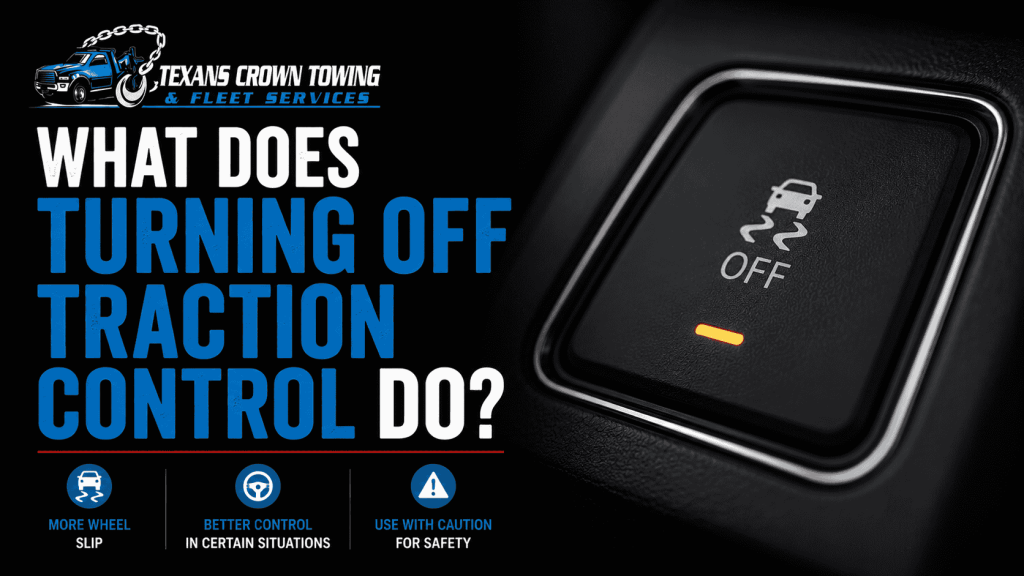
So what does “traction off” actually mean? It means you’ve turned that safety system off. Your wheels can now spin freely without the computer stepping in. The car gives you, the driver, full control of how much power reaches the ground.
Think of it like training wheels on a bike. Traction control is always quietly correcting your balance. Turn it off, and you’re riding without that backup, for better or worse.
What Does Turning Off Traction Control Do? A Closer Look
When you disable traction control, a few things change right away:
- Your tires can spin freely. The computer stops limiting wheel spin, so if you hit the gas hard, your tires can lose grip without the system correcting it.
- Power delivery feels different. Some drivers describe it as the car feeling “rawer” or more responsive, because the computer isn’t holding back engine power.
- You take over the job of managing grip. Instead of the car deciding how much power is safe, you decide, with your right foot and your steering.
- The dashboard warning light turns on. Most Texas vehicles show a “TRAC OFF” or a spinning-car icon to remind you the system is disabled.
In short, turning off traction control hands control back to you. That can be helpful in specific situations, like getting unstuck from mud or sand, but it also removes a safety net that many drivers don’t realize they’re relying on.
Does Traction Control Reduce Power?
Yes, and this is one of the most misunderstood parts of the system. Traction control doesn’t just apply brakes, it can also cut engine power the moment it senses wheel spin. This is why some drivers feel like their car is “holding back” when accelerating hard from a stoplight or merging onto I-10.
That power reduction is intentional. It’s designed to stop your tires from spinning uselessly and losing traction, especially in rain, which Houston and the Gulf Coast get plenty of. Without traction control, your engine can send full power to the wheels immediately, which is part of why some drivers feel a difference the moment they switch it off.
Does Turning Off Traction Control Make Your Car Faster?
This is where things get interesting, and where a lot of internet myths creep in.
Does turning off traction control make you faster? In a straight line, on dry pavement, from a smooth start, usually not by much. Modern traction control systems are calibrated to barely interfere when your tires already have good grip. You may not notice any difference at all in normal driving.
Does turning off traction control make your car faster in specific situations? Yes, sometimes. On loose surfaces like gravel, sand, or wet grass, or during hard acceleration where wheel spin would normally happen, disabling traction control can let your car respond faster because the computer isn’t cutting power. This is one reason some off-road drivers in rural Texas turn it off temporarily when climbing out of mud or soft dirt.
But here’s the catch: faster wheel spin isn’t the same as faster, safer driving. Spinning tires waste energy and can actually make you slower in wet or slick conditions, since you’re losing grip instead of using it to move forward.
Benefits of Turning Traction Control Off
There are a handful of real, practical reasons drivers choose to disable this system:
- Getting unstuck. If you’re stuck in mud, sand, or deep snow, traction control can actually work against you by limiting the wheel spin needed to rock the car free.
- Off-road driving. On loose gravel or rocky trails, common in the Texas Hill Country, some drivers prefer full manual control over power.
- Performance driving on a closed track. Experienced drivers sometimes disable it to feel more connected to the car’s handling, only in controlled environments.
- Installing snow chains or aggressive tires. In rare cases, traction control can conflict with certain tire setups.
Outside of these specific situations, most everyday drivers in Texas are better off leaving it on.
Why Disable Traction Control? Common Reasons Drivers Do It
Why would you turn off traction control on a normal day? Here are the most common real-world reasons:
- You’re stuck in mud, sand, or a flooded low-water crossing (a serious hazard in Houston during heavy rain).
- You’re driving on a gravel or dirt road and want more direct control.
- You want to “rock” the car back and forth to escape a ditch.
- A mechanic or tire shop advised it for a specific repair or diagnostic reason.
- Curiosity, plain and simple, after noticing the button on the dash.
If your reason isn’t one of these, it’s usually safer to keep traction control on, especially in city driving, highway merging, and rainy conditions, which Texas has in abundance.
Should I Drive With Traction Control On or Off?
For most Texas drivers, the answer is simple: keep it on.
Traction control is one of the most effective, quietly working safety systems in your car. It helps prevent skids on wet roads, reduces the risk of fishtailing during sudden lane changes, and keeps your car stable during Houston’s sudden downpours or a surprise patch of ice near Lubbock in winter.
Turn it off only when:
- You’re genuinely stuck and need extra wheel spin to get moving.
- You’re on loose terrain like sand, mud, or gravel, away from traffic.
- You know how to control wheel spin and oversteer safely.
Turn it back on as soon as you’re back on normal pavement. Driving on wet Houston freeways or busy Dallas interchanges with traction control off is not worth the risk for the average driver.
What Happens When You Turn Off Traction Control? The Risks
Here’s the honest, no-scare-tactics truth about the risks:
- Increased skid risk. Without traction control, hard acceleration on wet or slick roads can cause your rear or front wheels to lose grip suddenly.
- Harder to recover from a slide. If your car starts to slide, traction control usually helps correct it automatically. Without it, that correction is entirely up to you.
- More stress on tires. Excessive wheel spin can wear down tread faster and, in extreme cases, damage a tire.
- Reduced control in emergency maneuvers. If another driver swerves in front of you and you need to brake and steer at the same time, traction control (along with stability control) helps keep the car planted.
This is exactly the kind of situation that leads to fender benders, spin-outs, and stuck vehicles across Texas, from the flooded underpasses of Houston to icy bridges near Amarillo. If that happens to you, don’t panic and don’t try to force your way out. Call a professional.
What To Do If You Get Stuck or Spin Out (Real Fixes)
If you turned off traction control to get unstuck and now you’re really stuck, or if a slide left you off the road, here’s what to do:
- Stop and assess safely. Turn on your hazard lights, especially on busy Texas highways.
- Don’t spin the tires more. If you’re stuck, gentle, steady throttle works better than flooring it.
- Check for damage. A hard slide or curb impact can bend a wheel or damage suspension, one reason your car might shake afterward. If you’re noticing unusual vibration, our guide on why your wheel shakes when driving can help you figure out if it’s tire, alignment, or something more serious.
- Watch your dashboard. If a check engine light or “trac off” light stays on afterward, it may need a diagnostic scan. We’ve covered this in detail in our post on why your check engine and trac off light is on.
- Call for help if you can’t move safely. Trying to rock a stuck car for 20 minutes in Houston traffic isn’t worth the risk to your transmission or your safety.
If you’re still not sure how the traction control button works on your specific vehicle, our step by step post on how to take traction control off walks through it model by model.
Why This Matters More in Texas
Texas weather is unpredictable, sunny one hour and flooding the next. Houston alone sees sudden, heavy downpours that turn streets into rivers within minutes. San Antonio and Austin get sudden thunderstorms. Amarillo and the Panhandle deal with ice in winter. Add in gravel roads across rural counties, and you’ve got a state where traction control genuinely earns its keep.
Whether you’re navigating the Katy Freeway during a storm or backroads near Lubbock, understanding this system isn’t just trivia, it’s practical knowledge that can keep you safe.
When It’s Time to Call a Tow Truck
Sometimes, no matter how careful you are, a slick road, a sudden skid, or a stuck vehicle leaves you needing more than advice, you need a truck and a professional. That’s where Texans Crown Towing comes in.
We’ve helped drivers across Houston and the entire state of Texas get out of tough spots: stuck in mud after a storm, spun out on a rain-slicked highway, or simply unable to get a car moving after wheels lost grip. Our team knows Texas roads, Texas weather, and how to get you back on track safely.
If you’re stuck, stranded, or unsure whether your vehicle is safe to drive after a slide, don’t take chances. Learn more about how roadside assistance works so you know what to expect, or reach out directly.
Call Texans Crown Towing now at +1 (713) 929-6299 for fast, reliable towing and roadside help anywhere in Texas, available 24/7. You can also find a nearby tow truck near you if you need immediate assistance.
Frequently Asked Questions
What does the “TRAC OFF” light mean?
It means your traction control system has been manually turned off, or in some cases, has detected a fault and disabled itself. If the light stays on after you didn’t turn it off yourself, it’s worth getting checked.
Is it safe to drive with traction control off all the time?
No. It’s best used temporarily, like getting unstuck from mud or sand. For everyday driving, especially in rain or traffic, keep it on.
Does turning off traction control damage my car?
Not directly, but driving aggressively without it, especially with excessive wheel spin, can wear tires faster and increase the risk of an accident that causes damage.
Why is my traction control light on and my car won’t accelerate normally?
This usually points to a sensor issue or the system detecting a problem, not just it being switched off. It may need a diagnostic check.
Can I turn traction control off with a button?
Most vehicles have a button, often labeled “TCS” or “TRAC,” near the dashboard or center console. Holding it for a few seconds usually disables the system, though it varies by make and model.
Does traction control help in Houston rain?
Yes, significantly. Houston’s sudden, heavy rainfall creates slick roads where traction control actively helps prevent skids and hydroplaning-related loss of control.
What should I do if I spin out with traction control off?
Ease off the gas, avoid slamming the brakes, and steer gently in the direction you want to go. If you can’t regain control or get moving safely, call a towing professional rather than risking further damage.
Final Thoughts
So, what does turning off traction control do? It hands you full control over your car’s power and grip, useful for getting unstuck or handling loose terrain, but riskier for everyday driving, especially on Texas’s unpredictable roads. For most drivers, in most situations, keeping it on is the safer choice.
But if you ever find yourself stuck, spun out, or simply stranded anywhere from Houston to the far corners of Texas, you don’t have to handle it alone.
Texans Crown Towing is ready 24/7. Call +1 (713) 929-6299 now for fast, dependable towing and roadside assistance, wherever you are in Texas.