

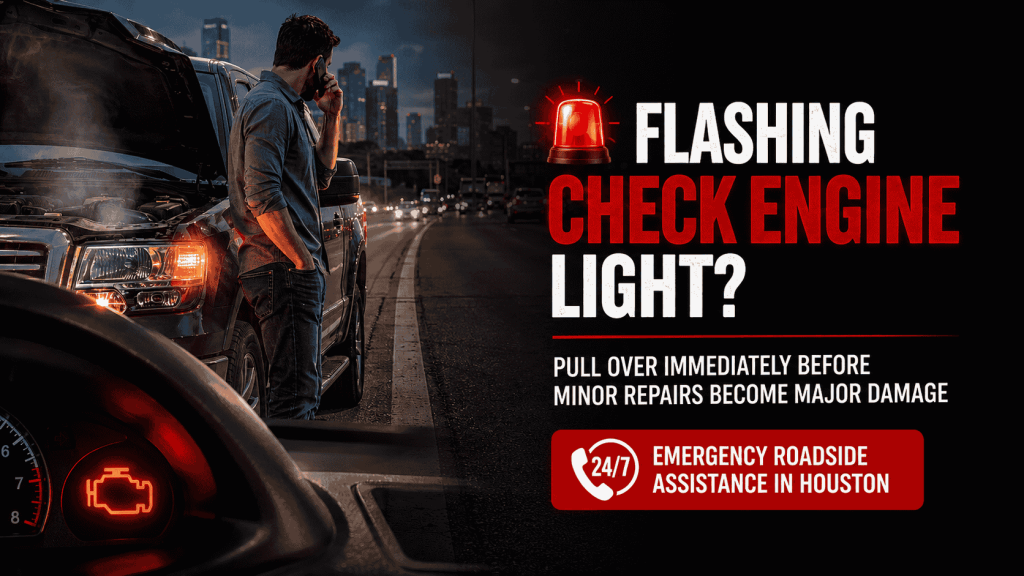
Imagine cruising down the Southwest Freeway (I-59) or navigating the chaotic merging lanes of the 610 Loop during evening rush hour when your dashboard suddenly delivers a worst-case scenario: your check engine light isn’t just glowing, it’s blinking rapidly.
For many Houston drivers, the initial reaction is to push through the traffic, try to make it home to Katy, Sugar Land, or The Woodlands, and deal with the problem over the weekend.
This is a critical mistake that could cost you thousands of dollars in irreversible engine damage.
A solid check engine light means your vehicle’s onboard diagnostics computer has detected a problem that needs attention soon. A flashing check engine light is a mechanical scream for help. It means a catastrophic failure is actively occurring under your hood right now.
If your dashboard is blinking, don’t risk a complete engine meltdown on a dangerous Houston shoulder. Turn on your hazard lights, safely move out of traffic, and call Texans Crown Towing immediately at (713) 929-6299 for fast, reliable emergency flatbed transport.
Table of Contents
Toggle
What Does a Flashing Check Engine Light Actually Mean?
When the malfunction indicator lamp (MIL) flashes continuously, it almost always indicates a severe, continuous engine misfire.
An engine misfire occurs when one or more cylinders fail to ignite the fuel-air mixture properly. When this happens, unburned raw fuel passes straight out of the combustion chamber and directly into your vehicle’s exhaust system.
[Severe Cylinder Misfire]
│
▼
[Raw Fuel Enters Exhaust]
│
▼
[Catalytic Converter Overheats (Up to 2,000°F)]
│
▼
[Meltdown & Complete Engine Failure]
Within blocks of driving on hot Texas roads, that unburned fuel will hit your catalytic converter. The converter will rapidly overheat, sometimes reaching temperatures exceeding 2,000°F. This can melt the internal honeycomb structure of the converter, completely blocking your exhaust, ruining your engine, and potentially sparking an under-hood fire.
The Most Common Causes Behind the Blink
While an engine misfire is the functional result, several underlying mechanical or electrical failures can trigger the flashing warning:
- Failing Ignition Coils: The ignition coil delivers the high-voltage surge needed to create a spark. If a coil fails completely, the spark plug cannot fire.
- Worn or Damaged Spark Plugs: Over time, the gap in your spark plugs widens, or the plug becomes fouled by oil or carbon deposits, preventing proper combustion.
- Bad Fuel Injectors: A fuel injector that is stuck wide open will flood the cylinder with too much fuel, while a clogged injector won’t supply enough, causing a severe lean or rich misfire.
- Blown Head Gasket or Compression Loss: Mechanical internal issues can cause a cylinder to lose the compression required to ignite the air-fuel mixture.
Why Driving to Your Destination Is Not an Option in Houston
Trying to “nurse” your vehicle home along the Katy Freeway or Sam Houston Tollway with a blinking engine light is an incredibly high-stakes gamble for two major reasons:
1. The Cost Scalation is Staggering
Replacing a set of spark plugs or an ignition coil is a standard, relatively affordable auto repair. However, if you keep driving and melt your catalytic converter, you are suddenly looking at a repair bill that can easily range from $1,500 to $4,000. If the unburned fuel causes severe internal engine damage or an engine fire, your car may be completely totaled.
2. The High Danger of Stall-Outs on Houston Freeways
When an engine misfires severely enough to flash the dashboard light, it is running on reduced power. If you are trying to maintain 65 MPH on I-45, your vehicle can suddenly lose all acceleration, drop into a “limp mode,” or stall completely out of nowhere. Getting stranded in a dead vehicle in the middle of active freeway lanes is an incredibly hazardous situation for you and your passengers.
Step by Step: What to Do When the Light Starts Flashing
If you see that warning light start blinking while driving around the Houston area, follow these steps to protect your safety and your wallet:
1.Get out of active traffic lanes: Immediate Action.
Signal clearly and carefully navigate across lanes toward the nearest exit or a wide, safe right-hand shoulder. Avoid stopping on narrow left shoulders next to the fast lane if possible.
2.Kill the engine: Within 60 Seconds.
Once you are safely parked in a secure location, turn off the ignition immediately. Do not leave the car idling on the shoulder while you look up mechanics, as the raw fuel will continue to cook your exhaust components.
3.Assess your surroundings: Safety Check.
Look out your mirrors before opening doors. If you are stuck on a tight highway shoulder with heavy traffic flying past, stay inside the vehicle with your seatbelt fastened and call for emergency assistance.
4.Call for a professional tow: Resolution.
Do not attempt to restart the engine to “see if it fixed itself.” Contact a professional towing provider to load your vehicle onto a flatbed and transport it safely to a certified mechanic.
Don’t Gamble with a Blown Engine — Call Texans Crown Towing
When your dashboard is flashing, every mile you drive is a ticking clock for your engine. You need a towing service that understands the urgency, knows the local Houston landscape intimately, and uses the right equipment to handle your car with absolute care.
Texans Crown Towing provides rapid-response emergency flatbed towing throughout Houston, Sugar Land, Katy, Pearland, and surrounding communities. Our licensed, professional operators are available 24/7 to get you and your vehicle off the dangerous roadside and safely to a repair facility.
Stuck on the road right now? Save your vehicle from a catastrophic breakdown. Call the dispatch team at Texans Crown Towing immediately at (713) 929-6299 for fast help.
Frequently Asked Questions (FAQ)
Can I drive with a flashing check engine light if the car feels normal?
No. Even if the vehicle runs smoothly at the moment, a flashing light indicates an active emission or engine fault that is dumping unburned fuel into your exhaust system. Driving even a few miles can permanently melt your catalytic converter.
What is the difference between a solid and a flashing check engine light?
A solid check engine light indicates an issue that needs to be diagnosed soon (like a loose gas cap or an O2 sensor error) but is safe to drive home or to a shop. A flashing light indicates a severe, current misfire that requires you to pull over and shut off the engine immediately.
Will a flashing check engine light turn off on its own?
Sometimes a flashing light will turn solid or turn off if the misfire is intermittent. However, this does not mean the problem is resolved. The underlying mechanical or electrical fault remains trapped in the computer’s memory and will happen again, risking sudden stall-outs.
How much does it cost to fix the issue causing the flashing light?
The cost depends entirely on what caused the misfire. If it is a bad spark plug or ignition coil, repairs can be relatively inexpensive ($150 to $400). However, if you continue driving with the light flashing and damage the catalytic converter, repair costs can quickly skyrocket past $2,000.