

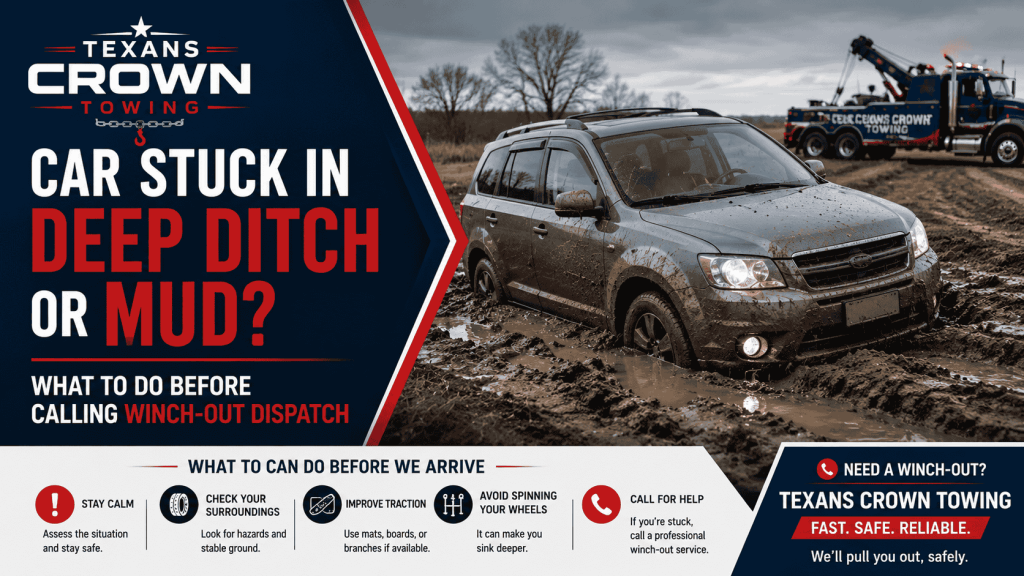
Your stomach drops. One second you’re driving down a rain-soaked backroad outside Houston, and the next, your tires are spinning, mud is flying, and your car isn’t going anywhere. Maybe you slid off the shoulder during a storm. Maybe you took a shortcut through a field that looked solid but wasn’t. Either way, you’re stuck, you’re stressed, and you’re not sure what to do next.
Take a breath. You’re not the first Texan this has happened to, and you won’t be the last. Between heavy spring rains, flash floods, and soft shoulders on rural highways, getting a car stuck in deep mud or a ditch is one of the most common roadside emergencies across the state, from Houston’s low-lying streets to the backroads of Lubbock and San Antonio.
This guide walks you through exactly what to check, what to try, and what to avoid before you call for professional winch-out help. Getting this right can save you time, money, and a lot of frustration. Getting it wrong can turn a simple recovery into a much bigger repair bill.
Table of Contents
ToggleWhy Cars Get Stuck in Mud and Ditches So Often in Texas
Texas weather doesn’t do anything halfway. When it rains, it often pours, and the ground can go from dry and firm to soft and swallowing in a matter of hours. A few reasons this happens so often across the state:
- Heavy, sudden rainfall turns shoulders, fields, and unpaved roads into soft traps, especially in the Houston area where drainage is already a challenge.
- Clay-heavy soil, common throughout Central and East Texas, becomes extremely slick and sticky when wet, unlike sandier soil that drains faster.
- Construction zones and rural roads often have loose gravel or freshly graded dirt shoulders that look solid but give way under weight.
- Low water crossings, a well-known hazard in Texas, can hide deep ruts or soft mud underneath moving water.
Whatever the cause, once your tires sink past a certain point, spinning them only digs you in deeper. That’s where most people start to panic, and where a few smart moves can make all the difference.
Step 1: Stop Spinning Your Wheels (Literally)
The single biggest mistake drivers make is flooring the gas the moment they feel resistance. It feels instinctive, but it’s the fastest way to dig your tires deeper into the mud and pack it tighter around them.
Instead:
- Take your foot off the gas immediately.
- Put the car in park (or neutral for manual transmissions) and turn off traction control if your dashboard shows it’s engaged, since it can actually work against you in loose mud by cutting power right when you need a steady, controlled input.
- Get out and assess the situation before you try anything else.
Step 2: Check How Deep and How Stuck You Really Are
Before you try to drive out, walk around the vehicle and look at:
- How deep the tires are sunk. If mud is up past the hubcaps or touching the bottom of the car, you’re likely dealing with a situation that needs a winch, not a push.
- What’s under the tires. Wet clay, standing water, or a soft ditch bottom all behave differently than loose dirt.
- The angle of the vehicle. If your car is leaning into a ditch at a steep angle, there’s a real risk of it tipping or sliding further if you rock it too aggressively.
- What’s nearby. Note any drop-offs, water, traffic, or utility lines. Your safety comes first, always.
If your car is tilted, resting on its undercarriage, or the ditch is deep and steep, this is the point to stop trying DIY fixes and call a professional recovery team. Some situations genuinely need an off road recovery towing in Houston crew with the right winch, cable angles, and experience to pull a vehicle out without damaging the frame or flipping it further into the ditch.
Step 3: Safe DIY Techniques to Try (When It’s Not Too Deep)
If your car is only lightly stuck, a few tried-and-true methods might get you moving again without any special equipment.
Improve Traction Under the Tires
Loose material under the tires is often the whole problem. Try placing:
- Floor mats, cardboard, or a section of an old tarp under the drive tires
- Sand, kitty litter, or gravel if you happen to have any
- Sticks, branches, or rocks wedged in front of the tires for grip
Rock the Vehicle Gently
Shift between drive and reverse in short, gentle bursts (not aggressive gas) to slowly rock the car and build a bit of momentum. Go easy. This works best when combined with the traction materials above.
Reduce Tire Pressure Slightly
Lowering tire pressure a little increases the tire’s surface contact with the ground, which can help in mud or sand. Just remember to re-inflate as soon as you’re safely out, since driving far on low pressure can damage the tire.
Use a Traction Board or Recovery Strap (If You Have One)
If you regularly drive rural roads or expect bad weather, keeping a set of traction boards or a tow strap in your trunk is one of the smartest, cheapest investments you can make.
A quick word of caution: if none of this works after two or three careful attempts, stop. Continuing to spin your tires or force the car can damage your transmission, overheat your engine, or bury you even deeper.
What NOT to Do (Common Mistakes That Make It Worse)
- Don’t gun the engine. It digs you deeper and can overheat your transmission.
- Don’t attach a strap to plastic bumpers or trim. They’re not built for towing loads and can snap off, sometimes dangerously.
- Don’t have a friend push from behind while you’re at the wheel spinning tires. Flying mud, sudden movement, and a spinning tire near someone’s hands or legs is a real injury risk.
- Don’t attempt a self-recovery near standing water or a steep drop-off. Ditches can be deceptively deep, and rushing water is far more powerful than it looks.
- Don’t ignore warning lights or a burning smell. That’s your car telling you to stop immediately.
When It’s Time to Call a Winch-Out Professional
Some situations simply aren’t DIY-friendly, and there’s no shame in that. It’s time to call for professional help when:
- Your vehicle is sunk past the wheels or resting on the frame
- You’re on a slope, near water, or close to traffic
- Your attempts at rocking or adding traction haven’t worked after a couple of tries
- You’re stuck at night, alone, or in an unfamiliar area
- The ditch is on private property, a rural road, or off the beaten path
A trained recovery team brings the right winch, cables, snatch blocks, and know-how to pull your car out at the correct angle, protecting your frame, suspension, and tires from further damage. This is especially true for off road recovery towing in Houston, where soft clay soil and sudden downpours mean recovery crews handle this exact situation on a regular basis.
What a Professional Winch-Out Actually Involves
Understanding the process can ease some of the worry:
- Assessment. The technician evaluates the depth, angle, and terrain before attaching anything.
- Safe anchor points. Cables or straps are attached to the vehicle’s frame or designated tow points, not bumpers or axles.
- Controlled winching. The vehicle is pulled out slowly and steadily, avoiding sudden jerks that could cause more damage or shift the car unpredictably.
- Post-recovery check. A quick inspection for undercarriage damage, fluid leaks, or anything knocked loose during the incident.
This is very different from a standard tow, and it’s why it’s worth calling a company experienced specifically in mud, ditch, and off-road recoveries rather than a general dispatch line.
How Texans Crown Towing Handles Mud and Ditch Recoveries
At Texans Crown Towing, we get calls like this constantly, especially after Houston’s heavy rains and flash floods. Our crews are equipped with heavy-duty winches, recovery straps, and the experience to handle everything from a car gently stuck on a soft shoulder to a truck buried axle-deep in a rural ditch.
We know Texas roads because we’re Texans ourselves. From Houston’s flood-prone streets to backroads across the state, our team shows up with the right equipment and a calm, careful approach that protects your vehicle from further damage. If you want to see how our broader vehicle recovery process works beyond just mud and ditches, our team breaks it down in this guide to vehicle recovery services.
We also know that being stuck isn’t just inconvenient, it’s stressful, especially if it’s dark, raining, or you’re not familiar with the area. That’s why our dispatch team works to get a truck to you quickly and keeps you updated the whole way.
Don’t Risk More Damage. Call the Pros.
If you’ve tried the safe DIY steps and you’re still stuck, or if your car is in a spot where DIY recovery just isn’t safe, stop right there. Trying to force it further can turn a simple mud recovery into an expensive repair bill for your transmission, suspension, or frame.
Texans Crown Towing is available across Houston and the rest of Texas for fast, careful winch-out and off-road recovery. Our crews handle deep ditches, muddy fields, flooded shoulders, and everything in between, with the equipment and experience to get you out safely the first time.
📞 Call now: +1 (713) 929-6299
We’re ready around the clock, because mud and ditches don’t wait for business hours, and neither do we.
Frequently Asked Questions
How do I get my car out of a deep ditch by myself?
If the ditch isn’t too deep, you can try improving traction under the tires with floor mats, sand, or gravel, then gently rock the car between drive and reverse. If the car is sunk past the wheels, resting on the frame, or on a steep angle, stop and call a professional winch-out service instead of risking further damage.
Will insurance cover a tow if my car gets stuck in mud?
Many auto insurance policies with roadside assistance coverage do include towing and recovery for a vehicle stuck in mud or a ditch, though coverage varies by provider and policy type. It’s worth checking your specific policy, but Texans Crown Towing can also work directly with you on cost and payment options regardless of your coverage.
Can spinning my tires in mud damage my car?
Yes. Spinning your tires generates heat that can damage the transmission, and it also digs the tires deeper into the mud, making the situation worse. If gentle rocking doesn’t free the car within a couple of tries, it’s time to stop and call for a winch-out.
What’s the difference between towing and a winch-out recovery?
Standard towing moves a vehicle that’s already accessible, like one parked on a road or in a lot. A winch-out recovery is used when a vehicle is stuck in mud, sand, a ditch, or off-road terrain and needs to be pulled free using a winch and cable before it can be towed anywhere.
How much does a winch-out or mud recovery cost in Texas?
Pricing depends on how deep the vehicle is stuck, the terrain, and how much equipment and time the recovery takes. For a general idea of typical towing and recovery pricing across the state, see this breakdown of towing costs in Texas, and call Texans Crown Towing directly for an accurate quote on your specific situation.
Is it safe to have someone push my car out of mud?
It can be risky. A spinning tire can kick up mud, rocks, or debris, and a car that suddenly breaks free can lurch forward unexpectedly. If you do have help, make sure anyone pushing stays well clear of the tires and only pushes while the car is moving slowly and steadily, not while tires are spinning in place.
Stuck in mud, sand, or a ditch anywhere in Houston or across Texas? Texans Crown Towing offers fast, professional off-road recovery and winch-out service. Call +1 (713) 929-6299 any time, day or night.