

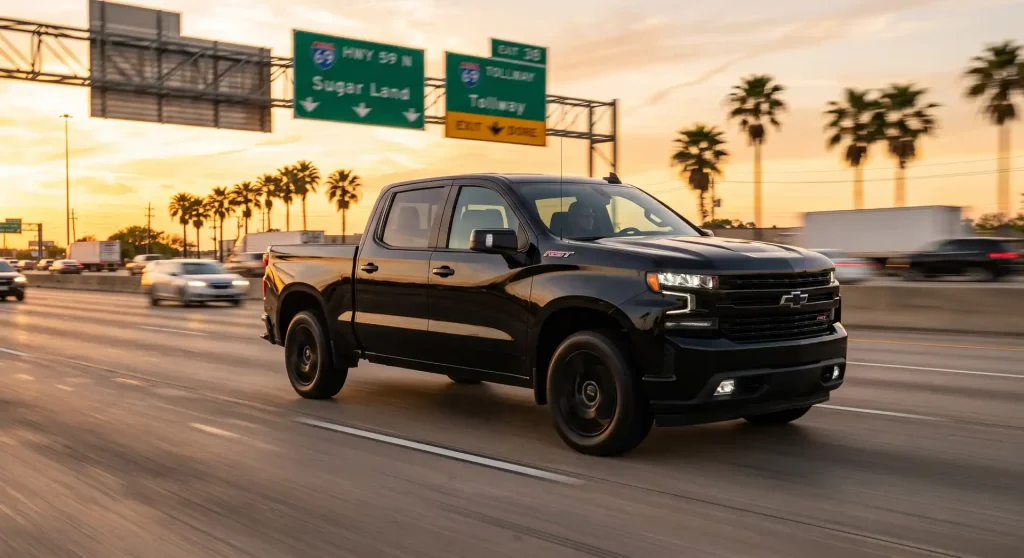
Merging onto I-69 during morning rush hour or navigating open stretches near Sugar Land requires dependable throttle response. Whether you are hauling gear down Grand Parkway or cruising home from First Colony, knowing the exact Chevrolet Silverado top speed gives you a clear picture of what your pickup can safely do on Texas highways.
Many truck owners assume that having a massive 6.2L V8 under the hood means their truck can hit 130 MPH or more. In reality, modern trucks are electronically governed far below their raw horsepower potential.
In this comprehensive guide, we will break down the true Chevy Silverado top speed across different trim levels and trim options, explain why factory limiters exist, and share essential safety advice for local drivers.
Table of Contents
ToggleThe Quick Answer: How Fast Can a Chevy Silverado Go?
In stock factory condition, the electronic speed governor caps the standard Chevrolet Silverado top speed between 98 MPH and 112 MPH across most half-ton 1500 trims.
Here is a quick snapshot of the speed limits set by General Motors across various configurations:
- Standard Silverado 1500 (V6, 2.7L Turbo, 5.3L V8): Governed at approximately 98 MPH to 106 MPH
- Silverado 1500 with 6.2L V8 / RST Performance Package: Governed up to 112 MPH
- Silverado ZR2 (Off-Road Package with All-Terrain Tires): Governed at approximately 98 MPH
- Silverado 2500HD / 3500HD Heavy-Duty Models: Governed between 98 MPH and 105 MPH
If you want to see how these velocity caps tie into specific factory engine packages, take a close look at our guide covering 2020 Chevy Silverado engines to understand how power delivery translates to real-world highway performance.
Why Is the Chevy Silverado Top Speed Limited?
It might feel frustrating to press the gas pedal on a 420-horsepower truck and feel the power cut out around 100 MPH. However, General Motors installs these electronic governors for critical engineering and safety reasons.
Tire Speed Ratings and Heat Buildup
The primary bottleneck for truck speed is tire design. Standard all-season and all-terrain truck tires carry speed ratings like “S” (up to 112 MPH) or “T” (up to 118 MPH). Pushing heavy trucks past these ratings causes rapid friction heat buildup, drastically increasing the risk of high-speed tire blowouts.
Aerodynamics and High-Speed Stability
Full-size pickup trucks are shaped like brick walls compared to sleek sports cars. At speeds above 100 MPH, aerodynamic lift increases on the front axle, making steering feel light and imprecise. GM limits speed to ensure drivers maintain full steering control.
Driveshaft Vibration and Driveline Stress
The long steel or aluminum driveshaft connecting your transmission to the rear axle turns at extremely high RPMs. If the truck exceeds factory speed thresholds, critical vibration harmonics can snap the driveshaft or crack the transmission tail housing.
Chevy Silverado Top Speed and Performance Specs by Trim
Different trims pair distinct rear axle ratios, wheel sizes, and suspension setups. The table below outlines how top speeds and acceleration figures compare across the lineup.
| Silverado Trim & Engine | Governed Top Speed | 0 to 60 MPH Time | Primary Mechanical Limiting Factor |
| Custom / LT (2.7L Turbo) | ~98 MPH | ~6.8 seconds | Factory All-Season Tire Speed Rating |
| LT / RST (5.3L V8) | ~98 – 106 MPH | ~6.1 seconds | Factory Governor & Driveshaft RPM Limits |
| RST / High Country (6.2L V8) | ~112 MPH | ~5.4 seconds | Electronic Governor Cap |
| ZR2 Off-Road (6.2L V8) | ~98 MPH | ~5.7 seconds | Goodyear Wrangler Territory MT Tires |
| 2500HD Heavy Duty (6.6L Duramax) | ~98 MPH | ~6.5 seconds | Gross Vehicle Weight & Heavy Axle Assembly |
Step-by-Step Diagnostic Routine for High-Speed Steering Instability
If your Silverado feels unstable, vibrates, or pulls dangerously when driving at Texas highway speeds (65 to 80 MPH), follow this structured inspection routine.
Step 1: Measure Tire Inflation Pressures Cold
Check all four tires using an accurate digital pressure gauge before driving. Under-inflated tires flex heavily at high speeds, generating excess heat and causing the rear end to feel floaty or loose.
Step 2: Inspect Wheel Weights and Rim Runout
High-speed steering wheel wobble usually stems from dynamic tire imbalance. Inspect your inner and outer wheel rims for missing clip-on weights or heavy mud buildup after off-roading.
Step 3: Check Suspension Bushings and Tie Rod Ends
Raise the front axle on heavy-duty jack stands. Grab each front tire at the 3 o’clock and 9 o’clock positions and shake firmly. Any clunking play points to worn outer tie rod ends or loose steering rack mounts.
Step 4: Inspect the Driveshaft Universal Joints
Crawl underneath the truck and grab the main rear driveshaft near the transfer case output. Twist it side-to-side. Loose or binding U-joints cause severe drivetrain vibration that peaks between 60 MPH and 80 MPH.
High-Speed Driveability Symptom, Cause, and Action Matrix
This guide connects high-speed driving symptoms with their underlying causes and remedies.
| High-Speed Driving Symptom | Probable Cause | Corrective Repair Action |
| Steering wheel shakes above 65 MPH | Front wheel assembly out of balance | Road-force wheel balancing at a tire shop |
| Body hums or buzzes through seat floor | Worn driveshaft U-joint or carrier bearing | Replace universal joints and rebalance shaft |
| Vehicle wanders across highway lanes | Worn upper control arm ball joints | Install new upper control arms and align |
| Brake pedal pulses violently when slowing from 70 MPH | Warped front brake rotors | Replace front rotors and heavy-duty brake pads |
Common Pitfalls to Avoid Regarding Top Speed Modifications
Attempting to force your truck past its factory limitations can lead to serious mechanical failures and voided warranties.
- Bypassing Governors with Handheld Tuners: Using aftermarket tuners to remove the speed limiter without changing hardware is dangerous. Keeping the factory driveshaft and basic tires while running 120+ MPH risks total drivetrain failure.
- Installing Under-Rated Tires: Buying cheap replacement tires with lower speed ratings (like “Q” rated tires maxing out at 99 MPH) compromises safety, even if your truck engine can go faster.
- Ignoring High-Speed Braking Distances: A 5,500-pound truck traveling at 100 MPH requires more than double the stopping distance of a standard sedan. High-speed emergency stops quickly overheat stock brakes.
High-Speed Safety and Mechanical Urgency Guide
Never ignore unusual noises, vibrations, or dashboard warnings when operating a heavy pickup at highway speeds.
| Warning Sign / Symptom | Urgency Level | Driver Action Required |
| Severe Steering Wobble (“Death Wobble”) | Critical Emergency | Slow down immediately, activate hazard lights, and pull onto the shoulder safely |
| Flashing Check Engine Light at Highway Speed | Critical Emergency | Reduce speed immediately, exit traffic, and turn off the engine to protect converters |
| High-Speed Brake Pedal Pulsation | Medium Urgency | Avoid sudden hard stops; schedule brake rotor inspection within 48 hours |
| Continuous Rear-End Vibration Above 60 MPH | High Urgency | Avoid high speeds until driveshaft and rear differential are inspected |
Estimated High-Speed Component Repair and Service Costs
Maintaining high-speed stability requires keeping your steering, suspension, and driveline components in peak condition.
- Road-Force Four-Wheel Balancing: $80 to $150 (Smooths out high-speed wheel vibration)
- Complete Front-End Wheel Alignment: $120 to $220 (Corrects highway lane-wandering issues)
- Driveshaft Universal Joint Replacement: $250 to $450 (Includes parts and shop labor)
- Upgraded Performance Brake Rotors and Pads: $600 to $950 (Improves high-speed stopping power)
Local Texas Driving Realities for Sugar Land Truck Owners
Driving in Fort Bend County exposes your truck to unique high-speed conditions. With open speed limits reaching 75 MPH on regional tollways and fast-moving traffic along I-69, your truck operates at higher sustained speeds than in many other parts of the country.
Subtropical Texas heat places extreme demands on your tires. Pavement surface temperatures along Highway 6 can easily exceed 130°F during summer afternoons. Combining extreme road surface heat with high highway speeds accelerates tire degradation and increases the risk of tread separation.
Additionally, heavy rain showers create sudden standing water risks on highway lanes. Driving a tall truck near its top speed during rain greatly increases the risk of hydroplaning on uneven road surfaces.
Pro Tip #1: Check Your Spare Tire Rating
If you suffer a flat tire on I-69, remember that your factory full-size spare tire might carry a lower speed rating than your custom road tires. Never drive above 65 MPH on a temporary or aged spare tire.
Pro Tip #2: Account for Texas Heat Friction
Before heading out on long summer road trips across Texas, set your cold tire pressures early in the morning. As highway speeds elevate internal tire temperatures, pressure rises by 4 to 6 PSI. Proper cold inflation prevents over-pressurization on hot asphalt.
Frequently Asked Questions
Can you remove the top speed governor on a Chevy Silverado?
Yes, aftermarket engine tuning software can disable or increase the factory speed governor setting. However, doing so without upgrading your tires, driveshaft, and suspension components creates severe safety risks and voids your GM powertrain warranty.
Why does my Silverado cut power around 98 MPH?
The engine computer (ECM) cuts fuel and ignition timing when output reaches the preset speed threshold. This prevents the truck from exceeding the speed rating of its factory tires and protects the driveshaft from dangerous rotational forces.
What is the fastest factory Chevy Silverado ever built?
The 2022+ Silverado RST equipped with the 6.2L V8 and performance package is among the fastest modern production models, reaching 60 MPH in roughly 5.4 seconds with a factory-governed top speed of 112 MPH.
Does towing lower the top speed governor?
The electronic speed governor threshold remains the same when towing. However, Chevrolet strongly recommends keeping towing speeds under 65 MPH to maintain vehicle stability and prevent trailer sway.
How does tire size affect top speed readings?
Installing larger aftermarket tires without recalibrating your speedometer causes your dash to read slower than your actual speed. You may hit the electronic speed limiter at a lower dash reading because the wheels are turning fewer revolutions per mile.
Safe, Smooth Driving for Sugar Land Truck Owners
Understanding your truck’s mechanical limits allows you to enjoy its power safely while protecting your investment. Keeping your steering, tires, and driveshaft in peak condition ensures that whether you are commuting locally or cruising Texas highways, your ride remains stable and controlled.
If high-speed vibration, flat tires, or sudden mechanical issues leave your truck disabled along I-69 or Grand Parkway, you do not have to handle it alone. Reach out to Texans Crown Towing for fast, friendly roadside assistance and local towing services tailored for Sugar Land truck drivers.