

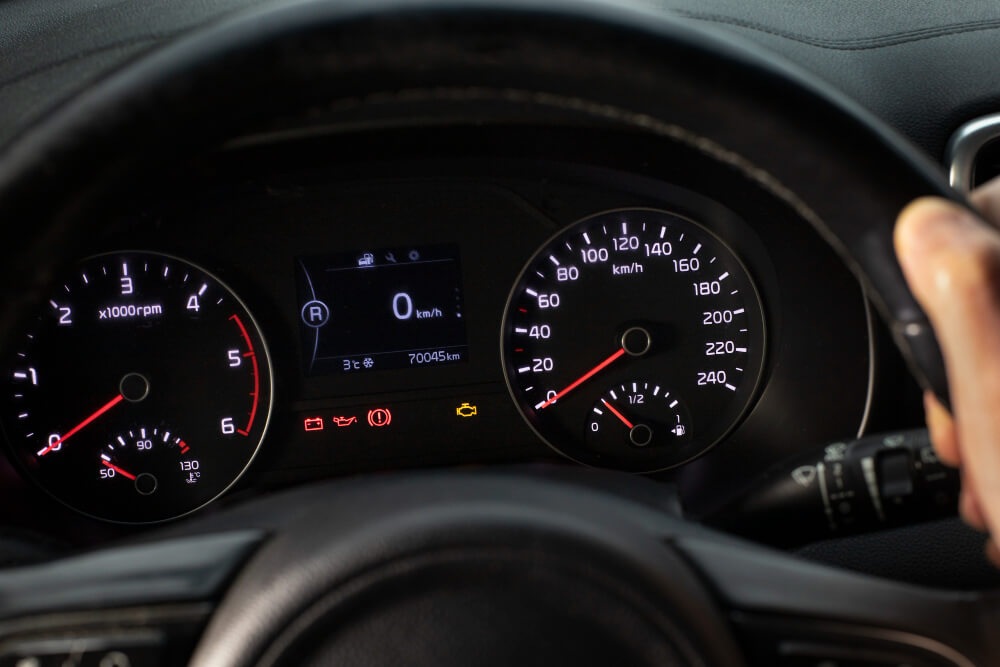
You’re cruising down I-10 in Houston, you press the gas pedal, and suddenly — the check engine light starts flashing. Not just glowing. Blinking. Your stomach drops. Is this serious? Can you keep driving? Will your car break down on the highway?
If your check engine light blinks when accelerating, this is your car screaming for help. Unlike a steady glow, a blinking check engine light means something is actively going wrong right now — not just a sensor issue you can ignore for a week. This is one of those moments where acting fast can save you from a very expensive repair bill, or worse, being stranded on the side of a Texas highway.
In this guide, we’ll walk you through exactly why this happens, what it means for your specific vehicle, what the risks are if you keep driving, and what steps to take. Whether you’re in Houston, Dallas, San Antonio, Austin, or anywhere else in the Lone Star State, this information applies to you.
Table of Contents
ToggleWhat Does It Mean When the Check Engine Light Flashes While Accelerating?
Most drivers know the check engine light as that orange glow that comes on and stays on. That version is a “soft” warning — important, but not immediately critical. A flashing check engine light while accelerating is a completely different animal.
When the check engine light flashes when accelerating, your vehicle’s onboard diagnostic system (OBD-II) has detected an active engine misfire. That means one or more of your cylinders is failing to fire properly — and it’s happening right now, every time you step on the gas.
The reason this matters so much is what happens downstream. When your engine misfires repeatedly, unburned fuel gets pushed into the exhaust system and into your catalytic converter. The catalytic converter is not designed to handle raw fuel. It will overheat. And a damaged catalytic converter costs anywhere from $800 to $2,500+ to replace — one of the most expensive repairs a car owner can face.
So when drivers ask “why does my check engine light flash when I accelerate?” — the answer almost always involves misfires and the risk of serious secondary damage.
7 Most Common Reasons Your Engine Light Comes On When Accelerating
Understanding the root cause helps you make smarter decisions. Here are the most common culprits behind a check engine light flashing when accelerating:
1. Worn or Faulty Spark Plugs
Spark plugs are small, cheap, and incredibly important. They ignite the air-fuel mixture in each cylinder. When they wear out or fail, they misfire — especially under load, like when you’re accelerating.
Signs: Rough idle, poor fuel economy, sluggish acceleration.
Fix: Replacing spark plugs usually costs $100–$300 depending on your vehicle. It’s one of the most affordable fixes on this list.
2. Bad Ignition Coils
Each spark plug has an ignition coil that sends it a high-voltage charge. If one coil fails, that cylinder misfires every single time. You’ll often notice the engine light comes on when accelerating and the car feels rough or shaky.
Signs: Rough running, loss of power, sometimes a P0300–P0308 diagnostic code.
Fix: Individual coil replacement runs $150–$400 per coil, parts and labor included.
3. Clogged or Failing Fuel Injectors
Fuel injectors spray the exact right amount of fuel into each cylinder. When they get dirty or fail, the fuel mixture gets thrown off. Your car becomes a car struggling to accelerate with check engine light glowing or flashing.
Signs: Hesitation on acceleration, rough idle, poor MPG.
Fix: Injector cleaning runs $50–$100. Full replacement can be $300–$600+.
4. Low Compression in One or More Cylinders
This is a more serious issue. If a cylinder has low compression due to worn piston rings, a damaged valve, or a head gasket issue, it won’t fire properly. The engine light blinks when you accelerate because the problem gets worse under load.
Signs: Significant power loss, oil consumption, white or blue exhaust smoke.
Fix: This one ranges from $500 to $2,000+ depending on the cause.
5. Vacuum Leaks
Your engine relies on a sealed system of hoses and gaskets to maintain proper air pressure. A cracked vacuum hose throws off the air-fuel ratio, causing misfires — particularly when acceleration demands more air and fuel.
Signs: Hissing sound from the engine, rough idle, engine light flashes when accelerating.
Fix: Vacuum hose replacement is usually inexpensive ($100–$300), but finding the leak requires a professional.
6. Mass Airflow Sensor (MAF) Failure
The MAF sensor tells your engine’s computer how much air is coming in so it can calculate the right amount of fuel to inject. A dirty or failing MAF sensor causes an incorrect reading — lean or rich fuel mixture — leading to misfires under acceleration.
Signs: Hesitation, stalling, poor fuel economy, check engine light comes on when accelerating.
Fix: MAF sensor cleaning is cheap ($10–$20 DIY). Replacement is $150–$400.
7. Catalytic Converter Problems
If your catalytic converter is already partially clogged or damaged, it creates back pressure in your exhaust system. This makes your engine work harder and can trigger misfires when you try to accelerate.
Signs: Rotten egg smell, significantly reduced power, engine light flashes when accelerating.
Fix: Catalytic converter replacement is expensive — typically $800–$2,500+. This is why catching misfires early matters so much.
Chevy Silverado & Dodge Ram Owners: Pay Special Attention
Two of the most popular trucks in Texas — and two of the most common vehicles we see with this exact issue.
Chevy Silverado Check Engine Light Flashing When Accelerating
The Chevy Silverado check engine light flashing when accelerating is often caused by worn spark plugs or faulty ignition coils. Silverados, especially the V8 models, are notorious for coil failures on high-mileage engines. The 5.3L and 6.2L V8 engines are particularly susceptible after 80,000–100,000 miles.
If you’re driving a Silverado in Texas and notice the flash while towing or hauling — stop. The added load from towing makes misfires dramatically worse and can destroy your catalytic converter in minutes.
Dodge Ram 1500 Check Engine Light Flashing When Accelerating
The Dodge Ram 1500 check engine light flashing when accelerating often points to HEMI tick issues, spark plug failures, or problems with the Multi-Displacement System (MDS) on V8 models. The MDS system deactivates cylinders under light load — and when those cylinders have worn plugs or coils, the transition can trigger misfires and a flashing CEL.
Ram owners should also check for fuel injector issues, particularly on higher-mileage 3.6L Pentastar V6 models.
Why Does My Check Engine Light Blink When I Accelerate — But Not at Idle?
This is one of the most common questions we hear. The answer is simple: acceleration puts more stress on your engine.
At idle, your engine is doing the bare minimum — low RPM, low demand. The misfire might be small enough that your car’s computer doesn’t flag it immediately. But when you press the gas pedal, the engine needs more fuel, more air, and perfectly timed ignition. A weak spark plug or marginal injector that barely gets by at idle will fail under load.
That’s why the engine light comes on when accelerating — not during light driving. The problem exists at all times, but the flash is the computer’s way of saying: “This just got bad enough to damage the catalytic converter.”
Is It Safe to Drive With a Flashing Check Engine Light?
No. This is not a situation where you keep driving and “get it checked when you have time.”
A blinking check engine light — especially one that blinks when accelerating — means:
- Active misfires are happening right now
- Your catalytic converter is potentially being destroyed with every mile you drive
- Your car could stall suddenly at highway speed
- You risk being stranded, especially on Texas highways like I-45, I-35, or US-59
If the light is flashing, pull over safely when you can. Reduce your speed. Do not push the engine hard. Call a mechanic or a towing service immediately.
Important: A steady glow is serious but less urgent. A flashing check engine light is a red alert. The difference matters.
For a broader look at all the reasons your check engine light might be flashing — not just during acceleration — check out our full guide on the check engine light flashing pillar page. It covers everything from blinking patterns to what specific error codes mean for Texas drivers.
What Happens If You Ignore a Flashing Check Engine Light?
Let’s be direct about the cost of ignoring this warning:
Short-term (days): Reduced fuel economy, rough driving, possible stalling.
Medium-term (weeks): Catalytic converter damage begins. At $800–$2,500 for replacement, this alone makes early action worth it.
Long-term (months): Engine misfires can damage cylinder walls, pistons, and valves. You’re now looking at a potential engine rebuild — anywhere from $3,000 to $8,000+. Or a new vehicle entirely.
In Texas heat, engines also run hotter. A misfiring engine in Houston’s summer heat is under more stress than in a cooler climate. What might be a manageable issue elsewhere can escalate quickly here.
Step-by-Step: What to Do Right Now
If your check engine light is blinking when you accelerate, here’s exactly what to do:
Step 1: Don’t panic — but don’t ignore it either. Stay calm, reduce speed, and avoid hard acceleration.
Step 2: Pull over safely if the light is actively flashing. Find a safe spot to stop. A Texas highway shoulder is better than a blown catalytic converter or stalled engine in traffic.
Step 3: Turn off the engine and let it cool. Wait 10–15 minutes. Check for anything obviously wrong — steam, smoke, unusual smells.
Step 4: Don’t try to drive to a mechanic if the car is running rough. If the car feels rough, shaky, or is losing power, do not drive it. Call for a tow.
Step 5: Get a diagnostic scan. Any mechanic or auto parts store (like AutoZone or O’Reilly) can plug in an OBD-II scanner and pull the trouble codes. This tells you exactly which cylinder(s) are misfiring and what the likely cause is.
Step 6: Get the repair done promptly. Once you know the code, don’t delay the fix. The longer misfires continue, the worse the damage gets.
When to Call a Tow Truck Instead of Driving
There are situations where driving — even slowly to a mechanic — is the wrong call:
- The check engine light is flashing and the car is shaking badly
- You notice a burning smell or see smoke
- The engine is making unusual noises (knocking, popping, clunking)
- The car struggles to maintain speed or stalls
- You’re on a highway or in heavy traffic with no safe exit nearby
In these situations, calling a trusted towing service is the safest and most cost-effective move. Driving a misfiring vehicle can turn a $300 repair into a $3,000 one.
🚨 Stranded in Texas? Call Texans Crown Towing — Available 24/7
When your check engine light is flashing and your car isn’t safe to drive, Texans Crown Towing is the name Houston drivers trust.
We provide fast, reliable towing service across the Greater Houston area and throughout Texas, including Harris County, Fort Bend County, Montgomery County, Galveston County, and beyond.
Why Texas drivers choose us:
- ✅ 24/7 emergency towing — we’re always available
- ✅ Fast response times — even on Houston highways and interstates
- ✅ Flatbed and wheel-lift towing for all vehicle types
- ✅ Trusted by families, fleets, and businesses across Texas
- ✅ Transparent pricing — no surprise fees
Whether you’re stuck on I-10, I-45, the 610 Loop, the Grand Parkway, or anywhere in Texas, we’ll get to you fast and get your vehicle to the mechanic safely.
📞 Call or Text Now: +1 (713) 929-6299
Don’t risk further engine damage by driving a car that’s warning you to stop. Let us handle the tow — you handle the peace of mind.
Frequently Asked Questions
What does it mean when my check engine light blinks when I accelerate?
A blinking check engine light during acceleration typically means your engine is actively misfiring — one or more cylinders are not firing correctly. This is different from a steady glow. A flashing light is urgent and signals that your catalytic converter is at risk of damage. You should stop driving and get a diagnosis as soon as possible.
Why does my check engine light flash when I accelerate but not at idle?
Acceleration puts significantly more demand on your engine. A weak spark plug, failing coil, or partially clogged injector might barely function at idle but fail under the load of acceleration. The flash is your car’s computer detecting active misfires that are severe enough to damage the exhaust system.
Can I drive with a blinking check engine light?
No — not safely and not without risking expensive damage. A flashing check engine light means an active misfire is occurring. Every mile you drive with a misfiring engine risks destroying your catalytic converter, which can cost $800–$2,500 to replace. Reduce speed, avoid hard acceleration, and either get to a shop carefully or call a tow truck.
What’s the difference between a flashing and steady check engine light?
A steady check engine light means a fault has been stored in your vehicle’s computer — it’s serious but not immediately catastrophic. A flashing or blinking check engine light means a severe, active fault is happening right now, typically an engine misfire serious enough to damage emission control equipment. Always treat a flashing light as urgent.
How much does it cost to fix a flashing check engine light?
It depends entirely on the cause. Spark plug replacement: $100–$300. Ignition coil: $150–$400. Fuel injector: $300–$600. MAF sensor: $150–$400. Catalytic converter (if damaged): $800–$2,500+. Getting a diagnostic scan first (usually free at auto parts stores) helps identify the exact problem before spending money.
My Chevy Silverado’s check engine light is flashing when I accelerate. What should I do?
First, reduce speed and avoid hard acceleration or towing. Silverados commonly experience this issue due to worn spark plugs or failed ignition coils, especially on high-mileage V8 engines. Get a diagnostic scan to pull the specific trouble code. If the vehicle is running rough or shaking, don’t drive it — call a tow truck to get it to a mechanic safely.
My Dodge Ram 1500 check engine light is flashing when I accelerate. What’s wrong?
Ram 1500s frequently experience this issue due to spark plug wear on the HEMI V8, MDS (Multi-Displacement System) issues, or fuel injector problems on the Pentastar V6. A diagnostic scan will reveal the exact code. For Rams with the MDS system, occasional coil failures on dormant cylinders are especially common after 75,000 miles.
Should I pull over immediately if my check engine light blinks?
If the light is flashing and you notice any rough running, shaking, loss of power, or unusual smells — yes, pull over as soon as it’s safe. If the car feels normal but the light is flashing, reduce speed and drive carefully to a mechanic or auto parts store for a scan. Do not continue hard driving or highway speeds with an actively flashing check engine light.
Will the check engine light stop flashing on its own?
It might — if the misfire stops occurring (for example, if it was temperature-related or an intermittent fuel delivery issue). However, the fault code will remain stored in your computer, and the underlying problem is still there. A light that stops flashing does not mean the problem is solved. Get a scan even if the light settles back to a steady glow or turns off.
Where can I get a free check engine light scan in Texas?
Most major auto parts stores in Texas — including AutoZone, O’Reilly Auto Parts, Advance Auto Parts, and Pep Boys — offer free OBD-II diagnostic scans. They’ll read the trouble codes and can often tell you what the most likely cause is. This is always a good first step before committing to a repair.
Final Thoughts
A check engine light that blinks when accelerating is your car being as clear as it possibly can be: something is wrong right now, and it’s getting worse every time you press the gas pedal. In Texas, where highway driving is a daily reality and summer heat puts extra strain on engines, ignoring this warning can quickly turn a $200 repair into a $2,000 nightmare.
Know the signs. Know the causes. And know that when your car tells you to stop — it means it.
If you’re ever in a situation where driving isn’t safe, Texans Crown Towing is just one call away.
📞 +1 (713) 929-6299 — 24/7 Towing Across Houston and All of Texas
Texans Crown Towing | Serving Houston, Harris County, and the Greater Texas area