

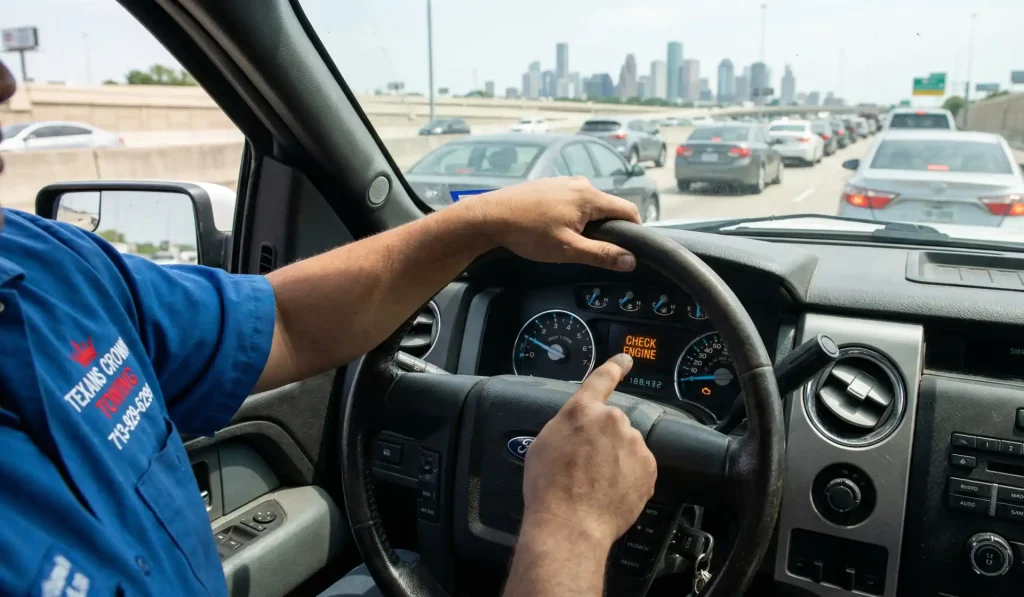
A flashing check engine light indicates a severe engine misfire that requires immediate attention. Unlike a solid light, a blinking indicator means unburned fuel is entering the exhaust system, which can cause permanent damage to your catalytic converter or total engine failure. Safely pull over and turn off the engine immediately to avoid repair bills exceeding $3,000.
Table of Contents
ToggleThe Moment the Panic Sets In
Imagine driving down the West Loop 610 in Houston during rush hour, and suddenly, that orange engine icon on your dashboard starts blinking like a distress signal. Your car might start shaking, losing power, or making strange noises.
In 2026, modern vehicles are equipped with more sensors than ever before. While these sensors make cars safer and more efficient, they also make the dashboard warnings more specific. A flashing check engine light (also known as the Malfunction Indicator Lamp or MIL) is the automotive equivalent of a 911 emergency.
In this comprehensive 3000-word guide, we will explore exactly why your check engine light is flashing, the common symptoms like car shaking, and what it costs to fix these issues in 2026.
Solid vs. Flashing: Understanding the Severity
Not all check engine lights are created equal. Understanding the “language” of your car’s computer (ECU) can save you thousands of dollars.
The Solid Check Engine Light
A steady, non-blinking light usually points to a “non-critical” emissions problem. It could be as simple as a loose gas cap or a sensor that is starting to wear out. You should still get it checked soon, but it isn’t an immediate emergency.
The Flashing Check Engine Light
When the light flashes, it means an “active” and “severe” fault is occurring. In most cases, this is a Type A Misfire. This means that in one or more of your engine’s cylinders, the fuel is not being burned. This raw fuel then travels into your exhaust system, where it can literally melt the internal components of your catalytic converter.
Top 7 Causes: Why Is My Check Engine Light Flashing?
Based on 2026 automotive data, here are the primary reasons why your dashboard has turned into a strobe light.
A. Ignition Coil Failure (The #1 Culprit)
In modern “coil-on-plug” ignition systems, each cylinder has its own coil. If one fails, that cylinder stops firing. This is the most frequent cause of a blinking light in cars over five years old.
- NLP Keyword: Ignition system malfunction
- Repair Cost: $150 – $350 per coil.
B. Worn-Out Spark Plugs
Spark plugs are the heart of the combustion process. If the gap in the plug is too wide or if the electrode is fouled with oil or carbon, it won’t create a spark.
- Symptom: Rough idling and poor fuel economy.
- LSI Term: Spark plug fouling, gap erosion.
C. Faulty Fuel Injectors
If a fuel injector gets clogged or stuck open, the air-fuel ratio becomes imbalanced. A “lean” mixture (too much air) or a “rich” mixture (too much fuel) will cause a misfire.
- NLP Keyword: Fuel delivery system failure.
D. Mass Air Flow (MAF) Sensor Issues
The MAF sensor tells the car’s computer how much air is coming into the engine. If it’s dirty or faulty, the computer won’t know how much fuel to spray, leading to erratic engine behavior.
- LSI Term: Air-intake sensor calibration.
E. Failed Oxygen (O2) Sensors
O2 sensors monitor the exhaust. If they send incorrect data, the engine may run so poorly that it begins to misfire and flash the warning light.
F. Vacuum Leaks
A cracked hose or a leaking intake manifold gasket allows “unmetered” air into the engine, disrupting the delicate balance required for smooth combustion.
G. Catalytic Converter Obstruction
While a misfire causes catalytic converter damage, a previously damaged converter can also cause enough backpressure to trigger a flashing light.
Deep Dive into Symptoms: “My Car is Shaking.”
When people search for “Why is my check engine light flashing and car shaking?” they are describing a classic engine misfire.
Why the Shaking Happens
Your engine is a finely balanced machine. If you have a 4-cylinder engine and one cylinder stops working, the engine is now trying to run on three cylinders. This creates an imbalance in the crankshaft rotation, leading to physical vibrations that you feel in the steering wheel and seat.
Scenarios and Intents:
- Flashing then stops: This usually happens under “load”—like when you are accelerating onto a Houston highway. It means the misfire is intermittent.
- Flashing on and off: This often points to a loose electrical connection or a sensor that is on the verge of total failure.
- Flashing then Stays On: This means the computer has detected a “Hard Fault.” The emergency is no longer intermittent; it is permanent.
The Financial Impact: 2026 Repair Costs in Houston
Ignoring a flashing light is the most expensive mistake a driver can make. Here is a breakdown of what you can expect to pay in the Houston area this year.
Component | Estimated Parts Cost | Labor Cost (Houston Avg) | Total Estimated |
Spark Plugs (Set of 4) | $40 – $80 | $100 – $150 | $140 – $230 |
Ignition Coil (Single) | $80 – $150 | $75 – $125 | $155 – $275 |
MAF Sensor | $120 – $250 | $50 – $100 | $170 – $350 |
Fuel Injector | $150 – $300 | $200 – $400 | $350 – $700 |
Catalytic Converter | $1,200 – $2,500 | $300 – $600 | $1,500 – $3,100 |
The Lesson: Spending $200 on a spark plug change today saves you $3,000 on a catalytic converter tomorrow.
What to Do Immediately (The Emergency Protocol)
If the light starts flashing while you are driving:
- Do Not Panic: Stay calm and check your surroundings.
- Reduce Speed: Slow down immediately to reduce the load on the engine.
- Find a Safe Spot: Pull over to a parking lot or a wide shoulder.
- Turn Off the Engine: Do not let the car “idle” to see if it fixes itself. Idling with a misfire still sends raw fuel into the exhaust.
- Check the Gas Cap: It’s rare for a flashing light, but a very loose cap can occasionally cause pressure issues.
- Call for a Tow: In 2026, driving a car with a flashing MIL even for 2 miles can cause irreversible damage. Instead of risking a $5,000 engine overhaul, the smartest move is to call a professional tow truck in Houston like Texans Crown Towing at (713) 929-6299. Our team is equipped with flatbed trucks that ensure your sensitive engine components aren’t further stressed during transport.
Advanced Diagnostics: The Role of OBD-II Codes
When a technician plugs a scanner into your car, they are looking for Diagnostic Trouble Codes (DTCs).
- P0300: Random or Multiple Cylinder Misfire Detected.
- P0301 – P0308: Misfire detected in a specific cylinder (the last digit tells you which one).
- P0420: Catalytic Converter Efficiency Below Threshold (This is what happens when you ignore the flashing light).
Preventing Future Lights: Maintenance Tips
In 2026, preventative maintenance is cheaper than emergency repairs.
- Stick to the Schedule: Change your spark plugs every 60,000 to 100,000 miles.
- Use High-Quality Fuel: Cheap, unbranded gas can clog injectors.
- Listen to Your Car: If you notice a slight “hiccup” while idling, get it checked before the light starts flashing.
Conclusion
A flashing check engine light is your car’s way of asking for help. Don’t risk a total engine meltdown by trying to “limp” it home.
At Texans Crown Towing, we specialize in emergency roadside assistance and towing across Houston. We understand that your vehicle is an investment, and we treat it with the care it deserves.
Answering Your Top Concerns
Q1: Why is my check engine light flashing, then stops?
This is an intermittent misfire. It usually occurs when the engine is under stress, like towing a trailer or high-speed overtaking. Even if it stops, the code is “stored” in the computer and needs to be read by a professional.
Q2: Why is my check engine light flashing and my car shaking?
The shaking is caused by the loss of one or more combustion cycles. The engine’s internal weights are no longer balanced, causing the physical jerking or vibrating sensation.
Q3: Why is my check engine light flashing on and off?
This is often a sign of a loose wire or a failing sensor that is “glitching.” It could also be a sign of poor fuel quality (water in the gas).
Q4: Can I drive with a flashing check engine light if the car feels okay?
No. Sometimes the car might feel “mostly fine,” but the computer is detecting a “Catalytic Damaging Misfire.” Just because you don’t feel the vibration doesn’t mean your exhaust isn’t melting.