
Rotator Service in Houston, TX
Some recoveries can’t be handled with a standard wrecker. A semi on its side on I-10. A dump truck rolled into a drainage ditch off Beltway 8. A bus hanging over a guardrail on the Grand Parkway. These jobs need a rotator.
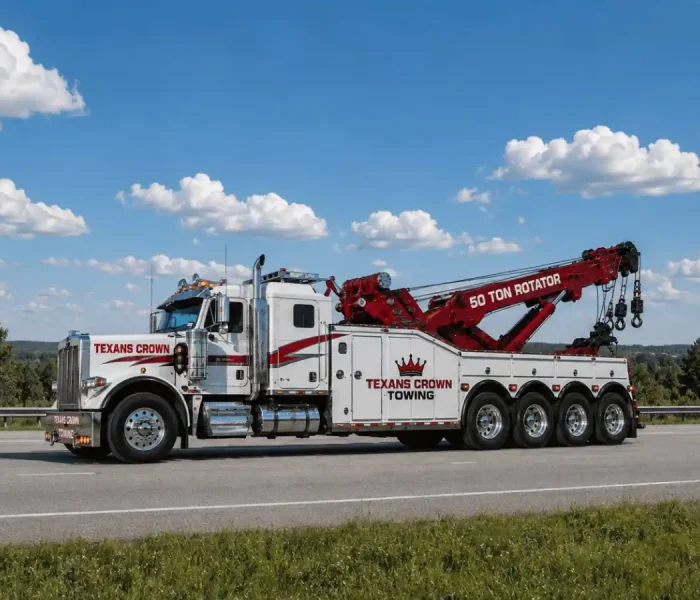
Texans Crown Towing runs a 50-ton rotator recovery truck across the Houston area. We handle the recoveries other companies have to turn down or call in help for.

What a Rotator Truck Actually Does
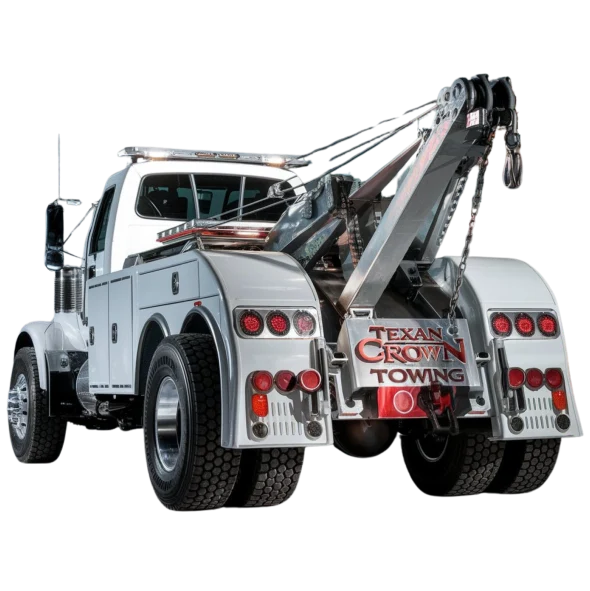
A rotator is different from a regular heavy-duty tow truck. Its boom can rotate a full 360 degrees and lift a vehicle straight up, sideways, or at an angle, not just pull it in a straight line.
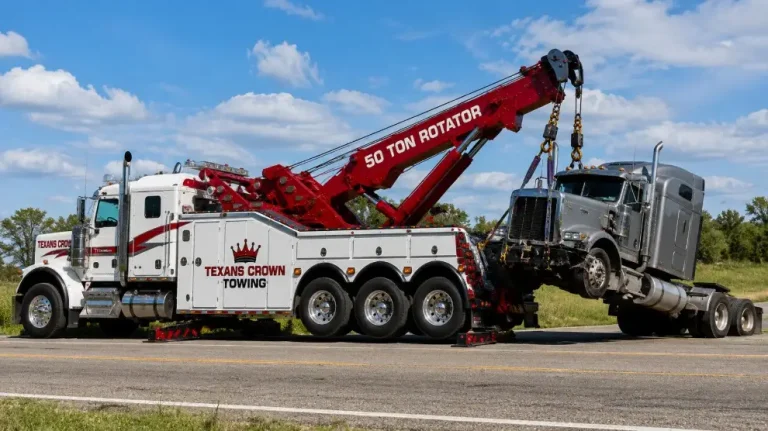
That matters when a vehicle isn’t sitting flat on the road. If a truck is on its roof, tipped into a ravine, or wedged against a bridge rail, a standard tow truck can’t get a safe angle on it. A rotator can lift the load clear, rotate it upright in the air, and set it back down on its wheels before towing it away.
This is why rotators are called in for the recoveries everyone else describes as “complicated.”










When You Need a Rotator Service in Houston
Most drivers never need this service. When they do, it’s usually one of these situations:
- Overturned semi trucks or trailers — on the highway shoulder, in the median, or off an exit ramp
- Vehicles in ditches, culverts, or embankments — common along feeder roads and drainage areas after heavy rain
- Vehicles that went off an elevated roadway — onto a lower service road or into a barrier
- Multi-vehicle wrecks where a heavy vehicle is blocking traffic and can’t be moved with a standard tow
- Equipment or cargo trucks that have shifted load and tipped during a turn
- Recoveries near water, rail lines, or pipelines where precise, controlled lifting is required to avoid a bigger mess
If Houston police, TxDOT, or your fleet’s safety manager is telling you a wrecker “can’t get to it,” that’s usually a rotator call.
How a Rotator Recovery Works
Every rotator job starts with an assessment, not a hookup. Our operators look at the position of the vehicle, the ground conditions, what’s underneath or around it (guardrails, drainage, other traffic), and the safest lift angle before anything moves.
From there, a typical recovery follows this order:
- Scene control — cones, lighting, and lane coordination with police or TxDOT so the recovery doesn’t create a second accident.
- Rigging — chains, straps, and lift points are set based on the vehicle’s weight and balance, not a one-size-fits-all approach.
- Lift and rotate — the boom lifts and rotates the vehicle to an upright position in a slow, controlled motion.
- Set-down — the vehicle is lowered onto its wheels, a flatbed, or a second tow truck.
- Site cleanup — debris, fluids, and cargo are cleared so the road can reopen.
The whole point of a rotator is control. A rushed recovery risks more damage to the vehicle, the road, and anyone nearby. We’d rather take the extra ten minutes to rig it correctly.
Our 50-Ton Rotator in Houston
Texans Crown Towing‘s rotator is built for the loads Houston actually produces full-size semis, loaded trailers, construction and oilfield equipment, and municipal vehicles. It’s not the tool we reach for on a flat tire or a dead battery. It’s the tool we reach for when a vehicle is somewhere it isn’t supposed to be, and moving it wrong would make things worse.
We keep the rotator staffed and ready because Houston’s highway volume and weather make these calls a matter of when, not if.
Why Houston Sees More Rotator Calls Than Most Cities
Houston’s roads put a lot of heavy freight in a small area. I-10, I-45, I-69/US-59, the Sam Houston Tollway (Beltway 8), and the Grand Parkway (99) all carry constant commercial truck traffic connecting the Port of Houston, the ship channel refineries, and warehouses across Harris, Fort Bend, Montgomery, Brazoria, and Galveston counties.
A few things make rotator recoveries more common here:
- Heavy commercial traffic on elevated interchanges and feeder roads, where a rollover often means a truck ends up off the main roadway.
- Flat terrain with drainage ditches running along most major roads a common spot for a vehicle to end up on its side.
- Sudden storms and standing water, which cause more loss-of-control incidents than most people expect.
- Industrial and port traffic around the ship channel, where oversized loads and specialized equipment sometimes need controlled recovery, not just a pull.
We work these conditions daily, which is a different thing from owning a rotator and using it occasionally.
Who Calls Us for Rotator Service
- Trucking companies and owner-operators with a rig down on a Houston route.
- Fleet and logistics managers who need one call to handle recovery, reporting, and getting the truck to a yard or repair shop.
- Construction and oilfield companies with equipment stuck or tipped on a job site or access road.
- Insurance adjusters who need a documented, professional recovery for a claim.
- Municipal and county agencies clearing a blocked roadway.
- Individual drivers involved in a serious accident who need their vehicle recovered safely
Safety First, Every Time
Rotator recoveries happen in some of the most dangerous conditions on the road live traffic, unstable ground, and heavy loads overhead. Our crews are trained specifically for rotator operations, not just standard towing. We coordinate with police and TxDOT on scene control, use proper rigging for the vehicle’s actual weight, and don’t rush a lift just to clear traffic faster. A safe recovery protects our crew, your vehicle, and everyone still driving past the scene.
What to Expect When You Call
Tell us where you are and what happened on its side, in a ditch, off the road, blocking a lane. That’s enough for us to bring the right equipment the first time instead of showing up short and calling for backup. We’ll give you a realistic ETA based on where you are in Harris, Fort Bend, Montgomery, Brazoria, or Galveston County, and we’ll coordinate directly with police or TxDOT if they’re already on scene.
Call (713) 929-6299 for rotator service anywhere in the Houston area.
Frequently Asked Questions
What is a rotator tow truck?
A rotator is a heavy-duty recovery truck with a boom that rotates 360 degrees and lifts in almost any direction. It’s used for vehicles that are overturned, off the road, or in a position a standard tow truck can’t safely reach.
How is a rotator different from a regular heavy-duty tow truck?
A standard heavy-duty wrecker pulls in a straight line along the ground. A rotator can lift a vehicle straight up, swing it sideways, and set it down at a different angle which is what’s needed when a vehicle isn’t upright or isn’t on solid ground.
When does a wreck actually need a rotator instead of a regular tow truck?
Usually when a vehicle is overturned, in a ditch or embankment, off an elevated road, or blocking a lane in a position a standard truck can’t get an angle on. If the responding tow company says they need to call in a rotator, that’s the sign.
How fast can you get a rotator to a Houston highway?
Response time depends on your location and current traffic, but we keep the rotator staffed and ready specifically because these calls tend to be urgent. Call us and we’ll give you a real-time estimate.
Do you work directly with police and TxDOT on accident scenes?
Yes. Rotator recoveries almost always involve coordinating lane closures, traffic control, and scene clearance with law enforcement or TxDOT, and we handle that coordination as part of the job.
Will a rotator recovery damage my truck or trailer further?
Our goal is the opposite: controlled rigging and a slow, deliberate lift are what prevent additional damage. Rushed recoveries with the wrong equipment are what cause secondary damage, which is exactly why a rotator is used for these situations.
Can you recover a loaded semi trailer, not just an empty one?
Yes. Our 50-ton rotator is sized for fully loaded commercial trucks and trailers, along with construction and oilfield equipment common in the Houston area.
Do you provide documentation for insurance claims?
Yes, we can provide details of the recovery for insurance adjusters and claims processing. Let us know at the time of the call if you need this.
What counties do you cover for rotator service?
We respond throughout Harris, Fort Bend, Montgomery, Brazoria, and Galveston counties, including Houston and the surrounding highways and feeder roads.
Do you handle rotator recoveries at night or in bad weather?
Yes. Heavy weather and low visibility are actually when we see more of these calls, particularly after storms. We run 24/7.
What happens to my vehicle after it’s recovered?
Once the vehicle is upright and stable, we can tow it to a repair shop, storage yard, or another location of your choice.
Do fleets and trucking companies set up accounts for repeat service?
Yes. If your company runs routes through the Houston area regularly, we can set up a direct line for fleet dispatch instead of going through a general request each time.
Is a rotator recovery more expensive than a standard tow?
Rotator jobs take specialized equipment, trained crews, and more time to rig safely, so costs are higher than a routine tow. We’ll walk you through what’s involved before the work starts whenever possible.
Can a rotator lift a vehicle out of water or a flooded ditch?
In many cases, yes rotators are often used for exactly this kind of recovery along Houston’s drainage-heavy roadways. Every situation is assessed on site since water and unstable ground both affect the lift.
What should I do while I’m waiting for the rotator to arrive?
Stay in a safe location away from traffic and the vehicle itself, especially if it’s unstable. If police or TxDOT are on scene, follow their direction on where to wait.
Areas we Served
No locations found.
Try searching for a different area.