
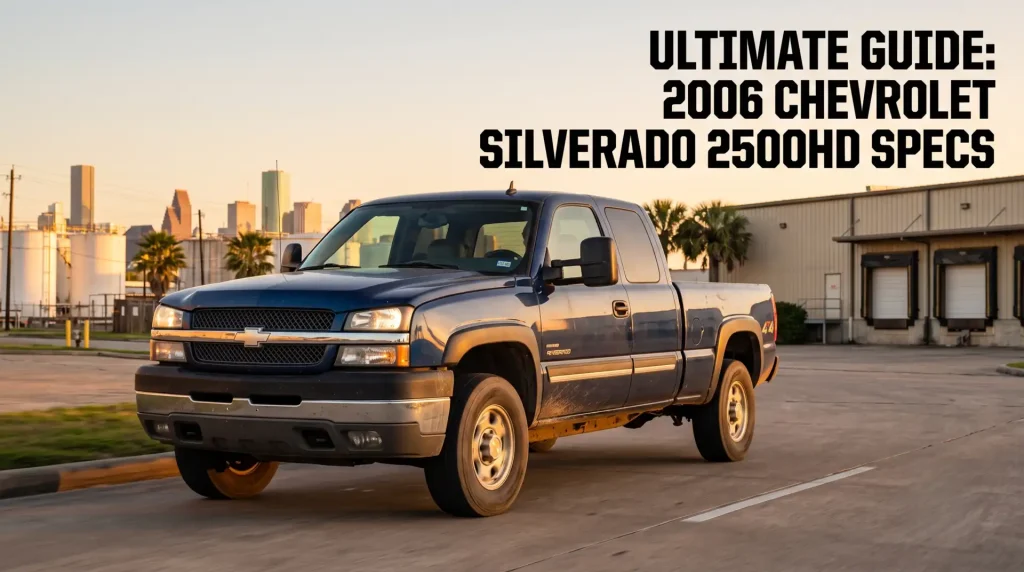
Whether you are navigating the busy construction zones around the Houston Ship Channel or prepping your rig to haul heavy equipment down the Grand Parkway, having a truck you can depend on is non-negotiable. For truck enthusiasts and working professionals across Texas, the first-generation heavy-duty trucks from General Motors remain legendary for their sheer toughness. If you are shopping the used market or trying to get the absolute most out of your current workhorse, understanding the official 2006 Chevrolet Silverado 2500HD specs is the best place to start.
This specific model year represents a high-water mark for mechanical reliability. It sits right at the sweet spot of classic, durable engineering before emissions systems became incredibly complex. In this complete guide, we will break down the essential numbers, including the 06 Chevy 2500HD specs for engines, transmissions, and towing limits, so you know exactly what this heavy-duty machine can handle in the demanding Texas climate.
Table of Contents
ToggleThe Quick Answer: 2500HD 2006 Silverado Specs Overview
If you are looking for a rapid-fire breakdown of the core numbers, the 2006 Silverado 2500HD is a true heavy-duty three-quarter-ton truck. Unlike lighter half-ton trucks, this pickup features a reinforced full-size frame, an upgraded floating rear axle, and robust heavy-duty suspension components.
Here is a quick snapshot of the key baseline capabilities for this classic year:
- Standard Gas Engine: 6.0L Vortec V8 (300 hp / 360 lb-ft torque)
- Maximum Towing Capacity: Up to 12,000 lbs conventional (and over 14,000 lbs with a fifth-wheel setup)
- Standard Payload Capacity: Up to 4,058 lbs, depending on cab configuration
- Gross Vehicle Weight Rating (GVWR): Typically 9,200 lbs
If you find that this level of heavy-duty capability is more than your daily routine requires, you might want to investigate the lighter Silverado 1500 engine options to find a setup better suited for regular city commuting.
The Engine Lineup: Exploring Your Powertrain Options
The heart of any heavy-duty truck is what sits beneath the hood. The 2006 Chevrolet Silverado 2500HD specs include three very distinct engine options, each offering a unique balance of utility, raw horsepower, and mechanical longevity.
6.0L Vortec 6000 V8 (LQ4)
This was the standard base gas engine for the 2006 model year. It is an iron-block powerhouse known throughout the automotive industry as an absolute tank. While it will not win many fuel economy awards on long highway stretches, it provides steady, predictable power and is remarkably inexpensive to maintain and fix.
8.1L Vortec 8100 V8 (L18)
For those who wanted maximum gas power without moving to a diesel, Chevrolet offered the massive 8.1-liter big-block V8. This engine is a pure torque monster designed to pull massive loads up steep inclines. It is a rare find today, but it remains a favorite among heavy-haulers who prefer simpler gas mechanics over diesel maintenance.
6.6L Duramax Turbo-Diesel V8 (LBZ)
The late-2006 introduction of the LBZ generation Duramax engine is widely considered by diesel technicians to be one of the greatest truck engines ever built. It produced a massive jump in factory performance, pushing out 360 horsepower and a relentless 650 lb-ft of torque. It pairs exclusively with the legendary 6-speed Allison automatic transmission, making it the ultimate highway towing weapon.
2006 Silverado 2500HD Engine Specs Comparison
To see exactly how these power plants stack up against each other on paper, review the formal engine capabilities outlined in the table below.
| Engine Option | Fuel Type | Horsepower | Torque | Standard Transmission |
| 6.0L Vortec V8 | Gasoline | 300 hp @ 4,400 RPM | 360 lb-ft @ 4,000 RPM | 5-Speed Manual / 4-Speed Auto |
| 8.1L Vortec V8 | Gasoline | 330 hp @ 4,200 RPM | 450 lb-ft @ 3,200 RPM | 6-Speed Allison Automatic |
| 6.6L Duramax Diesel (LBZ) | Diesel | 360 hp @ 3,200 RPM | 650 lb-ft @ 1,600 RPM | 6-Speed Allison Automatic |
Step-by-Step Guide: How to Verify Your 2006 Silverado Specs
Because these trucks were highly customizable from the factory, two trucks that look identical on the outside can have vastly different towing and hauling limits. Follow this simple process to uncover the exact specs of your vehicle.
Step 1: Locate the RPO Code Sticker
Open your glove box compartment and look for a silver sticker filled with dozens of three-digit alphanumeric codes. These are your Regular Production Option (RPO) codes, which dictate every single component installed on your specific truck at the factory.
Step 2: Check Your Engine and Transmission Codes
Scan the sticker for your specific powertrain identifiers. An “LQ4” code means you have the standard 6.0L gas engine, while an “LBZ” code confirms you have the highly coveted high-output 6.6L Duramax diesel. Look for “M74” or “MW7” to verify your automatic transmission type.
Step 3: Identify Your Axle Ratio
Your truck’s axle ratio heavily dictates its true towing performance. Look for the codes GT4 (3.73 rear axle ratio) or GT5 (4.10 rear axle ratio). A 4.10 ratio provides much better low-end mechanical leverage for pulling heavy trailers through thick mud or stop-and-go highway conditions.
Step 4: Verify the Suspension Setup
Heavy-duty performance requires a solid foundation. Ensure your RPO sticker lists the Z85 heavy-duty chassis package or the Z71 off-road package. This ensures your front torsion bar suspension and heavy rear leaf springs are rated for maximum workspace abuse.
Real-World Towing and Hauling Realities
While the official 2500HD 2006 Silverado specs claim a towing limit of up to 12,000 pounds for a standard bumper hitch, real-world conditions require careful calculation.
When you factor in the weight of a fully loaded trailer, tools in the truck bed, and a cab full of work crew members, you quickly approach your maximum gross vehicle weight rating, which is the absolute maximum safe operating weight of the vehicle.
Pro Tip #1: Always Factor in Tongue Weight
Do not just focus on total trailer weight. Your payload capacity must account for the trailer’s tongue weight (usually 10% to 15% of the total trailer weight for conventional hitches). If your trailer weighs 10,000 pounds, it places roughly 1,000 to 1,500 pounds directly onto your truck bed, drastically reducing the remaining passenger and cargo weight you can legally carry.
Common Pitfalls with an ’06 Chevy 2500HD
Even the most indestructible trucks have a few weak points you need to watch out for, especially as these vehicles age past the two-decade mark.
- The Infamous GM Cluster Failure: The gauge clusters on 2006 GM trucks are notorious for failing stepper motors. Your speedometer or oil pressure gauge may suddenly drop to zero or give completely erratic readings while driving down the highway.
- Transfer Case “Pump Rub”: On four-wheel-drive models, an internal oil pump component can slowly wear a hole directly through the magnesium transfer case housing over time. This causes a slow fluid leak that can completely destroy the transfer case if left unchecked.
- Rusting Brake Lines: The factory steel brake lines on this generation were prone to severe corrosion. If you are inspecting a used truck, always crawl underneath with a flashlight to verify the lines are clean, dry, and structurally sound.
Maintenance Symptoms, Causes, and Solutions
Keeping an aging heavy-duty truck on the road requires staying ahead of minor mechanical symptoms before they leave you stranded on the side of a busy Texas highway.
| Observed Symptom | Likely Underlying Cause | Required Fix / Remedy |
| Soft, mushy brake pedal | Corroded or leaking factory steel brake lines | Install a complete stainless steel brake line kit |
| Erratic instrument panel gauges | Failed internal stepper motors in the cluster | Send the gauge cluster out for a professional rebuild |
| Diesel engine hunting or surging at idle | Sticking the fuel pressure regulator on the Duramax CP3 pump | Replace the fuel pressure regulator valve |
| Fluid pooling under the center of the truck | The transfer case pump rub is causing a housing leak | Apply a transfer case saver kit and replace the rear half housing |
Estimated Repair and Upkeep Costs
Maintaining a heavy-duty platform means dealing with larger components, higher fluid capacities, and slightly higher repair costs than a standard passenger vehicle.
- Complete Brake Line Replacement: $800 to $1,200 (Requires roughly 4 to 6 hours of shop labor)
- Instrument Cluster Rebuild: $150 to $300 (Typically a 1-day turnaround through specialty repair shops)
- Transfer Case Pump Rub Repair: $400 to $700 (Depending on whether the housing shell requires full replacement)
- Duramax Fuel Pressure Regulator: $600 to $900 (Includes parts and intensive labor underneath the intake tract)
Operating an Overaged Heavy-Duty Truck on Houston Roads
Driving a 2006 heavy-duty truck in Southeast Texas presents a unique set of operating conditions. Our blistering summer temperatures regularly exceed triple digits, putting immense stress on older cooling systems. If you are towing a heavy load in July traffic along the West Loop, an old radiator or worn-out fan clutch can cause your engine temperatures to skyrocket in minutes.
Furthermore, local diesel owners must ensure their trucks stay completely compliant with Texas Department of Public Safety safety standards during annual vehicle inspections. Keeping your mechanical components free of leaks and maintaining clear visibility through functional factory equipment is essential for passing local safety regulations without unnecessary delays.
Pro Tip #2: Upgrade Your Factory Transmission Cooler
The stock transmission cooler on the 2006 models is decent, but if you regularly sit in humid, stop-and-go Houston traffic with a heavy trailer attached, upgrading to an aftermarket high-efficiency auxiliary cooler is one of the smartest investments you can make. It can lower your Allison transmission temperatures by up to 30 degrees, extending the lifespan of your fluid and internal clutches.
Frequently Asked Questions
What makes the LBZ Duramax engine so special?
The LBZ version of the 6.6L Duramax is highly sought after because it offers massive power straight from the factory while lacking the complex diesel particulate filters (DPF) and diesel exhaust fluid (DEF) systems found on modern trucks. This makes it incredibly reliable and much simpler to modify or repair.
What transmission comes standard in the 06 Chevy 2500HD specs?
The gas 6.0L V8 came standard with either a 5-speed manual or a 4-speed automatic transmission. The heavy-duty 8.1L gas V8 and the 6.6L Duramax diesel came standard with the world-renowned 6-speed Allison automatic transmission, famous for its smooth shifting and immense strength.
Can a 2006 Silverado 2500HD tow a modern fifth-wheel camper?
Yes, absolutely. Depending on your cab setup, bed length, and rear axle ratio, a ’06 2500HD can safely handle fifth-wheel trailers weighing up to 14,000 pounds or more. Always verify your specific truck’s payload capacity to ensure your pin weight remains well within safe factory limits.
How many miles can a 2006 Silverado 2500HD last?
With diligent maintenance, both the 6.0L gas engine and the 6.6L Duramax diesel are easily capable of clearing 300,000 to 400,000 miles. Regular oil changes, fresh coolant, and addressing transmission service intervals are the keys to hitting these high-mileage milestones.
What is the difference between a 2500 and a 2500HD?
The “HD” stands for Heavy Duty. The 2500HD models feature a stronger, taller frame, higher payload capacities, larger brakes, and access to heavier powertrain options like the 8.1L V8 and the Duramax diesel, whereas the standard 2500 light-duty models share more components with the half-ton platform.
Dependable Heavy-Duty Support for Your Texas Driving Needs
No matter how tough or well-maintained your classic truck is, time and hard work can eventually take their toll on aging mechanical systems. Knowing your vehicle’s exact capabilities allows you to push it to the limit safely, avoiding dangerous overloads and keeping your operations running smoothly across the Lone Star State.
If an unexpected component failure or sudden fluid leak ever leaves your heavy-duty rig stranded on the side of a busy highway, you do not have to tackle the challenge alone. For fast, careful, and highly dependable vehicle recovery, contact Texans Crown Towing for professional roadside assistance and heavy-duty towing services throughout the greater Houston area.