

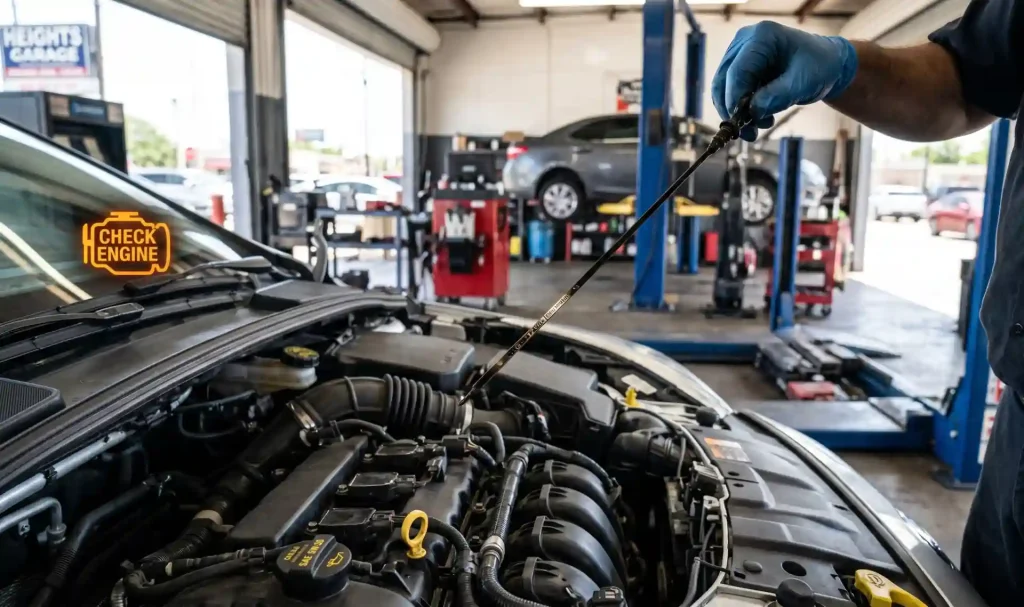
You’re cruising down I-45 or sitting in traffic on the Beltway and suddenly, there it is. That amber glow on your dashboard. The check engine light.
Your first thought might be: Is this about my oil change?
It’s a completely fair question. And the answer is: sometimes yes, but often it’s more complicated than that. This guide walks you through everything step by step, what the check engine light actually means, how oil plays into it, what to check first, and when to head to a shop in Houston before a small issue turns expensive.
Table of Contents
ToggleThe Check Engine Light vs. The Oil Change Light: They Are NOT the Same Thing
This is the confusion that trips up most drivers, and none of the top search results explain it clearly enough.
Your car actually has two separate warning lights related to oil:
| Warning Light | What It Looks Like | What It Means |
|---|---|---|
| Oil Change Reminder Light | Oil can icon or “MAINT REQ’D” | Mileage-based reminder — your car has hit its service interval |
| Check Engine Light (CEL) | Engine outline / “CHECK ENGINE” | Your car’s computer has detected a fault code — could be oil-related or something else entirely |
These are completely different systems.
The oil change reminder light is just a timer. It counts miles and reminds you to schedule service — it has nothing to do with your engine’s actual condition.
The check engine light, on the other hand, is tied to your vehicle’s on-board diagnostics system (OBD-II). It triggers when a sensor detects something is outside its normal operating range. That could be oil-related, or it could be a dozen other things.
💡 Pro Tip: If you see “MAINT REQ’D” or an oil can icon, that’s a routine reminder, not an emergency. If you see an amber engine outline that says “CHECK ENGINE,” that requires actual diagnosis. Never assume they mean the same thing.
So, Does the Check Engine Light Come On for an Oil Change?
The direct answer: not typically, but it can, indirectly.
Here’s how oil problems connect to the check engine light:
Low Oil Pressure Triggers the CEL
When oil drops too low, your engine can’t properly lubricate its moving parts. Sensors detect the drop in oil pressure, and the ECU (Engine Control Unit) logs a fault. The check engine light follows.
This is a real situation. Driving on critically low oil in Houston’s summer heat, where temperatures routinely exceed 95°F, accelerates engine wear dramatically. If you’re seeing the CEL and your oil level is low, treat it as urgent.
Dirty Oil Causes Misfires, Which Trigger the CEL
Old, degraded oil becomes thick and sludgy. It doesn’t lubricate evenly. That uneven lubrication can cause rough combustion in one or more cylinders. And when cylinders misfire, the CEL comes on.
This is especially common in Houston stop-and-go traffic, where engines run longer at low speeds and oil degrades faster than on open highways.
The Oil Pressure Sensor Itself Can Fail
Sometimes the oil is perfectly fine, but a faulty oil pressure sensor sends a false reading to the ECU. Your dashboard lights up, but the actual oil is at the right level and clean. A proper diagnostic scan will distinguish between a real oil issue and a sensor issue.
Step-by-Step: What To Do When Your Check Engine Light Comes On
Don’t guess. Follow these steps in order.
Step 1: Check Whether the Light Is Steady or Flashing
This matters more than most drivers realize.
- Steady amber light: Something needs attention soon, but you can drive carefully to a shop
- Flashing or blinking check engine light: This means an active, severe fault (often a bad misfire). Pull over when it’s safe. A Check Engine Light Flashing situation can damage your catalytic converter within miles if you keep driving
⚠️ Common Pitfall: Many Houston drivers see a flashing CEL and assume it’s minor because the car still moves. A flashing light is the most urgent warning your engine can send, don’t ignore it.
Step 2: Check Your Oil Level and Condition
Pop the hood and pull the dipstick. Here’s what to look for:
- Level too low? Add oil immediately and see if the light clears
- Is oil black or gritty? You’re overdue for an oil change. Schedule one right away
- Oil looks milky or foamy? That could indicate coolant mixing with oil, a sign of a head gasket problem. Don’t drive; get it towed
- Oil looks normal? The issue is likely not oil-related. Move to the next steps
Step 3: Check Your Gas Cap
A loose or cracked gas cap is one of the most common and most overlooked causes of a check engine light in Houston. Heat causes the rubber seal to crack over time, which creates a small evaporative emissions leak.
Twist the cap off and back on firmly. Drive for a day or two. If that’s all it was, the light should go out on its own.
Step 4: Get a Diagnostic Scan (OBD-II Code Read)
This is the only way to know for certain what triggered the light. Most AutoZone and O’Reilly Auto Parts locations in Houston offer free OBD-II scans.
The scan will return a fault code. Common oil-related codes include:
| Code | What It Means |
|---|---|
| P0520 | Oil pressure sensor circuit malfunction |
| P0521 | Oil pressure sensor range/performance issue |
| P0522 | Low oil pressure sensor voltage |
| P0300–P0308 | Engine misfire (can be caused by dirty or degraded oil) |
| P0011 / P0021 | Camshaft timing, often linked to dirty oil clogging VVT components |
💡 Pro Tip: Reading the code is free, but interpreting it correctly takes experience. A P0300 misfire code, for example, could be dirty oil, spark plugs, a coil, or a fuel injector. Don’t just clear the code without finding the root cause.
Step 5: Address the Root Cause, Don’t Just Reset the Light
This is where many drivers go wrong. They clear the code without fixing the underlying problem. The light comes back within a few days, and now the situation is worse.
If an oil change solves it, great. If the light returns after the oil change, the issue is something else and needs professional diagnosis.
Can the Check Engine Light Come On Right After an Oil Change?
Yes, and this one frustrates a lot of Houston drivers.
You just paid for an oil change. You’re driving home. The check engine light comes on. What happened?
Here are the most common reasons for a check engine light after an oil change.
Wrong Oil Viscosity Was Used
Modern engines are highly specific about oil weight. If your engine calls for 5W-30 and the shop used 5W-20 (or vice versa), the ECU can detect the pressure difference and flag it.
Always verify what oil specification your vehicle requires; it’s in your owner’s manual and often on a sticker under the hood.
Oil Fill Cap Was Left Loose
It happens. A loose oil fill cap creates a vacuum leak, which the MAF sensor detects immediately. The CEL follows within miles.
Check the cap on top of your engine. It should be tight and secure.
Oil Drain Plug Wasn’t Fully Tightened
If oil leaks out after your oil change, the pressure drops, and the CEL triggers. Check under your car for fresh oil drips after any service visit.
The VVT System Got Disrupted
Vehicles with Variable Valve Timing (VVT), which includes most modern engines, are sensitive to oil changes. If there’s air in the oil system immediately after a change, the VVT solenoids can temporarily trigger codes like P0011 or P0021.
These usually clear on their own after a few drive cycles once the fresh oil fully circulates. If they don’t clear within 50 miles, get it checked.
The Dipstick Tube or Oil Cap Sensor Wasn’t Reseated
On some vehicles, disturbing components during an oil change can dislodge nearby sensors or vacuum lines. A quick visual inspection of the engine bay after any oil service is always a good habit
What About When the Engine Light Blinks When Accelerating?
If your Engine Light Blinks When Accelerating, especially right after an oil change, that’s a misfire happening under load.
Fresh oil that’s the wrong viscosity, or air trapped in the system, can cause brief misfires during acceleration. However, if the light is blinking consistently every time you accelerate and doesn’t stop after a day of driving, the issue is likely not oil-related.
Blinking during acceleration, combined with hesitation or rough power delivery, points toward ignition (spark plugs, coils) or fuel delivery problems that need a shop’s attention.
Other Common Reasons the Check Engine Light Comes On in Houston
Oil is just one possibility. Here are the other frequent culprits Houston mechanics see:
| Cause | How Common | Urgency |
|---|---|---|
| Loose or cracked gas cap | Very common | Low, fix it yourself |
| Faulty oxygen sensor | Common | Medium, affects fuel economy |
| Worn spark plugs | Common | High expensive if delayed |
| Bad ignition coil | Common | Medium causes misfires |
| Failing catalytic converter | Moderate | Highly expensive if delayed |
| Evaporative emissions leak (EVAP) | Common in Houston heat | Low-Medium |
| MAF sensor malfunction | Moderate | Medium |
| Transmission issue | Less common | High |
Houston’s heat and humidity specifically accelerate oxygen sensor failure and EVAP system leaks. Rubber hoses and sensor O-rings crack faster in the Texas climate than in cooler states, worth keeping in mind if you drive an older vehicle.
Houston-Specific Advice: What to Watch For
Living and driving in Houston adds a few unique considerations:
- Summer heat (95°F+ for months) thickens and degrades oil faster. Stick to your oil change schedule religiously, especially if you’re doing highway miles on I-10 or 290
- Stop-and-go traffic, on the Beltway, 59, and downtown Loop causes engines to run longer at low RPM, which is harder on oil than freeway driving
- Texas state inspection, Harris County, includes an emissions check. A check engine light with an active fault code is an automatic inspection failure. Fix the issue before your inspection date, not after
- Reformulated gasoline, required in Houston, can affect older engine sensors more than standard fuel blends
Should You Keep Driving With the Check Engine Light On?
It depends entirely on the light’s behavior.
You can drive (carefully) if:
- The light is steady amber
- The car runs normally with no rough idle, hesitation, or shaking
- You’re heading directly to a shop or auto parts store for a scan
Stop driving immediately if:
- The light is flashing or blinking
- You notice rough running, loss of power, or shaking
- The oil pressure warning light (red oil can) is also on
- You smell burning oil or see smoke from the engine bay
Common Pitfalls to Avoid
❌ Assuming the CEL always means an oil change: it can mean dozens of things; scan it first
❌ Clearing the code without fixing the problem: the light will return, and you may fail a Texas inspection because the system hasn’t completed its readiness monitors
❌ Ignoring the oil change reminder light for too long: eventually, dirty oil does cause engine problems that trigger the actual check engine light
❌ Using the wrong oil after a DIY oil change: always match the viscosity on the sticker under your hood or in your owner’s manual
❌ Driving on a flashing check engine light: this can turn a $200 repair into a $1,500 catalytic converter replacement
Frequently Asked Questions
Q: Will an oil change turn off the check engine light?
Only if the underlying cause was oil-related (low pressure, dirty oil causing misfires, etc.), if the light stays on after a fresh oil change, the problem is something else that needs a diagnostic scan.
Q: How long after an oil change should the check engine light go off?
If it was triggered by a minor oil issue, the light may go out within one to two drive cycles (usually 50–100 miles). If it doesn’t clear within that window, get a diagnostic scan.
Q: Can I reset the check engine light myself?
Yes, with an OBD-II scanner or by disconnecting the battery. But resetting without fixing the problem just clears the code temporarily. It will return. And in Texas, a recently reset CEL means your car’s readiness monitors haven’t been completed, which also causes an inspection failure.
Q: Does low oil pressure always turn on the check engine light?
Not always, some vehicles have a separate red oil pressure warning light that comes on first. The CEL may follow. If you see the red oil pressure light, stop driving immediately.
Q: Is it safe to drive from Sugar Land to downtown Houston with the check engine light on?
If the light is steady and the car drives normally, it’s generally okay for a short trip to a shop. If the light is flashing or the car is running rough, don’t risk it; call a tow or get roadside assistance.
Final Word: Don’t Guess, Diagnose
The check engine light is your engine’s way of asking for help. Sometimes it’s asking for something simple, like an oil change. Other times, it’s flagging something more serious.
The worst thing you can do is ignore it or guess. A free OBD-II scan takes five minutes at any Houston auto parts store and instantly narrows down the cause.
If your oil is overdue, get it changed. If the light stays on after that, book a diagnostic appointment with a trusted Houston auto repair shop, before what’s fixable today becomes expensive tomorrow.